Thursday, August 10, 2017

So You've Been Tainted by the Unknowable Far Realms II

Some years ago, I posted a table of mutations as part of a template. I've since changed the way the tables are organized and the way they work; now a Tainted character gets to pick as many mutations as they want off of each table, with the caveat that for each one they pick, they have to roll one at random off the same table. I'm posting the re-organized tables here so I can refer to them in future posts.

It should be noted that I cribbed some ideas from the wonderful Scrap Princess, whose blog, “Monster Manual Sewn From Pants", is linked over there on the right.

d100 -- Minor Mutations

  1. 1d12 pairs of vestigial humanoid legs on torso.
  2. 1d12 pairs of vestigial insectoid legs on torso.
  3. 1d12 pairs of vestigial tentacles on torso.
  4. 1d12 tentacles instead of legs.
  5. 1d4 extra fingers & toes (roll separately for each limb)
  6. A cluster of 2d12 small tentacles (about six inches long) can be found on  your… [roll 1d6. 1: shoulder 2: knee 3: chest 4: neck 6: spine]
  7. Acrid green smoke drifts upward from your apparently-empty eye sockets at all times. This does not affect your ability to see.
  8. Alcohol is like acid to you.
  9. All of your bodily fluids are replaced with quicksilver. It can be used for magical or alchemical purposes, but you have to purify the hell out of it first, lest you inadvertently open portals to places where you really don’t want to go.
  10. All of your voluntary motions are accompanied by flickers of bale fire. 
  11. Ashen skin, milky eyes, gaunt appearance.
  12. Batlike ears.
    Townsend's Big-Eared Bat
    (Wikimedia Commons)
  13. Beak.
  14. Birdlike legs.
  15. Cat eyes.
  16. Chitinous segmented tongue.
  17. Complex network of cartilaginous tubes in respiratory system constantly produces eerie music at the edge of hearing.
  18. Compound eyes.
  19. Covered in cilia. They keep you clean and occasionally pass morsels of food into your mouth. They do so completely autonomically.
  20. Covered in protruding veins.
  21. Cuttlefish eyes.
    Cuttlefish Eye
    (Wikimedia Commons)
  22. Double normal number of legs. Arranged in radially symmetrical manner.
  23. Every so often, something twitches or wriggles under your skin. 
  24. Eyes are an unnatural color of the player's choice.
  25. Hair replaced with chitinous tendrils. Yes, that includes body hair and facial hair. Yes, they grow at a normal hair-growth rate. Cutting them hurts like hell. They spasm uncontrollably at all times.
  26. Hair replaced with chitinous tendrils. Yes, that includes body hair and facial hair. Yes, they grow at a normal hair-growth rate. Cutting them hurts like hell. You have complete control over their movement.
  27. Hallucinogenic saliva.
  28. Infested by symbiotic insects. 1d6 Con damage per day if they are killed off. Generally creep everybody out if they aren’t.
  29. Insectoid abdomen.
  30. Instead of eyes, you have a hole in your head the size of your fist that seems to open onto the blackness of space. Looking at it makes people dizzy. A natural wall of force keeps stuff from falling in. Oddly enough, you can see just fine.
  31. Irritating buzzing noise accompanies you everywhere you go.  
  32. Lamprey-like mouths on your palms.
    Lamprey mouths.
    (Wikimedia Commons)
  33. Legs atrophied and useless; you float a foot above the ground at all times.
  34. Light pours from your mouth whenever you speak.
  35. Light sensitivity.
  36. Mirrors don’t work when you’re within 100 ft.
  37. Mouth can distend like a snake's.
  38. Mouth full of long, thin fangs. Anglerfish fangs. So long they look like they can't possibly fit in your head. Your mouth distends impressively when you open it.
  39. Neck frill.
  40. No neck -- head hovers a few inches above body. You can rotate your head 360 degrees with ease.
  41. No nose -- you breathe through a pair of wide, squat tubes on the sides of your neck.
  42. No teeth -- you suck food through a quartet of stiff proboscii that resemble fangs.
  43. No teeth, inconveniently small mouth. Cannot eat solid food, super good at lapping up nutritious soup with tongue.
  44. Occasionally, tiny faces appear in relief on your skin, as if very small people were trapped inside you and were trying to push their heads out to the air. Usually they look humanoid, but not always. 
  45. One eye, cyclops-style.
  46. Prehensile teeth. Or possibly a mouthful of thin, bone-colored tentacles about three inches long that can snap into a rigid position and chew food when necessary. Same difference.
  47. Radial symmetry.
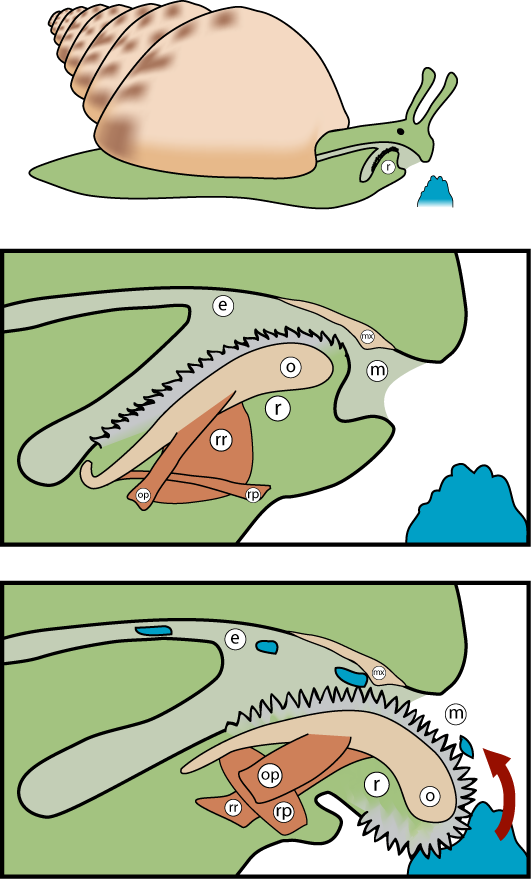
  48. Radula.
    Snail eating tasty blue stuff with its radula.
    (Wikimedia Commons)
  49. Rivulets of fine black sand trickle constantly from all of your facial orifices. 
  50. Six eyes clustered at front of face.
  51. Skin repels water.
  52. Smell like smoke at all times.
  53. Spots on your skin shift color with your mood.
  54. Swarms of harmless but annoying insects gather whenever you stay in one place overnight.
  55. The top of your skull has a ring of working fingers around it that form the appearance of a crown.
  56. There’s a tiny mouth on the nape of your neck. You have no control over it. Sometimes it whispers to you.
  57. Thick black blood.
  58. Thin spires of bone protrude from the top of your skull to form the appearance of a crown.
  59. Third eye on forehead, fully functional
  60. Third eye on forehead, nonfunctional
  61. Third eye on forehead, seems functional but definitely does not transmit information to your brain.
  62. Transparent skin.
  63. Very large mouth takes up most of the space between your sternum and your pelvis. No mouth on your head.
  64. Vestigial insect wings. Way too small to fly, way too big for you to cover them up with clothing. (They’re very tender -- compressing them is quite painful.) Player can choose what type of insect the wings resemble.
  65. You are totally squamous.
  66. You can squirt ink from an orifice in the small of your back.
  67. You cannot perceive any of the colors others can. You’re not colorblind, though -- you see an entirely different range of color.
  68. You exhale sulfuric gas.
  69. You exude foul-smelling black slime from all your pores constantly.
  70. You exude foul-smelling black slime from all your pores when asleep.
  71. You have 1d4 extra mouths scattered all over your body. None of your mouths are on your head.
  72. You have 1d8 extra eyes scattered all over your body. None of your eyes are on your head.
  73. You have a pair of mandibles at the back of your throat. They are both visible and audible when you speak.
  74. You have a second head. It’s vestigial and underdeveloped; it doesn’t move or do anything; it’s just there.
  75. You have a song in your heart. By which I mean your heart is literally singing. It produces eerie chanting in no particular language audible to anyone standing within ten feet of you. 
  76. You have an overlapping pattern of bioluminescent rings all over your body. Player can choose what color they are. -5 to Hide.
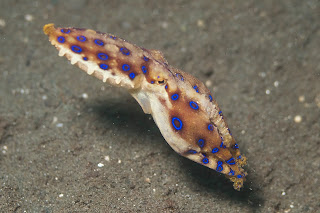
    Blue-Ringed Octopus
    (Wikimedia Commons)
  77. You have seven long, thin tongues. They don’t quite fit in your mouth and tend to stick out the sides. 
  78. You only eat live plants. Right out of the ground.
  79. You only eat tree bark. You need lots of it, though -- your daily rations weigh twice as much.
  80. You shed your skin once a month.
  81. You smell like death: -1 penalty to Charisma.
  82. You take gelatinous form when sleeping.
  83. Your body is bloated and pustulent. It’s not fat… it looks more like you’re full of tumors. This does not seem to pose a health risk.
  84. Your eyes are large & bulging, and set on the sides of your neck.
  85. Your footprints do not match your feet. Not even close. Player can decide what their footprints look like during character creation.
  86. Your hair grows by 18 inches every day, then falls out at night. 
  87. Your hands and feet resemble those of a tarsier: +1 to Climb.
    Tarsiers.
    (Wikimedia Commons -- left, right)
  88. Your head is stretched vertically into a four-foot-long tentacle. Your facial features are still present.
  89. Your legs bend the wrong way.
  90. Your limbs branch into two at the elbow, knee, or other halfway point.
  91. Your mouth is set vertically in your face rather than the normal horizontal configuration.
  92. Your mouth is vertically oriented, and runs from your chin to the back of your head. Any eyes on the front of your face are moved to the sides of your head, and your brain is somewhere in your torso.
    Abyssal Maw, from the 3e Monster Manual II.
  93. Your mouth wraps entirely around your head -- you open it by causing the top of your head to levitate a few inches with no visible means of support.
  94. Your neck is three feet long. There's an elbow-like joint about halfway up that lets you bend your head forward.
  95. Your nose is replaced with a cluster of tentacles.
  96. Your shadow leaves smears of blood. Small ones, hard to notice. The blood isn’t human.
  97. Your skin always takes on the color and texture of the last thing you ate. 
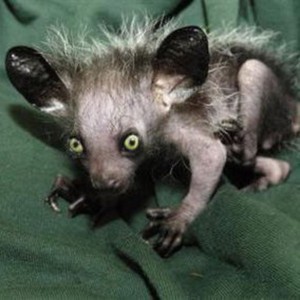
  98. Your skin and hair resemble that of a juvenile aye-aye. 
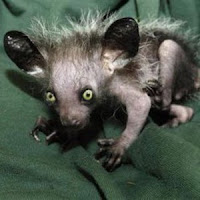
    Shamelessly re-using this image from the Hallucinations table.
  99. Your skin looks like layers upon layers of damp, rotting cloth.
  100. Your teeth are thick wedges of translucent keratin instead of bone. They require regular trimming.

d100 -- Medium Mutations

  1. 1d12 pairs of working  humanoid legs on torso.
  2. 1d12 pairs of working  insectoid legs on torso.
  3. 5% chance of interrupting any conversation in which you are a participant with uncontrollable, somewhat sinister, laughter.
  4. Antennae instead of eyes -- technically blind, but you get Blindsight as a free feat.
  5. Bone spurs protrude from flesh. Add 1d4 damage to all unarmed attacks.
  6. Born with no brain -- skull contains hundreds of tiny translucent silverfish operating as a hive mind. You are completely unaware of this condition, since you have no way of checking inside your head, so you generally behave normally. Unfortunately, you make the occasional social misstep due to a different set of natural instincts: -2 on Diplomacy. In addition, spells that target vermin tend to temporarily screw up your brain-bugs.
    Silverfish.
    (Wikimedia Commons)
  7. Compel hostility at will.
  8. Compulsive liar -- introduce elaborate falsehoods into every conversation.
  9. Compulsively adorn yourself with bones at any opportunity.
  10. Compulsively confirm veracity of mundane details -- “And we all agree that this chair is made of wood, right?"
  11. Conflict tends to happen in your presence. All Diplomacy and Bluff checks made while you are observing are at a -5 penalty.
  12. Covered in dozens of small spinnerets. They spin cobwebs whether you want them to or not. You tend to wake up inside cocoon-like structures. 
  13. Covered in thick, thick fur. Totally comfortable with non-magical cold; take heat penalties if it is over 60 degrees Fahrenheit.
  14. Direct sunlight causes you excruciating pain and 1 damage per round.
  15. Every night at midnight, every animal (Int 1-2) within a mile’s radius of you howls, bleats, or otherwise loudly vocalizes for exactly twenty-three seconds. It took you an embarrassingly long time to figure out that this wasn’t just what animals did.
  16. Every time you enter a building, there is a 3% chance the walls start bleeding.
  17. Exhale insanity mist 1/day, save DC = your Constitution score.
  18. Exoskeleton -- you are always considered to be wearing half plate.
  19. Exoskeleton -- you are always considered to be wearing leather armor.
  20. Eyestalks: +1 to Spot.
  21. Fingernails replaced with barbed stings -- 1d4 extra unarmed damage.
  22. Gelatinous flesh -- can squeeze through spaces as if one size category smaller.
  23. Gills -- take the Aquatic subtype and the Amphibious special quality.
  24. Gnat-sized pterodactyls live in your sinus cavity, teeth, throat, &c. They help you digest food and occasionally sing heartbreakingly beautiful, wordless songs.
  25. Hollow bones -- you weigh half as much and take a -2 penalty to Con.
  26. Huge bulging eyes -- +2 Spot.
  27. Huge frog-like legs. +20 Jump.
  28. If any of your bodily fluids fall on the ground, the next day, strange thorny plants will grow there.
  29. Intelligent centipedes live in your skin. People can see them moving around. If one is killed, take 1d4 Con damage.
  30. Irrational phobia of [player choice / GM approval]
  31. Magpie-like acquisitiveness.
  32. Mold and mildew develop in your vicinity at a rapid pace.
  33. Mouth can distend like a snake's, and you have the Swallow Whole ability.
  34. No arms, but when needed, you can extrude up to [roll 1d4 at character creation] pseudopod-like appendages from the flesh of your torso that function as crude hands.
  35. Obligate carnivore.
  36. Obsessive stargazing, astrology-based decision process. 
  37. Other people always know when you are saying their name.
  38. Pick a cosmetic mutation from the Minor list. That is the only aspect of your appearance anyone can remember.
  39. Poorly-played music or other unpleasant sounds causes you physical pain -- 1 damage / minute.
  40. Putrefy food and drink at will.
  41. Ratlike tail.
  42. Rats are constantly going out of their way to try and eat you. They think you smell delicious.
  43. Relentless cheer and optimism regardless of the situation. 
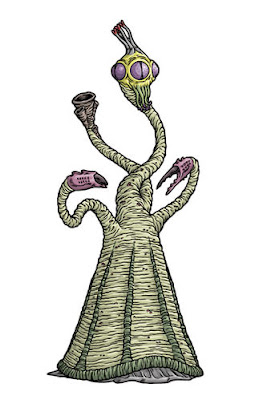
  44. Rugose cone-foot replaces legs.
    A member of the Great Race of Yith and his rugose cone-foot.
    Art by Michael Bukowski.
  45. Sense of humor based entirely on horrifying cruelty. 
  46. Skeletal structure not properly built for bipedal locomotion -- it is very uncomfortable for you to walk upright, and you have to use your hands to knuckle-walk unless you make a particular effort to stand. +10ft speed.
  47. Sometimes your shadow detaches itself and wanders off. It doesn’t do anything, but people tend to not like it much.
  48. Spit acid 1/day
  49. Spit contact poison 1/day. 1d4 Constitution damage, save DC = your Constitution score
  50. Surrounded by unnatural chill.
  51. Twisted, hunched, and asymmetrical. Half movement speed. 
  52. Unable to recognize value of sapient life. 
  53. Uncontrollable glossolalia several times a day. (GM is encouraged to roll for it whenever glossolalia would be inconvenient -- 10% chance.)
  54. Venomous bite, as Medium spider.
  55. Warped sense of aesthetics. Decay, destruction, vermin, &c. are beautiful to you.
  56. Webbed hands and feet -- +4 Swim.
  57. When you sleep, a shadowy form with glowing eyes, roughly the size of a housecat,  climbs out of your mouth and stares unnervingly at anyone nearby. Its origin and motives are unknown, and it only shows up when you’re unconscious, so you’ve never seen it yourself.
  58. Whenever you are asleep, anyone else sleeping within 100 ft. of you has a 10% chance of horrible nightmares that involve a colossal version of you cackling maniacally. You tend to get unpopular in towns really soon.
  59. Whenever your blood is outside your body, there is a 10% chance it animates and crawls away like an ooze.
  60. You always glow faintly, but once a day, you can emit a burst of dazzling light that functions as the Flare spell.
  61. You always know when someone is saying your name.
  62. You are incapable of intentionally breaking an oath.
  63. You are incapable of storing fat. As a result, you appear skeletally emaciated, and starvation affects you much more dramatically -- skip right to the “lethal damage" phase. 
  64. You are invisible to living beings in their first year of life, with the exception of outsiders and aberrations. 
  65. You are poisonous, i.e., anything that eats part of you has to make a Fortitude save DC 10+ your Con score or take 2d4 Con damage. 
  66. You are supernaturally beautiful. Even if your other rolls on this table make you a half-worm monster with mandibles, you pull it off somehow. +2 Cha
  67. You are supernaturally hideous -- whatever other symptoms of your tainted status you have are much, much worse-looking than they should be. If your other rolls on this table have no cosmetic effects, the player should assign some sort of mundane deformity; for some reason, it’s exaggerated in the minds of everyone who sees you. -2 Cha
  68. You can hover up to three feet off the ground.
  69. You can only sleep if you are hanging upside down. You have prehensile feet to facilitate this.
  70. You can plant anything -- i.e., anything you bury in the ground puts forth shoots within a month. No guarantees on what grows out of it, though. GMs are encouraged to come up with their own sufficiently insane method of deciding at random. 
  71. You can produce 1 gallon of amber-colored resin a day. You have to eat/otherwise absorb twice as much each day you do this, though.
  72. You can see bits and pieces of the ethereal plane. You have no way of distinguishing between ethereal stuff and material stuff without actually touching it.
  73. You can taste and smell emotions, but otherwise have no sense of smell or taste. +4 to Sense Motive.
  74. You cannot extract nutrition from food unless it died in agony. 
  75. You cannot sleep above ground. If there is no subterranean space available to you, you must burrow into the earth.
  76. You cannot tell lies.
  77. You carry a disease (player may choose from the rulebook) that can be spread by clawing or biting. Your travelling companions have to make monthly fortitude saves to avoid contracting it.
  78. You compulsively poison food.
  79. You compulsively record all of your actions in writing.
  80. You corrode metal on contact.
  81. You eat only live insects.
  82. You eat only pearls. One a day.
  83. You fail to understand the concepts of good and evil on a basic level, and are generally completely divorced from accepted humanoid morality. In a world full of ethical shades of gray, you are... orange. Seriously, your alignment is [Lawful/Neutral/Chaotic] Orange. Write that down.  May or may not lead to hilariously tragic misunderstandings. Have fun roleplaying it. 
  84. You gain a horseshoe-crab-like tail, which gives you a 1d6 lash attack.
  85. You have a second head. It does not have a mind of its own, but the extra brain mass gives you a +2 Int.
  86. You have no head. Your facial features, brain, &c. are all located elsewhere on your body. (Player chooses where.)
  87. You have the fragile, darkened, wrinkly skin of a bog mummy. You are always thirsty -- quadruple water rations, thirst penalties take 1/4 the time to take effect.
    Fun fact -- this particular bog mummy is Grauballe Man. Grauballe Man's hands show every sign of having never done manual labor, and the last meal preserved in his stomach is incredibly elaborate, containing sixty-three different varieties of grain. His throat was cut and he was thrown into the bog; general consensus is that he was a ritual sacrifice, and some people say he is evidence pointing to the practice of sacral kingship among the Germanic peoples. (He's also in the right place & time to have been killed by the continental ancestors of the Anglo-Saxons.)
    (Wikimedia Commons)
  88. You know, instinctually, certain runes and symbols that, when carved into the face of a dead humanoid, cause its eyes to animate and crawl away as very small oozes. They don’t pay any attention to you or listen to what you have to say, but you can make them as long as you have a knife, a corpse, and about ten minutes.
  89. You lay monthly batches of 1d12 eggs. (May result in some gender confusion if you are male.) If you have been -- ahem -- fertilized recently, each egg has a 75% chance of hatching into your biological children. If you haven’t, each egg has a 1% chance of spontaneous teratogenesis. Whatever comes out isn’t related to you by blood, and may or may not be harmless. Technically, each egg has enough nutrition to qualify as a day’s rations, but the idea of eating your eggs is viscerally horrifying to you, and you have to make a DC 20 Will save to force yourself to do it in desperate circumstances. Others may or may not have a moral problem with it, but the eggs do taste strongly of carrion.
  90. You naturally grow small cysts inside your body. They do not harm you, but there is a 1% chance each day that one of them hatches and 1d12 creatures unknown to science crawl out of your mouth & wander off. If you forget to roll the d% chance yourself, the GM is encouraged to roll it whenever it would be incredibly inconvenient for you.
  91. You only eat live animals. Swallowed whole.
  92. You put down literal roots if you stay in the same place for an hour or more. You only need to eat ¼ of what you would if you didn’t get nutrition from the ground. Unfortunately, it hurts like hell to get up in the morning because you have to snap off all the roots that grew during the night. Or, you know, just stay there and see if you can get people to bring you snacks.
  93. Your eyes are not attached to you -- instead, they hover a few inches away from your body, and slowly drift in circles around you. You can control their movement if you consciously think about it, but you can't send them more than three inches away.
  94. Your head is actually hollow, and has a fire burning inside that can be seen through your eyes, mouth, and other cranial orifices. If the fire is extinguished while you are in positive hit points, you immediately drop to -1.
  95. Your limbs are thin and spindly; -2 Str
  96. Your limbs are twisted and malformed; -2 Dex
  97. Your skin is one size category too large. It sags off of you and constantly gets in the way. -2 Dex penalty, +2 natural armor.
  98. Your teeth and nails are made of cold-forged iron. Well, okay, technically they were grown, not forged, but they have all the properties of cold-forged iron.
  99. Your torso is twice as long as it should be, and can bend and twist like a worm’s.
  100. Your voice always sounds like a chorus of three talking simultaneously.

d100 -- Major Mutations

  1. 10 ft. Burrow speed. You secrete a slimy substance like a worm to aid in this. 
  2. 1d12 pairs of working  humanoid arms on torso.
  3. 1d12 pairs of working raccoon-like paws (with associated raccoon-size arms) on torso.
  4. 1d12 pairs of working thri-kreen arms on torso.
  5. 1d4 of your limbs are shriveled, useless, and constantly covered in some sort of tarry substance. Player can pick which limbs.
  6. 2d12 working tentacles on torso.
  7. A large illusionary creature seems to follow you around. It takes great pains to hide itself, so usually nobody notices and you’ve never gotten a good description of it. Sometimes people just see something in the distance… or watching them through a window… now that you think about it, you only think it’s illusionary.
  8. Abnormally strong teeth and jaw -- you can chew through stone given sufficient time.
  9. All facial features replaced by forest of tiny wriggling tendrils. No verbal spells, yes blindsight, yes constant creepy quiet whistling noises.
  10. Amorphous -- though your “default" shape is whatever the other rolls indicate, you can, at will, revert to an amoeba-like shape and ooze around. You are immune to sneak attacks and critical hits when you do this.
  11. Birds HATE you. 
  12. Bleed (1 damage) whenever you touch living things.
  13. Breath weapon 1/day -- player can choose the breath weapon of any wyrmling dragon at character creation.
  14. Cannot perceive temperature -- immune to heat and cold damage.
  15. Cannot speak -- produce only birdsong when you try.
  16. Cause fear at random. (20% chance of activation whenever you are speaking with an NPC)
  17. Cause fear at will.
  18. Centaur-style body plan, but instead of a horse, your lower half resembles a house centipede.
    House Centipede.
    (Wikimedia Commons)
  19. Centaur-style body plan, but instead of a horse, your lower half resembles a silverfish.
  20. Centaur-style body plan, but instead of a horse, your lower half resembles an earthworm.
  21. Consume metal as rust monster.
  22. Every part of you except your head, hands, and feet is invisible, intangible, inaudible and otherwise undetectable. You get bonuses to AC and Stealth as if you were two size categories smaller. (These bonuses can be negated -- if someone tries to hit you with a ghost touch weapon, you don't get this special AC bonus; if you're trying to sneak past something that can see invisibility, you don't get the stealth bonus, etc.)
  23. Exoskeleton -- you are always considered to be wearing full plate.
  24. Gaze attack as Blindheim. Unfortunately, you can't switch it off. You might want to wear a blindfold when you're around people.
  25. Gelatinous skeletal structure: you gain the “compression" special ability.
  26. Incapable of using proper nouns in speech or writing, including the names of your companions, the town where you live, &c.
  27. Insect mandibles instead of mouth. You can’t cast verbal spells or speak coherently (bet you learned to write at an impressive speed, though) -- but you get a 1d8 bite attack.
  28. Instead of a normal nose, you are covered in crater-like nostrils (one every few inches or so, distribution apparently random). About once a minute or so, a tentacle shoots out of one and writhes around for a bit -- this is how you breathe. It’s really hard to suffocate you, but you also creep people the hell out.
  29. It takes a genuine effort for you to make noise. +10 on Move Silently, but nobody can hear you from more than a few feet away, even if you yell.
  30. Killing you would take a lot of work. Your skull is made of adamantine, and whatever is inside it (you assume brains, but who knows, right) can grow an entire body back from nothing. If you die, your body decays into goo within 24 hours, leaving just your metal skull & contents thereof. Your body grows back in 3d4 days, then comes back to life. Downside: you have to roll twice more on the Minor table each time this happens. 50% chance this whole sordid drama has already happened to you 1d4 times by the time the campaign begins. Oh, and if someone knows about your condition, they can totally kill you by just waiting for your body to decay then stabbing through your foramen magnum, so don't get too cocky.
  31. Like a crow with a golden tongue, you have an unfortunate compulsion to speak in gnomic simile & metaphor. 
  32. Long arms and legs, flat ray-like body (no gills or sting, yes mouth on bottom and eyes on top). You crawl around in a manner not unlike a tree frog and have a climb speed equal to your walking speed. 
  33. Long, thin, prehensile tongue; can wield additional light weapon with -2 penalty (on top of any other relevant penalties); 5% chance of arcane spell failure when verbal components are involved.
  34. Long, thin, transparent claws can unfold out of your mouth (giving you two 1d4 claw attacks). If you have no mouth, they come out of some other orifice. No, not that one.
  35. Microcephalic; -2 Int
  36. Mindless undead like you. If you come within fifty feet of them, they drop what they’re doing and follow you around like puppies. Like large, skeletal, mindlessly vicious puppies who won’t let anyone else near you under pain of being rent to shreds. They don’t listen to you at all, but their creator can call them off if they feel like it.
  37. Mosquito-like proboscis coiled at back of throat. Once a week, you must drain large quantities of blood from a warm-blooded creature. The process takes an hour and leaves you too bloated to fit into your armor for one day. Otherwise, you don’t need to eat.
  38. Mushrooms grow on your skin. 25% chance a given mushroom is poisonous, 10% chance it is hallucinogenic, 0% chance it is tasty. 
  39. No arms; Mage Hand at will.
  40. No mouth. Can’t speak, can’t cast verbal spells, can totally photosynthesize.
  41. Obligate cannibal.
  42. Once a month, you spontaneously generate 1d4 thin white worms with six rows of translucent cilia. They crawl out of your mouth (or other orifice if you have no mouth) and burrow into the ground nearby. You may or may not be aware that they do this in order to spend the next year growing and molting. When they emerge, they are six inches long, have a thick exoskeleton, and dozens of razor-sharp claws. They will seek out a sapient being, burrow into their flesh, and spend the next five years growing into new Tainted, who are technically your biological children. The “hatching" process is definitely fatal to the host. 
  43. Replace one arm with large insect leg. 1d6 claw attack, can’t do anything that requires two hands with opposable thumbs.
  44. Spit sovereign glue 1/week.
  45. Suggestion as a 1/day spell-like ability.
  46. The entire top half of your skull has been replaced by huge curling ram horns. (You assume your brain is in there somewhere, though.) You can use them to do 1d8 damage on a charge. Your nose & mouth had to be shifted down to make room for them, and your eyes are moved to your chin if they were still on the front of your face. Oh, and you have a really muscular neck to hold those horns up. FYI. 
  47. You do not eat, but instead gain energy directly from increasing localized entropy. The best way to do this, for your purposes, is to take something elaborate, complicated, & artificially constructed, and then smashing it to dust. You have to do this once per day. Your equivalent of “trail rations" is basically a sack of cheap objets d'art and a hammer.
  48. The exact reverse of the above. In order to sustain your existence, you have to spend 2 hours each day crafting complex and elegant artificial structures out of whatever comes to hand. Scrimshaw, architecture, painting... whatever. 
  49. The taint of the Far Realms had a particularly unfortunate effect on you when you were in the womb -- the mutations it provoked in your body turned out to be non-survivable, and you were stillborn. You weren't allowed to get off that easily, though, and you're still kind of alive. Kind of. You look a bit like a zombie fetus, to be honest. It's not pretty, but you can still walk and whatnot. Your size is Tiny and you count as undead for all relevant effects.
  50. Though you may or may not be horrifically squamous and tentacular, there's just something about you. Every time you meet a humanoid you have not met before, there is a 1% chance of them falling desperately in love with you. 
  51. Unusual body chemistry: you are immune to all poisons, but you find the following category of mundane items toxic. (Roll 1d6: 1 -- fruit (ingestion), 2 -- wood (injury), 3 -- silver (contact), 4 -- fungus (contact), 5 -- gemstones (contact), 6 -- fish (ingestion))
  52. Weirdly light and flimsy for your apparent size. -4 Str, -4 Con, 1/4 weight.
  53. When you die, the ground directly below you is tainted by the Far Realms, and children in the area will start being born Tainted. 
  54. Whenever your blood is spilled, there is a 25% chance it turns anything it touches to stone.
  55. Working insect wings -- 10 ft. Fly speed (poor maneuverability). Player can choose what type of insect the wings resemble.
  56. You are actually a hive-mind of 3d4 identical diminutive individuals who maintain a symbiotic relationship with the exoskeletal husk that is your “real" body. None of the components of the hive mind can go more than 50ft from the husk -- if they do, they pass out immediately. You still count as one person for all relevant effects.
  57. You are always hungry. So, so hungry. You require quadruple rations, but you can eat anything flammable. 
  58. You are incapable of causing physical harm to anyone who knows your name.
  59. You are one size category larger than you would be otherwise. You look swollen and disproportionate.
  60. You are one size category smaller than you would be otherwise. You look withered and shriveled.
  61. You are two size categories smaller than you would be otherwise, and you have a second, identical body. You can control both bodies simultaneously with ease -- basically you are a very small hive mind. Your two bodies cannot move more than five feet away from each other; if someone else forces them apart, you fall unconscious until this is corrected. If one is killed, the other goes into a coma until it is raised. 
  62. You are two size categories smaller than you would be otherwise. Once a week, you can burrow into the skull of any creature two or more size categories larger than you and control the body’s motions. The creature has to be alive but at negative hit points when you do this, and it decays too much to keep working after 1d6 days (roll separately each time you do this.)
  63. You can cast ethereal jaunt once per week. Except you don't go to the Ethereal Plane, but a different, previously unheard-of, overlapping plane. Things live there. They're hungry. Each time you do it, 10% chance something tries to eat you. GM is encouraged to generate a stack of random monsters with varied CRs for this purpose. 
  64. You can curl up like a pillbug / roly poly / giant isopod. You also have segmented plates on your back like said animals. +1 natural armor.
  65. You can only eat the flesh of sapient creatures (Int 5+).
  66. You can only sustain yourself on a diet of the still-beating hearts of birds. Naturally, this involves vivisecting at least one bird a day at mealtimes. Packing rations is very difficult, and fancy dinner parties are generally out.
  67. You can see people's true faces -- +10 to beat a disguise check, +5 to sense motive. Shaken if you see someone particularly evil.
  68. You cannot sleep within 500 feet of artificially cultivated plants.
  69. You cannot touch wood -- you pass right through it.
  70. You don't sleep; you are powered by the dreams of children. This might sound kind of cutesy, but here's how that goes down. This incorporeal rat-monkey-thing lives in your head, where you are constantly aware of it perusing its collection of dreams -- meaning that, literally in the back of your mind, there are surreal dreamscapes running through your thoughts. Anyway, every night at midnight, rat-monkey climbs out of your head, runs off to the nearest sleeping child, and climbs into its head. The kid wakes up somewhat traumatized, and you feel quite refreshed. Rat-monkey then comes back to your head with new dreams for its collection. It scampers like hell, so it can cover about 100 miles in a night. If rat-monkey is killed while it's outside your head, you spend 1d4 weeks catatonic while a new one coalesces inside your brain. 
  71. You don’t breathe, but you do have to eat a pound of rust every day.
  72. You don’t have to breathe, but you do have to drink a cup of tears harvested from a sapient creature daily.
  73. You don’t need to eat -- once per day, you draw sustenance from the soil. The process takes roughly an hour, and turns about a cubic foot of soil into fine black sand.
  74. You don’t sleep. However, you have to spend eight hours a day standing perfectly still while weird ethereal tendrils extrude from your face and collect… something… from the air. If you move during this process, the tendrils freak the hell out. You take 1d4 Con damage and have to start all over. Failing to do this means you are treated as though you have not slept.
  75. You eat memories. Once a week, you have to come into skin-to-skin contact with a sapient being for thirty seconds and eat one day of their memories. They will pass out and awaken with no memories of the last twenty-four hours. The process is in no way seamless -- they’ll definitely notice the missing day. You do not eat otherwise.
  76. You eat names. In order to eat someone’s name, you must maintain skin-to-skin contact with them for half an hour. They must be both sapient and alive. When you are finished, neither they nor anyone else (except you) remember their name. If they die before the month is out, you have to feed again within a day. You do not eat otherwise.
  77. You exhale a vapor with addictive properties. 
  78. You feed on suffering. Once a week, you have to spend one hour causing a sapient being significant physical or emotional pain. You do not eat otherwise.
  79. You have a second head. It’s fully developed, and has a mind of its own. It’s also an animal’s head, not a humanoid one. It has standard animal intelligence. Player can choose which animal.
  80. You have a second head. It’s fully developed, and moves around under your control. (There is not a second mind in the head.)
  81. You have a second stomach. You can control whether stuff you swallow goes into it, which is important because it works differently. Anything in your second stomach is kept alive (and aware) if you bit it off something that hadn't been dead for more than two minutes. You digest it over the course of a month. Yes, this means you can save on raise dead by biting off your buddy's thumb and bringing it to someone who can cast regenerate & doesn't mind mutants who vomit body parts at him. Your buddy's going to be fully conscious and aware the whole time, though, so he takes 1 point of Wisdom drain for every day you spend digesting him.
  82. You have an instinctual understanding of the Runes of Thuurrlmn. If you are not an arcane spellcaster, choose 1d4 cantrips off of the spell list of an arcane spellcaster. Once a day, you can cast one of those by spending one minute carefully drawing runic diagrams. If you are an arcane spellcaster, you can integrate the Runes of Thuurlm into your item creation, and thus increase the effective caster level of the item you are making to whatever number you want. However, this takes much longer -- double the item creation time for each caster level above your own.
  83. You have no eyes, but it’s cool, because each dawn the closest Tiny or smaller animal/vermin comes and perches on your shoulder. You can see through its eyes for the rest of the day. You can send it sneaking about spying for you if you want, but its eyes glow bright green, so it’s kind of conspicuous. At dusk, it wanders off.
  84. You have no sense of humor. This doesn’t just mean you’re boring -- you cannot comprehend, recognize, or intentionally produce humor.
  85. You have no skin; instead, you exude a mud-like substance to protect your internal organs. Water tends to wash it away, so you take a temporary -2 penalty to Con during the rain, and a -4 penalty for 24 hours after any time you are fully immersed in liquid.
  86. You have the brainworms. Yes, that means worms live in your brain. Take a 1d6 penalty to Wisdom. No, killing the worms doesn’t get your Wisdom score back, because they’ve already hollowed out little burrows for themselves.
  87. You moult regularly. Replace your normal aging process with Tainted Ecdysis (see attached* table).
  88. You move absurdly quickly. Double your walking speed.
  89. You move absurdly slowly. Halve your walking speed.
  90. You must spend one hour a day immersed in liquid. If you fail to do this, you take 1d6 Con damage a day until you can immerse yourself again.
  91. Your arms and legs can unfold and extend to impressive lengths. Triple natural reach, -4 Strength, +6 to Jump
  92. Your legs are half as long as normal, and you move at half speed. However, your arms are twice as long as normal, doubling your natural reach.
  93. Your legs are withered and weak, but your arms are disproportionately large. You have to knuckle-walk to move at normal speed, and you cannot do anything that requires you to stand and use both hands. However, you get a +2 Strength for your absurdly burly arms.
  94. Your mind leaks: 2d12 random NPCs (decided by GM at character creation) are regularly assailed by your thoughts and feelings, regardless of distance or other obstacles.
  95. Your saliva is saturated with dark reaver powder. Luckily, you are also immune to dark reaver powder.
  96. Your skin burns if it touches stone -- 1d4 damage/round.
  97. Your skin is always red-hot. You need to invest in fireproof clothing, but you also gain a Burn attack as thoqqua.
  98. Your skin resembles twisted, blackened wood. Half move speed, -2 Dex penalty, +5 natural armor. 
  99. Your tongue is a separate, worm-like creature with its own agenda & opinions.
  100. Your touch rots any vegetable matter -- plants get saving throw at GM’s discretion.

*If your character is a ___, roll on the Ecdysis Table once for every ___ years they have been alive. That is how many times they have moulted over their lifetime. (Round down.) If they are a crossbreed between two species, average the two numbers.

Bugbear: 6

Gnome: 20
Goblin: 3
Halfling: 10
Hobgoblin: 5
Human: 7
Kobold: 12
Lizardfolk: 11
Ogre: 9
Orc: 4
All characters using the Ecdysis Table start as Tiny and do not grow to another size category unless they roll it.
Characters of a species who would normally be Large or larger as an adult should add +1 to their rolls for each size category above Medium. (E.g., an ogre gets +1 to all Ecdysis rolls, a storm giant gets +2, etc.) The reverse applies to characters who would be Small or smaller.

Ecdysis Table -- Roll 1d12

1-4: Extra pair of arms
5-8: Extra pair of legs
9 +:  Increase one size category

You are considered Adult after your second moulting, Middle-Aged after your fifth, Old after your seventh, and Venerable after your tenth, with the normal age modifiers to your ability scores.

Bestiary: Galdikin

The following was supposed to be an entry on a table of magical side-effects / results of a botched spell. I let it get out of control somewhat.

Sometimes, when a spell is miscast -- be this through a wizard trying to use a scroll beyond their ken, the vagaries of wild magic, a rogue botching their Use Magic Device check, or whatever else can cause such results in your campaign -- the misdirected energy lets something through1. A sort of mindless spirit, given shape and intelligence by the spell that the hapless magic-user meant to cast. These creatures are called galdikins.2 Each galdikin takes a shape much like a mundane animal, often one common to the area, but with distinct visual differences based on the nature of the spell that gave them their form.3 Depending on the power of the spell, they could be anywhere from virtually harmless animals to incredibly dangerous creatures with supernatural intelligence.

Galdikins “feed" on the aura emanated by magic items. This does not damage the magic items, and it is not actually necessary for the survival of the galdikin, which is entirely capable of feeding itself as mundane animals of its apparent species do. However, if a galdikin does not spend at least eight hours a day in direct contact with a magic item, it feels an overpowering hunger until it gets the opportunity to replenish... whatever it is they get from such items. This is the overriding motivation of any galdikin: to have access to as many magical items as possible at all times. This behavior is the only way the wizard who creates them might be able to control the beasts -- they feel no loyalty whatsoever to the person whose blunders brought them into the world, but the more intelligent ones are willing to negotiate cooperation in exchange for access to magical items.

The thing that makes a galdikin a danger -- or a useful ally -- rather than a mere curiosity is that they retain the ability to use the spell that originally gave them form. Once a day, a galdikin can cast its “birth spell". In addition, if they spend enough time “feeding" on magic items, they are able to absorb some of the abilities of those items and increase their own powers. It is not uncommon for groups of galdikins to cooperate in order to build up a shared hoard for this purpose.
This man is having some difficulty with a fire shield galdikin. Or perhaps he is in negotiations and is offering it access to his enchanted trident. Who's to say?
(From the 16th-century Book of Lambspring)

Stats

“Galdikin" is a template that can be applied to any animal or vermin. Normally, this is only applied to Tiny creatures, but galdikins smaller or larger than the norm have been recorded. The base animal is whatever creature the GM thinks is an appropriate thematic fit for the galdikin's “birth spell" -- i.e., the spell that the inadvertent creator of the galdikin meant to cast. Note that galdikins are often Neutral, but can be of any alignment.

To create a galdikin:
  • Change the base animal's creature type to Magical Beast; they receive the d10 hit die and all other qualities that this creature type implies.
  • Give the base animal Hit Dice equal to the level of the galdikin's birth spell. (Galdikins from 0-level spells get ½ HD.)
  • The galdikin can cast their birth spell 1/day as a spell-like ability. The specifics of the spell it casts are always identical to the intent of the caster: a galdikin that came from an empowered spell always casts that spell as if it were empowered; a galdikin that came from a summon monster spell can only summon the monster that the caster originally intended; &c. The save DCs for a galdikin's abilities are Int-based.
  • Add 1d4 Intelligence points per hit die to the base animal. (Galdikins from 0-level spells get 1d4-2.) A galdikin from a low-level spell might be barely smarter than the animal it looks like, while a galdikin from a high-level spell could potentially be terrifyingly brilliant. 
So there you go. Now, if you botch a check to use a scroll of fireball, you might end up with a sapient flaming possum... who then spits a fireball right back at you, digs your magic items from the ashes, and runs off. You're welcome.

Care and feeding of your galdikin:

  • If a galdikin is able to remain in contact with the same magic item eight hours a day for a full month, it will gain a new 1/week ability that allows it to duplicate one of the spells or effects that can be cast from the item. 
    • If the item has multiple potential effects, such as a staff of frost, it gains only one of those abilities, chosen at random. It can, however, spend another month in contact with the item, and repeat this process to gain another ability until it has access to all of them.
  • Each time a galdikin gains a new ability, it also gains 1 HD and 1d4 Intelligence points.

Note: Calculating the CR for something that can cast, for instance, meteor swarm but has no other abilities to speak of is difficult to do with any of the guidelines I can find. I would generally approximate a galdikin's CR as equal to half of its HD. 

High-level galdikin can be unexpected and dangerous villains, as demonstrated by the galdikin shown here, using dominate person.

1. Through from where is up for debate. One leading theory suggests that these spirits don't come from outside the Material Plane, but are always around, drifting aimlessly through the world, until they get the opportunity to take form.
2. Real-world etymology: OE galdor, “sorcery" + diminutive suffix -kin (as in mannequin/manikin). Because “dweomerling" is taken.
3. So a galdikin based on color spray might be, say, a parrot whose feathers are constantly shifting color; one based on spider climb might be a tarantula with a dozen extra-long, multi-jointed, hooked legs.

Monday, August 7, 2017

Bestiary: C(h)amomile Urchin

In the last session, Bork declared that “herbs don't steal women". Now, in your campaign, that doesn't have to be true. Introducing the:

Chamomile1 Urchin

A plant that has grown into the rough size and shape of a human child, capable of scuttling around on its root-like feet. From its back sprout dozens of daisy-like flowers on long stems, giving the visual impression of a hedgehog.
CR 4; XP 1200
Chaotic Blue2 Small Fey
Init +1; Senses low-light vision, Perception +4

⸻Defense⸻

AC 17, touch 12, flat-footed 16 (+1 Dex, +5 natural, +1 size)
hp 27 (6d6+6)
Fort +4, Ref +8, Will +6
DR 5/cold iron

⸻Offense⸻

Speed 20 ft.
Melee 2 claws +0 (1d4-3)
Ranged seed +4 (1 damage + special)
Special Attacks chamomile seed
Spell-Like Abilities (CL 6th)
Constant -- speak with plants
At will -- stabilize
3/day -- charm person (DC 19), deep slumber (DC 21)

⸻Statistics⸻

Str 4, Dex 12, Con 12, Int 10, Wis 8, Cha 15
Base Atk +3; CMB -1; CMD 10
Feats Ability Focus (chamomile seed), Voice of the Sibyl
Skills Acrobatics +3, Bluff +15, Climb +2, Diplomacy +3, Perception +4, Perform (oratory) +3, Sense Motive +4, Stealth +10
Languages Common, Sylvan; speak with plants

⸻Special Abilities⸻

Chamomile Seed (Ex): A humanoid creature hit by a Chamomile Urchin's seed attack must make a DC 16 Fortitude save or contract the Chamomile Malady. (Creatures may voluntarily fail these saving throws -- see text below.) This counts as a disease for all relevant effects, and progresses along the standard Physical Disease Track3. Bed rest is ineffective, however. The incubation period is one day, and the afflicted humanoid must make a new Fortitude save daily. Two consecutive successes allows the victim to shake off the disease; each failed saving throw moves the character one step further along the track. A victim of the Malady begins sprouting small leaves and flowers from their skin as it progresses, though this causes no apparent pain. Upon reaching the “comatose" stage, the victim will instead sneak off to find a location with rich soil and regular sunshine. They will then “plant" themselves in the ground up to their knees, and the flowers and leaves that sprout from their skin will grow at a rapid pace until they form a chrysalis-like covering. (Damaging the chrysalis damages the victim, and it will continue to grow back until it has entirely depleted the victim's body, killing them.) If the victim fails another Fortitude save, they begin metamorphosis, and are irrecoverable. After 1d4 weeks, the chrysalis opens to reveal a new Chamomile Urchin.

⸻Ecology⸻

Environment temperate forests, hills, and plains
Organization frith (2-24 plus 1 Greater Chamomile Urchin[see below]) or thicket (10-120 plus 2-8 Greater Chamomile Urchins)5. 
Treasure no coins, double magic items
Chamomile, from the 6th-century Vienna Dioscurides manuscript.

Description

Chamomile Urchins are small plant-like faeries who tend to hang around small rural communities and lightly-traveled roads. The locals generally consider them to be cute, harmless, and benevolent, something like outdoor brownies. It is common for a thicket of Chamomile Urchins to be known for intervening subtly, yet helpfully, in everyday life -- bringing home lost livestock, setting traps for bandits, tending the natural plants and animals in the area, and maybe even bringing a few helpful herbs to the village healer. Generally, a place that has long been the home of Chamomile Urchins will consider them good luck, or even venerate them as minor nature spirits. This is, of course, exactly what the Chamomile Urchins want.

The actual purpose of all this is to facilitate Chamomile Urchin reproduction. Chamomile Urchins are a lot like more-mundane creatures in that their primary motivation is always to make more Chamomile Urchins -- and this can only be done through infecting people with the Chamomile Malady. A thicket of Chamomile Urchins sufficiently ensconced in a community will sometimes, leveraging their positive reputation in the region and their ability to charm person, suggest to misfits, outcasts, and dreamers that they might want to come live among the Chamomile Urchins, and offer to “bless" them with the immortality and harmony with nature afforded to the faerie folk -- i.e., infect them with the Chamomile Malady. They are careful to always choose people that few will miss, or at least to charm anyone who might otherwise object; another common strategy is to make their offer to the ill, the very old, or the dying, who might see it as the only chance to prolong their lives. This behavior, however, is just to maintain positive population growth until the real targets come along.

Chamomile Urchins really want to “recruit" outsiders, travelers, or people with interesting knowledge or experience; they see this as the best way to increase the knowledge base of their thicket. (If they are deciding between multiple potential “recruits", they will unerringly choose the one with the highest combined mental stats.) If travelers pass through their territory, the Chamomile Urchins will observe them from a distance; if they decide that one or more of them would make good additions to their thicket, they will act. In these cases, they rarely bother with trying to convince their targets to voluntarily join them, but wait until their guard is down, then use their Stealth skills and deep slumber ability to spirit their targets away in the night. A common scenario in this case is for them to creep into the local inn after any travelers have gone to sleep, use deep slumber to ensure they stay asleep, then carry their target(s) away -- this usually requires a group of Chamomile Urchins working in concert, since they are individually far too weak to carry a full-grown humanoid. In the morning, the travelers will find one of their number missing, and a strangely-unhelpful (charmed) innkeeper. Generally, the only sign of the Chamomile Urchins' presence is a lingering herbal scent in the room of the abducted traveler.

Once the abductee has woken up, the Chamomile Urchins might attempt to convince them as usual, with liberal use of charm person, to join their number voluntarily. This may sound tempting, but the secret of the Chamomile Urchins is that the offer for a humanoid to become a Chamomile Urchin themselves is, fundamentally, a lie. Inside the chrysalis formed around a victim of the Chamomile Malady, the victim does not turn into a Chamomile Urchin, but dies, dissolves, and serves as food for the new Chamomile Urchin growing within them. The Chamomile Urchin who comes out of the chrysalis has access to the victim's memories, so that they can pass themselves off as the deceased in a new form, but they have no emotional connection to their victim's life, and are fundamentally not them any more than someone who reads I Know Why the Caged Bird Sings is now Maya Angelou. Their personality, beliefs, and motivations are entirely faerie, and they have no interest in the affairs of the person that everyone thinks they used to be. They will convince the victim's friends and family that they are, indeed, the victim, and that they now want very much to stay here and live among the other Chamomile Urchins. (They will also insist on keeping the magic items that the victim had in their possession; a long-lasting thicket of Chamomile Urchins will build up quite a hoard of these, and they are not shy about using them if needed.)

If forced to engage in actual combat, Chamomile Urchins will make full and enthusiastic use of their spell-like abilities and any magic items they have collected over the course of their time in this region. They will also fight to incapacitate rather than kill, and if victorious, will keep their attackers alive, restrained, and imprisoned to the best of their ability (probably under deep slumber most of the time) and infect them with the Chamomile Malady until it takes. They avoid fighting to the death if possible, and will flee if they think the battle is turning against them.

Greater Chamomile Urchin

If a victim of the Chamomile Malady is 2nd level or higher, the resulting Chamomile Urchin will have access not only to their memories, but to some of their skills and abilities. The process of creating a Greater Chamomile Urchin is as follows -- the stats of the person who was infected with the Chamomile Malady will be hereby referred to as the subject, the Chamomile Urchin stats at the top of this entry will be referred to as the base, and the stats of the resulting Greater Chamomile Urchin will be the product.
  • If the subject's Intelligence is higher than that of the base, then the product's Intelligence is the average of the subject's and the base's. (e.g. Bob the Wizard had an 18 Int, and a normal Chamomile Urchin has only a 10 Int, so the Greater Chamomile Urchin that comes out of Bob's chrysalis has a 14 Int.)
  • Repeat the above with Wisdom and Charisma.
  • In addition to all skill ranks possessed by the base, the product has half the skill ranks of the subject (rounded down), in the same distribution. (e.g. Jane the Thief had 11 ranks in Perception, and a normal Chamomile Urchin has 5, so the Greater Chamomile Urchin has 10.)
  • The product has half of the feats that the subject had, rounded down, decided at random6.
  • If the subject was an arcane spellcaster, half of their Spells Known (again, rounded down and decided at random) become the product's 1/day spell-like abilities.
  • The product knows any languages the subject knew, in addition to Sylvan.
  • Adjust saves, skill bonuses, and spell DCs (the Chamomile Urchin's spell-like abilities are Charisma-based) to fit the improved stats.
  • Assign a higher CR at your discretion.
Once a thicket has accumulated a large number of Greater Chamomile Urchins, some will leave, along with a handful of regular Chamomile Urchins as support, to settle in a new location and thus spread their influence.


1. Or “camomile" -- both spellings are valid.
2. Some creatures possess what TV Tropes calls “Blue and Orange Morality" -- a moral structure that is based on a completely different axis than the black-and-white (or even shades-of-gray) good-vs.-evil construct around which your more typical inhabitant of a fantasy campaign build their moral codes.
This is the helpful chart TV Tropes provides.
In my campaign, I literally refer to this extra axis on the alignment chart as “Blue and Orange" -- inhabitants of the Realm of Faerie tend to be Blue and inhabitants of the Far Realm tend to be Orange. If you don't like “Blue" as an alignment, feel free to just consider this to be equivalent to “Chaotic Neutral".
3. The Physical Disease Track, laid out here, is Latent → Weakened → Impaired → Disabled → Comatose → Dead. Each failed saving throw moves the character one step further along the track.
5. If you want to decide it randomly, notice that those numerical distributions are exactly identical to 2d12, 10d12, and 2d4, respectively.
6. I would suggest numbering the subject's feats 1-whatever, then rolling dice until you've selected half of them.

D100 Table: Hallucinations

So you ate the funny mushrooms...

This table was requested by someone who wanted it for an assassin who incapacitates victims with hallucinogens. She described the substance as “incapacitat[ing] them with Weirdness," which is why a lot of the results leave the character unwilling to move. 

Anyone using this table is encouraged to copy it into a text file. Then, after each use, you should delete the results you used during the session and replace them with new results of your own devising, ensuring that the hallucinations never repeat. Since, you know, that would be weird.

I am always willing to write up tables for tabletop gaming by request. For free.

  1. A bird's leg descends from the sky. It is inconceivably massive, and so tall that the bird's body is too far away to be seen. It is shortly followed by another, and then by the beak, as the cosmic-scaled bird tries to find out what sort of food is beneath the surface of this campaign world.
  2. A creature of titanic scale cracks open the sky from outside -- like a clamshell -- and starts eating bits of the world with brobdingnagian chopsticks.
  3. A gargantuan human-looking mouth opens in the ground at your feet and screams as if in terrible pain. The scream continues as long as the hallucination lasts -- if you run away from the screaming mouth, another one opens in front of you and now you have to listen to two screams.
  4. A quasi-humanoid face forms on the largest surface you can see (other than “the ground", “the sky", or “the ocean" -- maybe on a mountainside). It immediately begins criticizing your every decision as well as every aspect of your appearance and personality with incisive and hurtful accuracy.
  5. A small imp materializes before you. It refuses to answer any questions, but pulls out a quill and a book, where it begins meticulously documenting your every motion, word, and thought. If you leave, it follows you, still writing. It may hum to itself off-key.
  6. A spectral aye-aye pulls itself out from inside your head, informs you that living on your thoughts is boring, and that it's going to go eat the dreams of some innocent children. Then it scampers off.
    Baby aye-aye -- the perfect combination of “creepy" and “adorable".
  7. Alien abduction. Flying saucers, greys, probes, the whole shebang. Described in a setting-consistent manner, of course.
  8. All animate things within your field of vision are staring upwards and screaming. You're not sure why.
  9. All artificial objects are sprouting limbs and forming themselves into humanoid shapes, then sprinting away as quickly as possible. It might be wise to chase down your undergarments and your more important equipment.
  10. All containers are filled with bees.
  11. All insects, arachnids, & other such vermin are growing to hundreds of times their natural size. As they swell to monstrous proportions, you can see malice in their eyes.
  12. All living things within your field of vision turn straight towards you, open their mouths impossibly wide, roll their eyes back in their head, and moan terribly.
    Art by Jessica Hayworth.
    (Welcome to Night Vale)
  13. All natural features and large buildings in the area are actually giants wearing ill-fitting disguises -- how did you never notice this before?
  14. All openings, portals, holes, and apertures are prone to turning into a vast bottomless pit when you approach, providing a corresponding sensation of vertigo. This includes doorways, drinking vessels, anthills, small punctures in cloth, mouths, ears, &c.
  15. All senses inverted -- your eyes only see back into your skull, your ears only hear the sounds of your own internal systems, you can only feel the INSIDE of your skin, &c.
  16. All voices, including those of animals, are replaced with threats.
  17. Become utterly convinced that everything, including your “friends", wants to kill & eat you.
  18. Birds are conspiring against you. If you stay perfectly still and quiet, you can hear the hidden meanings behind the birdsong.
  19. Chanting in a language you've never heard before, at a deafening volume, is coming from all directions. You can see things starting to disintegrate from the arcane pressure behind the words.
  20. Did you read Dr. Seuss's The 500 Hats of Bartholomew Cubbins as a child? You now have that problem, except instead of hats, it's hideous & uncomfortable ritual masks.
  21. Discordant, atonal piping comes from nowhere. Ten-foot-high monstrosities with too many eyes and not enough skin emerge from every conceivable hiding place and begin dancing, carousing, and generally carrying on bacchanal-style.
  22. Elven abduction. Carried off to the Realm of Faerie for incomprehensible reasons, saw some bizarre and disturbing sights, then dumped back where you started -- after experiencing several subjective years in a few objective hours because that's how the Fair Folk roll. Bonus points if the GM quotes Sir Orfeo (or similar) at length.
  23. Everyone else is dead and rotting, but haven't realized yet and keep walking around. This applies to animals as well.
  24. Everyone is a demon in disguise. Including your neighbor, your neighbor's dog, the fleas on the back of your neighbor's dog, &c.
  25. Everything around you is melting; in about ten minutes, the only solid items will be you and the one-foot-radius portion of ground you're standing on, floating on a glutinous, deeply suspicious sea.
  26. Everything has eyes. They're watching you.
  27. Everything is mimics.
  28. Everything is suddenly one thousand times larger than it was. You must move carefully to avoid being eaten by roaches.
  29. Everything is suddenly one thousand times smaller than it was. You must move carefully to avoid crushing the town beneath your feet.
  30. Everything you touch turns to centipedes.
  31. Everything, including you, is becoming perfectly spherical. In a few minutes, you won't be able to do anything without rolling around and bumping into other spherical objects like a game of billiards .
  32. For a brief period, you have the color vision of a mantis shrimp; your brain desperately tries to catch up and interpret what you're seeing, but mostly everything is psychedelic madness that you will never be able to explain to another person.
    There's some debate about whether they actually see the amazing range of color suggested by their 16-coned eyes, but their visual system is definitely different from what you're used to. And they can see polarized light.
  33. Fregoli delusion.
  34. Friction stops working. If you move, you'll slip on the perfectly-smooth ground and slide until you bump into a wall or fall in a hole.
  35. Gravity has decided to hate you; any movement of voluntary muscles will send you careening off through the air in a random direction.
  36. Half of the world drops away. You are now looking over the edge of a cliff that reaches on and on into a terrible infinite void.
  37. Horrible abominations live inside everyone's pupils, including your own.
  38. Hundreds of slugs the size of your forearm are performing an impressive aerial ballet. You never realized slugs could fly, but they're actually quite good at it. Take some time to appreciate the artistic merit of their performance.
  39. Inanimate objects begin to develop horrible fanged mouths that snap at you whenever you approach.
  40. Inanimate objects move around when you aren't looking. Their plans are detailed, wicked, and targeting you personally.
  41. It is suddenly absolutely clear to you that the world you live in is a crudely-made stage set. You can see the strings holding up birds as they “fly" by and the costume fastenings on that “monster" over there. Optional: All women are actually men in drag, since women can't be actors in this time period.
  42. It's raining goats. They bounce impressively, and ricochet unpredictably, bleating angrily the entire time.
  43. It's raining. But the rain is an acidic orange fluid of unknown provenance, and it's coming up from the ground & falling into the sky.
  44. Previously-unknown deity manifests in front of you, informs you that you are its chosen prophet, and begins dictating a holy book. Better write it down quick. (At GM's discretion, individual suffering from hallucination may successfully start small religion, perhaps cause previously-hallucinatory deity to actually exist out of sheer belief -- but it's a pretty crappy deity until they get a bigger cult.)
  45. Reversed gravity. Hold on tight.
  46. Sailing ships filled with tentacular things drift down from the sky and, inexplicably, start sailing through the ground as if it were water. The crew is grabbing any people around and pulling them aboard.
    Art by Raya Golden.
  47. Some sort of stinking ooze starts bubbling up from the ground and forming itself into monstrous shapes. Odds are good they want to eat you.
  48. Spiders the size of your hand keep appearing from nowhere, swarming towards you.
  49. Strange beings with cyclopean visages and horrible claws sprout out of the earth and slither about on their murderous business. They viciously dismember anything living, but you're pretty sure they can only see movement, like a badly-researched T. Rex.
  50. Strange limbs keep ripping through the fabric of reality, flailing around for organic matter, and retracting with their prey through the unsettling portals they created. DON'T LOOK THROUGH -- you don't want to know.
  51. Struck with sudden-onset omniscience, paralyzed by complete knowledge of all things. (5% chance any given piece of information learned from this episode is remotely accurate.)
  52. Sudden guerilla attack of sixteenthlings (one-eighth the size of a halfling) who tie you down Gulliver's-Travels-style.
  53. Swarms of sea urchins begin migrating across the landscape. Rather than use their wee little feet as would be expected, they move like deranged tumbleweeds, bouncing from spine to spine at an alarming pace.
  54. Tentacles keep poking out of everyone's skin-suits. If no people are around, this applies to all living things instead.
  55. The air around you is entirely composed of miniscule air elementals. They are making fun of you and taking an unsettling amount of joy in the fact that you keep accidentally inhaling them.
  56. The color drains out of everything you touch.
  57. The entire world is on fast-forward. Seasons fly by in seconds. People are a blur too fast to see clearly. Pigeons treat you like a statue.
  58. The floor is lava.
  59. The GM should choose a passage in Revelations and read it out loud. That's what's happening right now.
  60. The ground beneath you turns into quicksand. It is also full of various invertebrates mocking your plight.
  61. The literal Grim Reaper is stalking the landscape, and you have a horrible certainty that he's looking for you.
  62. The moon is made of green cheese and is falling out of the sky, the distinctive odor of aged dairy products preceding it. (If you get this result when the moon is not in the sky, then it comes over the horizon, rolling over all obstacles with a sound exactly like a giant ball of cheese squishing into things. (Bonus points if the GM simulates this by balling up some cheese and gleefully rolling it over the dice and various gaming accoutrements on the table.))
  63. The nearest reflective surface (ponds, armor, any reasonably-shiny metal objects qualify if you are away from actual mirrors) bulges and distorts. Gnarled hands reach out of it and stretch it like a rubber band. A twisted facsimile of you with a malevolent grin clambers out and makes its way towards you. You KNOW, deep down in your gut, that this thing wants to kill & replace you and nobody will ever be able to tell the difference.
  64. The sky is the sea, and it's falling towards you.
  65. The sounds of revelry approach! When you look, however, you see a carnivalesque parade of unspeakable horrors. The GM should describe in obscene detail the things gibbering, waving flags, eating humans-on-a-stick, singing songs of madness, &c.
  66. The stones are talking to you, but they're strangely supportive and approve of your dress sense.
  67. The sun and moon are eyes of some colossal being... watching you, personally.
  68. The sun is being pushed across the sky by a giant dung beetle. The beetle hates you.
  69. The world around you is incredibly fragile. A sudden movement could cause you to rip through the ground like it was paper and plummet to the center of the earth.
  70. The world blinks out of existence, and you are floating in an endless void.
  71. There are horrible monsters, the size of a large dog, roaming the streets. Nobody else can see them. They regularly steal things, which people seem to assume they have dropped and lost in a completely innocuous way. They also eat people, and nobody seems to notice.
  72. There is a huge shadowy creature lurking nearby, stalking you. If you point this out to anyone else, it manages to hide just before they look in the right direction.
  73. This region is haunted by everything that has ever died here. This includes huge swarms of ghostly bugs.
  74. Unusually aggressive crabs scuttle out from hundreds of tiny, previously-unnoticed trapdoors and menace you with surprisingly dangerous-looking claws.
    This is actually a fiddler-crab mating ritual. So maybe the crabs aren't menacing you, exactly...
  75. Up is down, east is west, north is left, south is out, right is backwards in time, and in no longer exists.
  76. You are a turtle. Drop whatever you're doing and do turtle things instead.
  77. You are acutely aware of the movement of the tectonic plates, the rotation of the planet, the slightest currents in the air and water, the sound of sand grains moving against each other, and every other natural process that people normally do not notice. You cannot focus on anything else.
  78. You believe very strongly that you are dead and beginning to rot.
  79. You can hear the GM and the players talking at the table.
  80. You can hear the incomprehensible-yet-clearly-malevolent thoughts of the massive mollusk hive-mind a mile below the earth.
    The ALL-CONSUMING MOLLUSK HIVE-MIND is the true master of the earth, and it thinks you surface-dwellers are but IRRITATING PARASITES.
  81. You have an incredibly vivid vision of the distant future. It may or may not be accurate, but it is horrifying on an existential level. You cannot move or react to anything until the vision is complete.
  82. You have an incredibly vivid vision of the distant past. It is accurate in every particular. You cannot move or react to anything until the vision is complete.
  83. You have an incredibly vivid vision of the near future. It is accurate in every particular. You cannot move or react to anything until the vision is complete.
  84. You have an incredibly vivid vision of the near future. It is completely fictional, and seemingly designed to play into your most paranoid fantasies. You cannot move or react to anything until the vision is complete.
  85. You have an incredibly vivid vision of the recent past. It is accurate in every particular. You cannot move or react to anything until the vision is complete.
  86. You have an incredibly vivid vision of the recent past. It is completely fictional, and seemingly designed to play into your most paranoid fantasies. You cannot move or react to anything until the vision is complete.
  87. You have microscopic vision; your eyes seem stuck on 500x zoom. The microscopic world is bizarre and you can't really get a grasp on what's going on at the macro level when you can only see tiny bits of it at a time.
  88. You suddenly notice that you're standing on a sleeping dragon. Hold... very... still...
  89. You suddenly realize the nearest person is a beloved childhood friend in disguise. If there are no people within eyesight, this applies to the nearest living thing. You cannot be dissuaded from this belief in any way.
  90. You're turning to stone. You have maybe five minutes before you are nothing but a statue.
  91. Your arms, legs, and neck are all growing longer at a rapid pace. Your hundred-foot-long-legs are too clumsy to control, even if you could see what you were doing from atop your eighty-foot neck.
  92. Your ascension to godhood is imminent. Remain still and await apotheosis. Dramatic poses are acceptable.
  93. Your blood is made of ants. They bite.
  94. Your digestive tract is full of angry hornets. Sit down, keep your mouth tightly shut, and don't move; it'll be so much worse if they get out.
  95. Your ears have turned into bat wings and your head is flying away. While you struggle to get control of the wings, you pretty much have to accept that your body below the neck is a lost cause, as it's already somewhere out of sight behind you and you can't access the muscle systems anyway.
    From the 2e Monstrous Manual.
  96. Your limbs detach themselves and crawl off to take care of their own inscrutable business.
  97. Your shadow is not your own.
  98. Your skin is independently alive, mobile, and it hates you.
  99. Your teeth begin carrying on a vicious debate about impenetrable skeletal politics. A few of them “storm out of the room" by uprooting themselves, sprouting legs, and either hopping onto the ground or stomping off down your throat.
  100. Roll twice; reroll contradictions. Both are happening simultaneously.
You have my permission to use this, and any other resources on this blog, as long as you tell me how it went.

Tuesday, August 1, 2017

The Hungry Sky, Chapter Six

In Which

A Basilisk is Not Fought ⁂ The Party Arrives at Ang vy Moir ⁂ Beer is Had ⁂ The Locals Demonstrate How to Pronounce “Horned" with Two Syllables ⁂ Larceny is Perpetrated ⁂ Information is Gathered ⁂ Bork Sneaks About ⁂ Old Mother Rictus Makes a Deal

Oculi 16th, 211 Ravensblood

The next morning, the party continues along the lack of road. The northern foothills of the Afnung Mountains are bleak and colorless; the hills themselves look like huge swellings or boils in the landscape, and the valleys between are damp breeding-grounds for mosquitoes. The soil is nigh-lifeless; the only plants that seem to be able to survive are thickets of dark, thorny bushes and, on the highest parts of the hills, an evil-smelling grass that grows only above a certain altitude line.
GM: It's kind of a Dunwich Horror type of landscape.
Aster OOC: Okay?
GM: Massachusetts, but evil.
Bork OOC: So, Massachusetts.
Art by Santiago Caruso.
When a traveller in north central Massachusetts takes the wrong fork at the junction of the Aylesbury pike just beyond Dean’s Corners he comes upon a lonely and curious country. The ground gets higher, and the brier-bordered stone walls press closer and closer against the ruts of the dusty, curving road. The trees of the frequent forest belts seem too large, and the wild weeds, brambles, and grasses attain a luxuriance not often found in settled regions... When a rise in the road brings the mountains in view above the deep woods, the feeling of strange uneasiness is increased. The summits are too rounded and symmetrical to give a sense of comfort and naturalness, and sometimes the sky silhouettes with especial clearness the queer circles of tall stone pillars with which most of them are crowned. Gorges and ravines of problematical depth intersect the way... When the road dips again there are stretches of marshland that one instinctively dislikes, and indeed almost fears at evening when unseen whippoorwills chatter and the fireflies come out in abnormal profusion to dance to the raucous, creepily insistent rhythms of stridently piping bull-frogs... As the hills draw nearer, one heeds their wooded sides more than their stone-crowned tops. Those sides loom up so darkly and precipitously that one wishes they would keep their distance, but there is no road by which to escape them.
-- H.P. Lovecraft, The Dunwich Horror, opening paragraphs
Thanks to a good roll on a Perception check, Bork catches an unexpected scent on the wind from the next hill. Squinting, she sees that if she looks closely, what she had taken for yet another boulder is, in fact, a large lizard -- something like a bulky, terrestrial crocodile with too many legs -- casually sunning itself. She points it out to the others, and Aster's Knowledge(nature) check identifies the thing as a basilisk. The party decides to detour around that particular hill.
Art by Ian Miller.
 After several hours of rather unpleasant hiking, they arrive at the walls of Ang vy Moir; the town is located in a valley between two tall, steep, rocky hills, and a wall is built across the valley's entrance. The guard in the gatehouse demands that they identify themselves.
Aster: We are but a band of weary travelers. [Diplomacy: 13]
Bork: My name is Gnoll -- I mean Bork. [Diplomacy: 17]
Guard: You seem to have some sort of horrific beast following behind you.
Aster: He's not a horrific beast; he's our friend.
Guard: Are you sure? There are strange things in these hills; perhaps you only think he's your friend.
Aster: Um --
Guard: Perhaps he's preying on your mind.
Aster: He looks like a giant snail to you, right?1
Guard: Yes.
Aster: Then yes. He's our friend.
Guard: You know, there are things around here that can insert themselves into your memory, and you'll think he was always there...
Aster: Well, you have no way of knowing, and we have no way of knowing --
Bork: Do I look like someone whose memory gets fucked with?
Bariarti: If I could make people think I was always there, wouldn't I have done it to you? [Diplomacy: 16]
Guard: Good point. Okay, you can bring your snail-creature with you, but we're going to keep an eye on him.
Bork: Thanks for keeping an eye on him. He eats vegetables and needs to be watered every three hours.
Guard: I don't think we'll be taking over those duties.
With that, the guard raises the portcullis and allows the party to enter the town of Ang vy Moir.
Notice that the hunting lodge belongs to the “Marquis de Irzhihal"2. When this came up in the game, I used the map as a reference, wasn't able to read the friggin' font I used, and thought it said “Marquis de Jezhibal"3. So the entire session I was thinking, “why did I name this guy after an Old Testament queen?" The answer is, of course, that I didn't, but I guess it's canon now. (Also notice that I don't know how to make the roads look like they're winding up a mountain, so the ones that go out of the valley just kind of cut straight across.)
Anyway. Ang vy Moir is really just a hunting outpost that's been there so long it's turned into a town. To quote the setting document:
One of the older towns in the region, founded by a human barbarian tribe over a thousand years ago. It’s never gotten particularly large or powerful, however; mostly it’s just a place where human and goblinoid hunters can establish simple homes and trade with the local orc clans. 
As the party enters, they notice fairly crude, ramshackle cabins that are, presumably, the locals' homes, as well as a handful of larger buildings. The major feature that catches their eye, however, is a statue that depicts a bizarre, many-limbed beast that seems to have a hornèd tentacle in place of a head. It is shown as being engaged in mortal battle -- and losing -- against a man in furs. Fritha warns them that the locals, as a result of their long semi-isolation, are a little “off" in some ways, and not to be freaked out by that. She leads them to the inn, which, according to the sign, is called the “Unspeakable Visage".
His mouth is meant to be stitched shut. “Unspeakable", see? Ahahahahaha.
Aster rolls a natural 20 on an unprompted Bardic Knowledge check, and remembers an entire story cycle she's heard that was set in this region. As she recalls, some decades ago there was a minor Far Realms incursion nearby, and she heard the dramatized version of the local heroes fighting off the nameless creatures that slipped through. To her knowledge, there are still strange things up in the hills, but not anything that's sufficiently dangerous or organized to pose a real threat to the town. This more or less explains the unusual statuary, paranoid guards, and probably the name of the tavern; the whole event took a bit of a toll on the local psychology.4

The party enters the inn, and finds that the first floor is a tavern filled with raucous drinkers. The inhabitants all seem pretty... redneck-y, for lack of a better term. The sort of person whom one would associate with a rural, huntin' and fishin' and drinkin' lifestyle. They're also a little... greenish-gray, slightly tusky, kind of bulky and hairy... like there's just a touch of orcish blood floating around the local gene pool. They're a long way from half-orc, but might be the sort of person to boast that their great-great-grandfather was a full-blooded Medfudr.5,6 They seem pretty friendly, though, and jovially toast the new folk as they come in.

Bork scans the room for the wealthiest-looking group, and sees some men wearing nicer furs with what appear to be masterwork weapons at their belts; she decides she's going to try and get them drunk so she can scam some money off of them. Bork heads up to the bar and asks for a pitcher of their finest beer, which turns out to be a fairly strange concoction. The substance the barman pours for her is black as pitch and thick as mud; it smells like something profane, moldering, and rotten has been burnt to make it. If the dark beers you can buy in a more conventional bar are “stouts", this might be called a “corpulent", or possibly a “bloated"7. She carries the pitcher over to the table with the wealthy hunters, and announces, “this round's on me!" After a decent Diplomacy roll, the drinkers are very pleased to see her.
Drinkers: Woo! Yeah, drinks on... um..
Bork: Bork.
Drinkers: Drinks on Bork!
Bork sits down to drink with them. The beer is incredibly strong8, but Bork rolls a 24 on her Fortitude save, and is completely unaffected by it.
Bork: What race are these guys? I'm probably, like, twice their size.9
GM: Mostly human. By which I mean each individual is “mostly" human.
Bork eyes the hunters' weapons [Appraise: 16] and notes that everyone at her chosen table has at least one axe, bow, or other weapon of masterwork quality, though she can't tell whether any are enchanted. Aster wanders around the room and makes a very low Gather Information check10, while Bariarti scans the room with detect good. Aster doesn't pick up anything other than the exaggerated hunting stories being told around the bar, and Bariarti doesn't see anyone light up other than Aster. Notably, the hunting stories are a little odd -- there are very few about stags and similar, but "strange tentacular beasties" are apparently valid quarry in these parts.
Bork: So, guys, what's there to do in this town?
Dolyn11: We drink, we hunt... and that's more or less it.
Bork: What's the biggest thing you've ever killed?
Dolyn: I once shot a moon-beast up on the peak of that mountain over there.
Bork: What is that?
Dolyn: It's this great bat-wingèd thing with dangling tentacles and eyes that drive men maaad.
According to the 3e Monster Manual II, this thing is actually a mooncalf -- the moonbeast is the entry on the page right before it, and has no bat wings. To further confuse matters, the term mooncalf originally referred to a deformed cow fetus -- which sounds like it could have been made into a much weirder monster than this thing -- and in Pathfinder, a moon-beast is one of those things from The Dream-Quest of Unknown Kadath. I'm explaining this whole mixup in-universe by pointing out that Dolyn is a hunter, not a scholar; he doesn't place the beasties in a taxonomy, he just places an arrow in their brain-pan.
While Dolyn is telling his story, Bork uses her mage hand to lift his purse from his belt and into one of her belt pouches [Sleight of Hand: 28]. Bork asks Dolyn about how he shot the “moon-beast" in its madness-inducing eyes “without getting induced into madness" -- he tells her the trick is to already be a little mad.
 Bork: I really love stories about men killing big things.
GM: I don't know if you're trying to flirt with him there, but I'm going to go ahead and tell you that's a low-percentage strategy considering you're a giant hyena.
Bork: They're just jealous because I have a bigger dick than they do.12
She then repeats this process with another drinker  -- Otes -- and he tells a wild story about hunting a creature that looked like a basilisk but was made of translucent jelly “as if it had been touched by otherworldly energies."
Bork: How did you kill it?
Otes: From behind.
Bork rolls fairly low on her Sleight of Hand check this time, but Otes rolls even lower on Perception, so she gets away with it. Aster asks about the giant statue in the middle of town, and another drinker -- Teig -- explains that “when the Dread Gate opened fifty years ago, the great hunter Gastornax the Fabulous13 fought one-on-one with a hornèd beast from beyond reality and defeated it so that our town could continue to exist." Bork lifts Teig's purse while he is talking, then ducks into the privy so she can count her ill-gotten gains and consolidate them into her own purse. All together, the purses of the three wealthy hunters come to about 85gp, in varying denominations.

Bork decides that taking more purses would be pushing her luck, but the hunters continue to regale the party with stories. It becomes apparent that the reason they have more money than the others in the bar is because they are employed by an aristocrat who maintains a hunting lodge in town; he pays them handsomely to act as guides to the region and to lend aid if he runs into anything really dangerous. Bork is intrigued by the presence of an aristocrat nearby whom she might be able to rob, and prompts the hunters for more information. They tell her he is called the Marquis de Jezhibal14, that his hunting lodge is only a few minutes away, and that he summers here specifically to hunt the Far Realms aberrations that one still finds in the hills.
Bork: Does he kill them just for sport, or is he a mage harvesting bits of them, or...
Otes: I believe partially for sport and partially for culinary adventure.
Bork: I'm also a fan of culinary adventure.
Aster: I didn't realize you could eat those things.
Otes: Normally, you probably shouldn't. But... well, the Jezhibal Marches is one of those little states down to the south... you know, in the Necrotic Bloc? The Marquis himself is a ghoul15, so I'm assuming that a lot of what he eats is not healthy for actual living people.
Aster: What's it like working for a ghoul?
Otes: Well, it gives you the creeps at first, but eventually you get used to it. And it's not like they're animals -- he knows it's bad form to eat his employees.
Bork: Is he around?16
Otes: Yeah, he's in town. We just went hunting with him yesterday.
Bork: Oh, what'd you get?
Otes: Well, I haven't had time to make up an exaggerated story yet, but we did bag a few rock lizards.
Bork: Oh, rock lizards, fascinating.
Otes: Well, no, they're fairly easy quarry, nothing to write home about -- but the great thing about rock lizards is that if you get their hides tanned, they make good, tough clothing. There's a tannery outside town, and the guy there is real good at making armor and clothing out of animal bits.17
At this point, Aster, who noticed one of the purses Bork took, pulls her off to the side and lets her know that she's going to be very upset if Bork gets them kicked out of the inn before they even get their rooms. Bork heads back to the table, and tries to find out if there are any other nobles in town she could target -- there's an ambassador from the gnoll settlement of Grasp, which Bork has no interest in -- if there's somewhere she can buy magic weapons -- there's a talented smith in town who can forge enchantable-quality stuff, and knows where to contact people to do the actual enchanting -- and if any of them have magic weapons (presumably so she can steal them) -- Teig has an axe that can neutralize acid, which Bork thinks is boring.

Aster goes off to listen at other tables, and makes another Gather Information check -- she gets a 17 this time, and hears someone mention that there's a powerful magic-user who lives in a cabin way up in the hills -- a crone by the name of Old Mother Rictus. Soon after this, the party retires for the night -- they're the only outsiders in town, and the rooms are cheap, so they can each get their own. For a little while, sleep is difficult, because some of the drinkers downstairs are playing the pipes very badly, and the atonal, discordant music keeps them up.

Bork does not go directly to sleep, but instead sneaks out the window to go a-burgling. She decides that the smithy sounds like a safer target than the Marquis's lodge, and is able to find it with little difficulty. After checking that there is nobody watching, she takes 20 to pick the lock, and slips in. According to her Appraise check, there are a couple swords hanging on the wall that have elaborate designs -- at least masterwork, possibly enchanted -- and among the metal ingots sitting by the forge are a few small bars of mithral. She decides taking the swords would be too conspicuous, so she grabs two bars of mithral and leaves. Considering what to do with them, she eventually makes the very canine18 decision to bury them in the dirt floor of the inn's privy and come back for them later. Bork then heads back to her bed.

NPC Interlude -- Old Mother Rictus

Old Mother Rictus sat hunched in her cabin, breathing in the scent of the herbs she had burned in this room every day for -- oh, so many years. Across the table was a visitor. She got a lot of visitors like this one; nervous men and women, criminals with mundane concerns like the value of a stolen wand or how to evade the guards who even now chased them down. They were boring people, but very... profitable. She grinned at the visitor, her thin, dry, cracked lips stretching over unnervingly strong and sharp teeth; this grin, the one that came at opportune times and was just a little too wide, was her trademark now -- it put the visitors in the right frame of mind.

“What can old Mother Rictus do for you, dearie?" She asked, solicitous kindness not fully covering the eager, hungry greed.

The visitor placed two items on the table. “What are these?"

Under Mother Rictus's arcane sight, the items flouresced with strange colors, shades one only sees if one has the Sight. The patterns in which the colors moved were... interesting. Something she hadn't seen in a long time. “I can tell you," Mother Rictus said, “for a price."

Mother Rictus never charged in anything so mundane as gold. It had long since ceased to amaze her at what people would give for such simple spells. Mother Rictus named her price, and the visitor blanched, but agreed. 

“Hold on just a moment, dearie." Mother Rictus hobbled back further into the cabin, and rummaged through her pantry before producing a small jug of wine. She made the wine herself, from tannersblossom and weepingberry, plants that grew in some of the deeper valleys. The taste was passable, but it was mostly for this sort of thing. From a hook hanging on the wall, she retrieved a large brown feather, its quill having been carefully silvered and attached to a ring from which it could hang. Some years ago -- many years ago -- she'd demanded a dozen of these from a local hunter in payment for a spell; it was from an owlbear. Finally, she opened a cabinet and retrieved a shallow clay bowl.

Mother Rictus returned to the table, and poured the wine into the bowl, then carefully stirred it with the feather, whispering incantations under her breath. She poured the wine over the items in front of her; if one was looking closely, as she was, one might see that the wine never quite touched the items, but turned into vapor a fraction of an inch from their surface. To Mother Rictus's eyes, the vapor spiraled into larger, clearer, more detailed imitations of the invisible magical patterns that covered the statues, showing clearer gradations of the shades of arcane coloring. She nodded, satisfied.

“Now give me your arm, dearie. This'll only hurt a moment." The visitor flinched, but followed instructions. Mother Rictus gripped the arm before her with unexpected strength, and, with the index fingernail of her other hand, quickly and expertly carved a complex symbol into the flesh. It healed, leaving no trace, as soon as it was done. “Good. Now --" She told her visitor what the items she had brought were, and grinned as the visitor's eyes grew wide and avaricious. Yes, this one was worth watching, at least for a little while. 

“Better hurry, dearie," she said. “Your friends will be waking up in just a few hours; if you leave now, you'll be able to get back to town and take care of business before they do." The visitor looked at her with naked surprise. “Oh, yes. Mother Rictus knows, dearie. Don't worry, though; it's none of my business."

Some time after the visitor hurried out of her cabin and back down the winding road -- a path that had been formed, not by design, but by decades of people walking from the town to see Old Mother Rictus -- she whistled softly into the night air, and one of her little helpers soon loped into view, its four delicate hooves leaving almost no impression in the dirt, with something clutched in the jaws of its great wedge-shaped head. “What have you brought for me, Tsega?"

Tsega spit a dead snake onto the ground, and Mother Rictus picked it up. “Perfect. Would you like to watch?"

“Yesss."

Mother Rictus fetched the rest of the jug of wine, and poured it into a large brass bowl she kept on a pedestal out back; the ignorant might have mistaken it for a birdbath, though birds only landed there when she needed one. She slit the snake open with her fingernail, and threw its entrails into the wine. Lighting the candles that circled the rim of the bowl, she whispered some incantations and watched. The entrails formed shapes, which soon acquired detail and color -- and she was watching her visitor, back in the town, creeping into a room. 

“That's the one who came here tonight," she explained to Tsega. “To identify some unusual magic items. But, of course, the items belong to that one in the bed, so there's a problem." 

Tsega laughed in his high-pitched way.

The visitor looked at the items, then at the sleeping figure -- then grabbed a candlestick from beside the bed, and with a practiced, precise, violent effort, struck the figure at the base of its skull. It went from sleeping to unconscious with barely a transition between. With care, the visitor lifted the sleeper over its shoulder, and headed towards the window.

“Wherrre do theyyy go?" Tsega asked.

“I expect," said Mother Rictus with a secret smile, “that they made sure to find out the best way in this town to get rid of someone inconvenient."

Tsega grinned, and the pair watched the scene in the bowl carry on.


1. I regret not having made a different “horrific beast" follow the party, invisible to them but not to others, and just letting the party assume the guard means Bariarti.
2. The “zh" is meant to be pronounced /ʒ/ -- many European languages would skip the “h" and write “ž", but computers are often touchy about diacritics, so I stopped trying to use them. So it's /ir.ʒi.hal/.
3. Which I then, like some sort of sucker, pronounced as /dʒɛz.hi.bal/ instead of /dʒɛ.ʒi.bal/.
4. The town is actually so weird because the general feel was inspired by Laird Barron's short story “Hand of Glory", but even a natural 20 doesn't let Aster's bardic knowledge extend to out-of-game material.
5. One of the better-known orcish tribes of the Afnung Mountains. It roughly translates as “Bear Kicker".
6. As I write this, I'm filing away the idea of playing a character who has just a tiny bit of non-human heritage -- not enough for it to affect his stats in any way -- but brings it up every chance he gets. “Actually, I'm 1⁄32 elven, so I know what I'm talking about." Then again, that might be the sort of character who ends up "heroically" dying by GM fiat; that's what happened to my Neanderthal character Og after one session of “this remind Og of time Og hunt great mammoth."
7. Bork's player is more knowledgeable about beer than I am, and after she asked what type of beer the Leering Lamprey's “good" brew was -- and all I could come up with was “brown ale" -- I decided there should be a more interesting answer to that question in the Unspeakable Visage. Her reaction to my description of the odor was, “oh, a smoky beer then; hmm."
8. In modern terms, it's somewhere around 15-20% ABV -- so much less than, say, gin, but much more than normal beer.
9. Gnolls are at least seven feet tall. Since, in my setting, gnolls have a society based directly on their spotted-hyena counterparts, the women are noticeably larger than the men, meaning Bork would be significantly above seven feet. So not twice their size, but bigger.
10. I house-ruled the skill back in. Having it as a subset of Diplomacy just doesn't make sense to me, and Aster's player uses it a lot but never seems comfortable with rolling Diplomacy when she's trying to overhear something or trying to look stuff up in books. While I could rule that those actions are a Perception check and a Knowledge check respectively, it just makes things smoother to have a single skill for general information-gathering.
11. Bork didn't ask for the names of any of her drinking companions, so I didn't give them any. It is only now, in this write-up, that I am assigning them these so that I don't have to call them “Drinker #1" and so forth.
12. Bork's player has familiarized herself with the anatomical peculiarities of female spotted hyenas (hyenae?). If you are feeling inspired to look up the details, I advise not thinking about them too much, especially if you are the type of person to wince when you see an unpleasant injury on television.
13. I paused trying to come up with a name, and Aster's player immediately dropped in “Gaston". I tweaked it just a little in case I wanted to re-use the story in a future game, but after being reminded of Gaston -- nobody cleanses the land of beasts from beyond the walls of sanity like Gaston! -- the only thing I could think of as an epithet was “The Fabulous". I now have a growing table of NPC names from various species and cultures so I don't end up naming anyone after Disney characters out of desperation.
14. Sigh...
15. For years now, I've been kind of irked by the standard game depiction of ghouls as feral creatures living in crypts. I mean, that niche is pretty well filled. Ghouls are not only intelligent undead, they're smarter than the average human. Pathfinder gives ghouls these mental stats -- Int 13, Wis 14, Cha 14 -- and then tells us “Ghouls are undead that haunt graveyards and eat corpses," and “Ghouls lurk on the edges of civilization (in or near cemeteries or in city sewers) where they can find ample supplies of their favorite food." Why do they do that? They aren't just smart, they have charisma -- and since it can't possibly refer to physical attractiveness in this case, that must mean they're really fast talkers and have a strong force of personality. They should be cunning, clever, leader-type monsters -- more like a vampire than a zombie. Plus that allows for the scene of a group of ghoul aristocrats inviting the PCs to join them for a banquet -- oh, no, as guests, not as the food, don't be silly, you're such a card, Sir Jeff -- here, have some leg of rotted elf. And then the GM describes in detail the unnaturally mobile jaws, long tongues, pointed teeth, and the substance on which they are -- in a genteel way of course -- consuming... and the players decide to go play something else, probably. Besides, having the PCs encounter a bunch of ghouls in a cemetery is creepy and evocative, of course, but that always brings up questions like, “so how many people are buried here? And how many ghouls is this supporting? For how long?" Basically, an undead creature whose defining characteristic is that they eat suddenly has an ecology to worry about. So, in my setting, ghouls are usually the smooth-talking servants of someone powerful -- or, in the Necrotic Bloc, they often are the power.
16. Out of character, Bork checks to make sure it's actually summer. Oculi 16th is equivalent, on our calendar, to June 17th, so it is.
17. This is my “hint, hint, remember you're carrying around all that ankheg chitin, maybe you should do something with it."
18. Yes, I know hyenas aren't actually canine, but just look at them -- don't you just want to give them ear scritches and belly rubs and cuddle them?
Lookit the little baby
(Picture from the Cincinnati Zoo -- it's an aardwolf, the smallest member of the 
Hyaenidae)