Friday, May 18, 2018

Less Respected Lycanthropes

Werewolves are always a classic. Werebears, equally solid. Weretigers, terrifying1. Weresharks, dangerous in the right environment. Werebats, kinda creepy. Even wereboars have their place, and wererats have a solid niche carved out as a sort of urban criminal organization. This entry is about the lycanthropes who don't hold that same position in the public imagination -- who are obscure, or not particularly fearful, or actively mocked by the populace.
A wereterrier addresses some werefowl in animal form.

Notes:
All stat blocks are based on 1st-level human commoners. A template is also provided.
It should be noted that all lycanthropes have the special qualities Lycanthropic Empathy and Curse of Lycanthropy. The former allows the lycanthrope to communicate with animals of the type specified (not very well, since they're still just animals), and gives them a +4 bonus to any checks to influence that animal's behavior. Curse of Lycanthropy indicates that if the lycanthrope draws blood with any of their natural weapons (teeth, horns, hooves), the injured individual must make a DC 15 Fortitude save to avoid contracting lycanthropy themselves.
It should also be noted that a distinction is made between natural lycanthropes -- i.e., people who were born lycanthropes (it's genetic) -- and afflicted lycanthropes -- i.e., people who acquired the curse of lycanthropy at some point. Natural lycanthropes are far more likely to have the stereotypical attributes described in these entries.

Wereram (or Weresheep)

Even though, obviously, members of any gender can contract this particular form of lycanthropy, the male wererams are substantially more dangerous than the female weresheep (it's the horns) and most transmission comes from wererams (via the horns), so if anyone ever bothers to talk about them, they usually say “wereram". Plus, no adventurer would ever want to say they fought a “weresheep" -- it just sounds silly.

Wererams are highly social; they will gather with other wererams if possible, but otherwise are happy to treat a non-lycanthropic social group as a surrogate flock. Largely, they tend to be extremely relaxed, go-with-the-flow types -- with notable exceptions. Wererams, like the sheep they resemble, insist on an established dominance hierarchy. If a male wereram perceives the leadership of their current “flock" to be up for grabs -- either if no leader is established, or if the current leader appears weak -- they become extremely aggressive and argumentative, attempting to establish themselves as the leader. This often must be resolved by a clear show of dominance in one direction or another -- not literally doing the butting-horns thing, but analogous. They also tend to be slightly more religious than average, and in some cases, this fills their need for a hierarchy -- their god is their leader, problem solved. As one may gather from this description, wererams overwhelmingly trend towards Lawful alignments.

In humanoid form, wererams tend to be excessively hirsute, with somewhat “woolly" body hair. They also frequently have flat, grinding teeth. Commonly, they will give the impression of being vaguely dopey, or demonstrate a habit of “zoning out" and staring into space. The men often have overdeveloped neck muscles, as if they're used to holding up something heavy with them.

In hybrid form, wererams sprout a full coat of wool, and their face lengthens slightly in a sheep-like fashion. A coating of keratin grows over the backs of their hands, giving their unarmed strikes a little extra oomph. Men grow huge, spiraling ram's horns -- afflicted wererams will find that this really screws with their sense of balance until they get used to it, and will have to make frequent Strength, Balance, or other relevant checks just to keep their head up and not stumble.

Stats

Human -- hp 15 (2d8+1d6+3), CR 3 XP 800, M. humanoid (shapechanger) Init +0 Speed 30ft AC 12 (+0 dex, +2 nat. armor) Base Atk +1 CMB 2; CMD 12, Atk shepherd's crook +2 (1d6+1) (reach, trip) Space 5ft.; Reach 5ft Special low-light vision, scent, sheep empathy Saves Fort +4, Ref +3, Will +3 Abilities Str 13, Dex 11, Con 12, Int 10, Wis 12, Cha 9 Skills Climb 4, Craft (woodworking) 1, Handle Animal 6, Perception 6, Perform (sing) 1, Profession (farmer) 4, Ride 2 Feats Animal Affinity, Iron Will, Run, Skill Focus (perception)

Hybrid -- hp 15 (2d8+1d6+3), CR 3 XP 800, M. humanoid (shapechanger) Init +0 Speed 30ft AC 13 (+1 dex, +2 nat. armor) Base Atk +1 CMB 2; CMD 12, Atk shepherd's crook +3 (1d6+2) (reach, trip), unarmed strike +2 (1d6+2), bite +2 (1d6+2), gore +2 (1d8+2) Space 5ft.; Reach 5ft. Special curse of lycanthropy, DR 10/silver, low-light vision, scent, sheep empathy Saves Fort +4, Ref +3, Will +3 Abilities Str 15, Dex 13, Con 12, Int 10, Wis 12, Cha 9 Skills Climb 5, Craft (woodworking) 1, Handle Animal 6, Perception 6, Perform (sing) 1, Profession (farmer) 4, Ride 3 Feats Animal Affinity, Iron Will, Run, Skill Focus (perception)

Animal -- hp 15 (2d8+1d6+3), CR 3 XP 800, M. humanoid (shapechanger) Init +0 Speed 40ft AC 13 (+1 dex, +2 nat. armor) Base Atk +1 CMB 2; CMD 12, Atk bite +2 (1d6+2), gore +2 (1d8+2) Space 5ft.; Reach 5ft. Special curse of lycanthropy, DR 10/silver, low-light vision, scent, sheep empathy Saves Fort +4, Ref +3, Will +3 Abilities Str 15, Dex 13, Con 12, Int 10, Wis 12, Cha 9 Skills Climb 52, Craft (woodworking) 1, Handle Animal 6, Perception 6, Perform (sing) 1, Profession (farmer) 4, Ride 33 Feats Animal Affinity, Iron Will, Run, Skill Focus (perception)

Template

  • Add 2d8 hit dice
  • +3 Fortitude, +3 Reflex
  • +2 Wisdom
  • +2 Dexterity, +2 Strength (hybrid or animal form only)
  • +1 Base Attack
  • Gain (2 + Int modifier) x2 skill points 
  • Gain the feats Iron Will and Skill Focus (perception)
  • Gain low-light vision and scent
  • Gain +2 natural armor
  • Hybrid and animal forms gain a Bite attack (1d6)
  • Unarmed strikes of the hybrid form increase in damage by one die type (e.g. 1d6 instead of 1d3) -- they may also do lethal damage at the lycanthrope's discretion.
  • Hybrid and animal forms gain a Gore attack (1d8) (males only; female sheep have no horns)
  • Animal form gains a 40ft. speed
  • Challenge Rating +2 (+3 if natural)
  • DR 5/silver in hybrid or animal form (afflicted lycanthropes)
  • DR 10/silver in hybrid or animal form (natural lycanthropes)
St. Mildred the Weresheep preaches to the denizens of the Far Realms.
(I dare you to explain this image any better.)

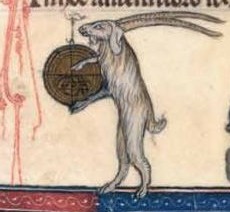
Wererabbit (also Werehare, Wereconey)

The great curse of being a wererabbit is not so much the shapeshifting; you'd think it might be stressful being a rabbit on the full moon, but it's not like foxes have silver teeth, you know? Also, they're much larger than your standard rabbit -- technically, their animal form is a “dire" rabbit, for what that's worth4. The point is, for a wererabbit in animal form, predators are just a minor annoyance, so their rabbit-experience really is fairly Disney; hopping about in fields of clover and whatnot. No, the problem is, once their wererabbit nature becomes known, the rest of their life is also fairly Disney -- in the exact wrong way.
In finding this image, I was painfully reminded that there are some Disney characters you DO NOT Google Image Search. Seriously, just don't. Trust me on this. It's grim.
That is to say, people thinking of you as a “bunny person" -- that there is your express ticket and all-access pass to nobody ever taking you seriously again. So, you know, wererabbits tend to be kind of secretive; if outed as a wererabbit, they may get defensive or develop a full-blown Napoleon complex. In some extreme cases, they might become bitter, nihilistic, and dangerous.
Some men just want to watch the world burn.5

Otherwise -- i.e., if not being mocked due to their condition -- wererabbits are generally non-confrontational, liable to freeze or flee if things get violent; even if they're well-equipped to deal with it, there's a certain instinctual resonance from the rabbit side of things. It's not uncommon for wererabbits to spend a lot of time at their local tavern, either drinking away their problems or trying the whole “hey, baby, you know what they say about rabbits, right?" thing. Plus, those rabbit instincts are telling them to be nocturnal, so they tend to be part of the nightlife generally. Rumors that wererabbits are unusually lucky -- due, of course, to their rabbit's feet, hahaha -- are probably just a joke and completely unfounded. Probably.

Visually -- in human form -- your average wererabbit tends to be a bit on the short side, with large ears and prominent front teeth. Some develop an odd facial tic that could be characterized as a “twitchy nose". In hybrid form, they develop a soft coat of hair, full rabbit ears, and a powerful set of legs -- the last allows for some impressive jumping.

Stats

Human -- hp 16 (2d8+1d6+6), CR 3 XP 800, M. Humanoid (shapechanger) Init +1 Speed 30 AC 13 (dex +1, natural +2) Base Atk CMB 0; CMD 11, Atk sling +2 (1d4) ; Space 5ft.; Reach 5ft Special low-light vision, rabbit empathy, scent Saves Fort +2, Ref +4, Will +0 Abilities Str 11, Dex 13, Con 8, Int 10, Wis 13, Cha 12 Skills Acrobatics 6, Handle Animal 7, Perception 6, Profession (farmer) 3, Ride 3 Feats Animal Affinity, Iron Will, Run, Skill Focus (Acrobatics)

Hybrid -- hp 16 (2d8+1d6+6), CR 3 XP 800, M. Humanoid (shapechanger) Init +1 Speed 30 AC 22 (dex +5, natural +7) Base Atk CMB 0; CMD 15, Atk sling +6 (1d4), bite +1 (1d6) ; Space 5ft.; Reach 5ft Special curse of lycanthropy, DR 10/silver, low-light vision, rabbit empathy, scent Saves Fort +2, Ref +8, Will +0 Abilities Str 11, Dex 21, Con 14, Int 10, Wis 13, Cha 12 Skills Acrobatics 10 (18 jumping), Handle Animal 7, Perception 6, Profession (farmer) 3, Ride 7 Feats Animal Affinity, Iron Will, Run, Skill Focus (Acrobatics)

Animal -- hp 16 (2d8+1d6+6), CR 3 XP 800, S. Humanoid (shapechanger) Init +1 Speed 60 AC 23 (dex +5, natural +7, size +1) Base Atk CMB -1; CMD 14, Atk bite +0 (1d6) ; Space 5ft.; Reach 5ft Special curse of lycanthropy, DR 10/silver, low-light vision, rabbit empathy, scent Saves Fort +2, Ref +8, Will +0 Abilities Str 11, Dex 21, Con 14, Int 10, Wis 13, Cha 12 Skills Acrobatics 10 (18 jumping), Handle Animal 7, Perception 6, Profession (farmer) 3, Ride 7 Feats Animal Affinity, Iron Will, Run, Skill Focus (Acrobatics)

Template

  • Add 2d8 hit dice
  • +3 Fortitude, +3 Reflex
  • +2 Wisdom
  • +8 Dexterity, +6 Constitution (hybrid or animal form only)
  • +1 Base Attack
  • Gain (2 + Int modifier) x2 skill points 
  • Gain the feats Iron Will and Run
  • Gain low-light vision and scent
  • Gain +2 natural armor (+7 in hybrid or animal form)
  • Hybrid and animal forms gain a +8 racial bonus on all Acrobatics checks that involve jumping
  • Hybrid and animal forms gain a Bite attack (1d6 M, 1d4 S)
  • Animal form gains a 60ft. speed
  • Challenge Rating +2 (+3 if natural)
  • DR 5/silver in hybrid or animal form (afflicted lycanthropes)
  • DR 10/silver in hybrid or animal form (natural lycanthropes)
Yeah, who's a ‘cute widdle bunny wabbit' NOW, asshole?"

Werefowl (definitely not Werechicken")

On the subject of not being taken seriously, meet the werefowl. Despite the fact that they are by no means the only lycanthropes who turn into fowl, which some suggest makes the term overly generic and confusing, they are very insistent about the terminology. Some will accept the gendered terms “wererooster" and “werehen", and a handful are okay with “werechook", but “werechicken" is a fighting word. The justification behind this distinction is that they don't really turn into a chicken, but into the junglefowl from which ordinary domestic chickens are descended. (Technically, this might make them werepheasants, but that doesn't go over too well either.) Really, though, it's just that the term “werechicken" is so... goofy-sounding.
Male & female junglefowl.
Image by George Edward Lodge, printed in A Monograph of the Pheasants by William Beebe
The life of a werefowl involves a lot of compensating for being a werefowl. They tend to speak with excessive bluster and bravado, and are quick to take offense. If they can afford it, they dress in flashy clothing. Werefowl often establish themselves as individuals deserving of respect by challenging anyone who shows disrespect to a duel. Anyone who finds this laughable, or expects a werefowl to be, well, “chicken", might do well to be reminded that chickens were likely originally domesticated for bloodsport, not food. In addition to their dueling prowess, werefowl also seem to develop the gift of prophecy with a significantly higher frequency than might be expected; some of history's greatest oracles were werefowl, though they tend not to advertise their lycanthropic condition.

Werefowl in hybrid form.
(Actually a Japanese breed of chicken called Shamo.)

Werefowl in human form tend to be red-faced, with large, beak-like noses; some develop an unfortunate neck wattle. They trend towards a wiry build and have impressive reflexes. In hybrid form, they develop scaly, saurian feet (this is tough on shoes, so many werefowl go barefoot), a coating of colorful feathers, a hard beak, and a reddish “comb" on top of their head. In addition, their necks lengthen and become more flexible, so as to allow them to peck their opponents more easily. In animal form, they very much resemble the junglefowl, but larger and more impressive; like the wererabbits, their animal form is technically “dire", so they reach the size of a large wild turkey, with noticeably rougher, scalier skin and a dangerously solid build. It is not unheard of for some werefowl to wear metal spurs of the type used in cockfights, adjusted to fit their hybrid or animal form -- they are difficult to use, but deadly on the claws of an expert.
Cockfighting spurs in East Timor.
By Alex Castro - https://www.flickr.com/photos/cruzalmeida/4757358049/in/photostream/


Stats

Human -- hp 30 (2d8+1d6+18), CR 3 XP 800, M. Humanoid (shapechanger) Init +5 Speed 30 AC 13 (dex +1, natural +2) Base Atk 1 CMB 0; CMD 11, Atk Dagger +2 (1d4-1/19-20) Space 5ft.; Reach 5ft. Special chicken affinity, low-light vision Saves Fort +4, Ref +4, Will +3 Abilities Str 9, Dex 13, Con 12, Int 10, Wis 12, Cha 11 Skills  Handle Animal 6, Perception 6, Profession (farmer) 4, Ride 3 Feats Animal Affinity, Improved Initiative, Iron Will, Weapon Finesse

Hybrid -- hp 30 (2d8+1d6+18), CR 3 XP 800, M. Humanoid (shapechanger) Init +5 Speed 30 AC 19 (dex +2, natural +7) Base Atk 1 CMB 0; CMD 12, Atk Dagger +3 (1d4-1/19-20) Full Atk 2 claws +3 (1d4-1) Space 5ft.; Reach 5ft. Special chicken affinity, curse of lycanthropy, DR 10/silver, low-light vision Saves Fort +9, Ref +4, Will +3 Abilities Str 9, Dex 15, Con 22, Int 10, Wis 12, Cha 11 Skills  Handle Animal 6, Perception 6, Profession (farmer) 4, Ride 3 Feats Animal Affinity, Improved Initiative, Iron Will, Weapon Finesse

Animal -- hp 30 (2d8+1d6+18), CR 3 XP 800, S. Humanoid (shapechanger) Init +5 Speed 40, fly 30 (clumsy, drift) AC 20 (dex +2, natural +7, size +1) Base Atk 1 CMB 0; CMD 12, Atk bite +3 (1d4-1/19-20) Full Atk 2 claws +3 (1d3-1) Space 5ft.; Reach 5ft. Special chicken affinity, curse of lycanthropy, DR 10/silver, low-light vision Saves Fort +9, Ref +4, Will +3 Abilities Str 9, Dex 15, Con 22, Int 10, Wis 12, Cha 11 Skills  Fly -2, Handle Animal 6, Perception 6, Profession (farmer) 4, Ride 3 Feats Animal Affinity, Improved Initiative, Iron Will, Weapon Finesse

Template

  • Add 2d8 hit dice
  • +3 Fortitude, +3 Reflex
  • +2 Wisdom
  • +2 Dexterity, +10 Constitution (hybrid or animal form only)
  • +1 Base Attack
  • Gain (2 + Int modifier) x2 skill points 
  • Gain the feats Iron Will and Improved Initiative
  • Gain low-light vision
  • Gain +2 natural armor (+7 in hybrid or animal form)
  • Hybrid and animal forms gain a Bite attack (1d6 M, 1d4 S)
  • Hybrid and animal forms gain 2 Claw attacks (1d4 M, 1d3 S); given that these are the same claws they are standing on, they can only be used in a full-round attack.
  • Animal form gains a 40ft speed
  • Animal form gains a 30ft Fly speed (clumsy) and the ability Drift:
    • Drift (Ex) -- A chicken flies in short bursts and can’t use its fly speed to hover. When it flies, a chicken must end its move action by landing or perching on a solid surface. 
  • Challenge Rating +2 (+3 if natural)
  • DR 5/silver in hybrid or animal form (afflicted lycanthropes)
  • DR 10/silver in hybrid or animal form (natural lycanthropes)

Werefowl Spur

Light Exotic Weapon; Dmg (S) 1d4, (M) 1d6; Critical x3; 1 lb.
Usually sold in pairs and worn one on each foot.
“No, I don't need help getting untangled -- shut up."

Wereleech

The wereleech is, for reasons that almost don't need explaining, generally not very popular or particularly welcome in society. No matter how nice a person you are, there's a certain “you turn into a what?" visceral factor among the non-hematophagous population that's just difficult to get past. As a result, wereleeches tend to live in solitude or small communities with each other, out in the swamps. It is not uncommon, however, for people to venture into the swamp to consult with wereleeches if they know where to find them; many wereleeches are expert healers, and the wereleech communities jealously guard secrets of herblore otherwise lost or undiscovered. Out in their huts in the swamp, the wereleeches are quiet and patient, enjoying peaceful if simple lives. They often spend many hours at a time relaxing in the water in leech form. Said leech form is not a normal leech, of course -- see “Leech, Giant" in your nearest bestiary.

In human form, the wereleech tends to have very sparse or fine hair, and commonly goes bald early. Their skin is disconcertingly slick, and they're always ever-so-slightly more damp than one might expect. Their facial features are small and unobtrusive -- small eyes, small ears, small nose -- except for wide, wide mouths full of sharp, sharp teeth.

In hybrid form, the wereleech's face vanishes almost entirely. Their nose and ears are no longer in evidence, and their eyes are only distinguishable if you look very closely. Their head is almost entirely occupied by their huge, leech-like maw. Their body is segmented in this form, and their skin is a slick grayish color; they are also abnormally flexible, as if their endoskeleton is just solid enough to keep them bipedal. 
Leech mouth.

Stats

Human -- hp 29 (3d8+1d6+12), CR 4 XP 1200, M. Humanoid (shapechanger, aquatic) Init 0 Speed 30 AC 12 (natural +2) Base Atk 2 CMB 1 (9 when grappling); CMD 11, Atk Dagger -1 (1d4-1/19-20) Space 5ft.; Reach 5ft. Special blindsight, leech empathy, scent Saves Fort +4, Ref +1, Will +3 Abilities Str 9, Dex 11, Con 12, Int 13, Wis 14, Cha 8 Skills Heal 6, Knowledge (nature) 6, Perception 5, Stealth 4 (12 in swamps), Survival 6 Feats Iron Will, Self Sufficient, Skill Focus (knowledge [nature])

Hybrid -- hp 29 (3d8+1d6+12), CR 4 XP 1200, M. Humanoid (shapechanger, aquatic) Init 1 Speed 30 AC 13 (dex +1, natural +2) Base Atk 2 CMB 1 (9 when grappling); CMD 12, Atk Dagger -1 (1d4-1/19-20), bite -1 (1d6-1, attach) Space 5ft.; Reach 5ft. Special amphibious, attach, blood drain, blindsight, curse of lycanthropy, DR 10/silver, leech empathy, scent, vulnerability to salt Saves Fort +6, Ref +2, Will +3 Abilities Str 9, Dex 13, Con 16, Int 13, Wis 14, Cha 8 Skills Heal 6, Knowledge (nature) 6, Perception 5, Stealth 5 (13 in swamps), Survival 6 Feats Iron Will, Self Sufficient, Skill Focus (knowledge [nature])

Animal -- hp 29 (3d8+1d6+12), CR 4 XP 1200, M. Humanoid (shapechanger, aquatic) Init 1 Speed 5, swim 20 AC 13 (dex +1, natural +2)  Base Atk 2 CMB 1 (9 when grappling); CMD 12, Atk Bite -1 (1d6-1, attach) Space 5ft.; Reach 5ft. Special amphibious, attach, blood drain, blindsight, curse of lycanthropy, DR 10/silver, leech empathy, scent, vulnerability to salt Saves Fort +6, Ref +2, Will +3 Abilities Str 9, Dex 13, Con 16, Int 13, Wis 14, Cha 8 Skills Heal 6, Knowledge (nature) 6, Perception 5, Stealth 5 (13 in swamps), Survival 6 Feats Iron Will, Self Sufficient, Skill Focus (knowledge [nature])

Template

  • Add 3d8 hit dice
  • +3 Fortitude, +1 Reflex, +1 Will
  • +2 Wisdom
  • +2 Dexterity, +4 Constitution (hybrid or animal form only)
  • +2 Base Attack
  • Gain (2 + Int modifier) x3 skill points 
  • Gain the feat Iron Will
  • Gain a +8 bonus on Stealth when in swamps
  • Gain a +8 bonus on Grapple checks
  • Gain blindsight and scent
  • Gain +2 natural armor
  • Hybrid and animal forms gain a Bite attack (1d6)
  • Hybrid and animal forms gain the special abilities Attach and Blood Drain.
    • Attach -- The wereleech automatically latches onto its target when it successfully makes a bite attack. The wereleech is considered grappling, but the target is not. The target can attack or grapple the wereleech as normal, or break the attach with a successful grapple or Escape Artist check.
    • Blood Drain -- The wereleech drains blood at the end of its turn if it grapples a foe, inflicting 1 Str and 1 Con damage.
  • Hybrid and animal forms gain the special quality Amphibious.
    • Amphibious -- Creatures with this special quality have the aquatic subtype, but they can survive indefinitely on land.
  • Hybrid and animal forms gain Vulnerability to Salt.
    • Vulnerability to Salt -- A handful of salt burns a wereleech as if it were a flask of acid, causing 1d6 points of damage per use.
  • Animal form drops to a 5ft land speed
  • Animal form gains a 20ft Swim speed
  • Challenge Rating +3 (+4 if natural)
  • DR 5/silver in hybrid or animal form (afflicted lycanthropes)
  • DR 10/silver in hybrid or animal form (natural lycanthropes)

Oddly, I can't find any medieval marginalia with anthropomorphic leeches.
You get this 19th-century image instead.

Weregoat

“What," you say, “weregoats? Didn't we have weresheep at the beginning? How different can they be?" Oh, my sweet summer child -- the wereram and the weregoat are as night and day. Wererams are largely relaxed, go-with-the-flow, social, pious types, of Lawful alignment and sometimes unironically described as “docile". Weregoats trend hard towards Chaotic alignment, acknowledge no other as their master, and will cheerfully fuck you up on a whim if they think you deserve it. They are assertive, irreverent, individualistic, stubborn, contrary, and somewhat abrasive. If the community in which they live gets tired of them playing the gadfly, the weregoat thinks little of pulling up metaphorical stakes and heading off to live alone in the hills; they don't feel any particular need to live in communities anyway.

In appearance, the weregoat is moderately unsettling, mostly due to their eyes; even in human form, weregoats can have pupils of oddly rectangular shape, to varying degrees of distinctiveness. Weregoats of all genders have the overdeveloped neck muscles common to male wererams -- both male and female weregoats develop impressive horns in hybrid and animal form. In addition, weregoats of all genders develop facial hair at an increased rate; women may or may not bother to trim it off, and men frequently sport caprine beards.
Kind of an “Uncle Sam" style.
In hybrid form, weregoats grow horns, hair, and hooves. Well, hooves on the legs; the hands get just enough keratin to give them the same unarmed-strike advantage as the wereram. Their eyes go full goat, and they usually grow the goat's characteristic beard.
In case someone needs reminding what a goat face looks like.
Photo by Johan Hansson
https://commons.wikimedia.org/w/index.php?curid=40576853

Stats

Human -- hp 19 (2d8+1d6+6), CR 3 XP 600, M. Humanoid Init 0 Speed 30 AC 13 (dex +1, natural +2) Base Atk CMB 1; CMD 12, Atk Club +1 (1d6) Space 5ft.; Reach 5 Special goat empathy, low-light vision, scent Saves Fort +4, Ref +3, Will +3 Abilities Str 10, Dex 13, Con 12, Int 13, Wis 12, Cha 7 Skills Acrobatics 3 (7 jumping) Climb 4, Craft Wood Working 5, Handle Animal 4, Heal 3, Profession (farmer) 4, Perception 2, Ride 3, Survival 4 (8 finding food) Feats Animal Affinity, Iron Will, Nimble Moves, Self Sufficient

Hybrid -- hp 19 (2d8+1d6+6), CR 3 XP 600, M. Humanoid Init 0 Speed 30 AC 15 (dex +2, natural +3) Base Atk CMB 2; CMD 14, Atk Club +2 (1d6+1), bite +2 (1d6+1), unarmed strike +2 (1d6+1), gore +2 (1d8+1) Space 5ft.; Reach 5 Special curse of lycanthropy, DR 10/silver, goat empathy, low-light vision, scent Saves Fort +5, Ref +4, Will +3 Abilities Str 12, Dex 15, Con 14, Int 13, Wis 12, Cha 7 Skills Acrobatics 3 (7 jumping) Climb 4, Craft Wood Working 5, Handle Animal 4, Heal 3, Profession (farmer) 4, Perception 2, Ride 3, Survival 4 (8 finding food) Feats Animal Affinity, Iron Will, Nimble Moves, Self Sufficient

Animal -- hp 19 (2d8+1d6+6), CR 3 XP 600, M. Humanoid Init 0 Speed 40 AC 15 (dex +2, natural +3) Base Atk CMB 2; CMD 14, Atk bite +2 (1d6+1), gore +2 (1d8+1) Space 5ft.; Reach 5 Special curse of lycanthropy, DR 10/silver, goat empathy, low-light vision, scent Saves Fort +5, Ref +4, Will +3 Abilities Str 12, Dex 15, Con 14, Int 13, Wis 12, Cha 7 Skills Acrobatics 3 (7 jumping) Climb 4, Craft Wood Working 5, Handle Animal 4, Heal 3, Profession (farmer) 4, Perception 2, Ride 3, Survival 4 (8 finding food) Feats Animal Affinity, Iron Will, Nimble Moves, Self Sufficient

Template

  • Add 2d8 hit dice
  • +3 Fortitude, +3 Reflex
  • +2 Wisdom
  • +2 Dexterity, +2 Strength, +2 Constitution (hybrid or animal form only)
  • +1 Base Attack
  • Gain (2 + Int modifier) x2 skill points 
  • Gain the feats Iron Will and Nimble Moves
  • Gain low-light vision and scent
  • Gain the following skill modifiers:
    • +4 Acrobatics when jumping
    • +4 Survival to find food
  • Gain +2 natural armor (+3 in hybrid or animal form)
  • Hybrid and animal forms gain a Bite attack (1d6)
  • Unarmed strikes of the hybrid form increase in damage by one die type (e.g. 1d6 instead of 1d3) -- they may also do lethal damage at the lycanthrope's discretion.
  • Hybrid and animal forms gain a Gore attack (1d8)
  • Animal form gains a 40ft. speed
  • Challenge Rating +2 (+3 if natural)
  • DR 5/silver in hybrid or animal form (afflicted lycanthropes)
  • DR 10/silver in hybrid or animal form (natural lycanthropes)
No, I have no idea what that wooden thing is.
This entry was originally intended to be something like thrice as long, before I discovered how time-consuming writing these things up is; doing the stats tends to bog me down more than I expected. When I got to this point, I still had a list that included, among others:
  • weredeer
  • werepossum
  • wereshrew
  • weretoad
  • werefinch
  • wereraccoon
  • wereterrier
  • weresquirrel
This is long enough, though, and I have other crap I should be working on, so I deleted the blank entries; maybe I'll come back to them later.


1 I am led to believe from other sources (specifically, the "Let's Read the AD&D 2nd Edition Monstrous Manual" PDF compiled and archived on the Monsters and Manuals blog) that, for those who were introduced to the 2nd Edition monster manual at a formative age, the weretiger also occupies a confusing place in their libido thanks to the following illustration:
I think this is DiTerlizzi's work.

2 This applies to climbing steep slopes and whatnot; anything that requires fingers is obviously not an option in animal form.
3 I mean, I guess? I don't know how that'd work.
4 Dire Rabbit -- hp 12 (2d8+6) CR 2 XP 600 Small Animal Init 3 Speed 60 AC 19 (dex +3, size +1, natural +5) Base Atk 1 CMB 7 CMD 14 Atk bite +1 (1d4) Space 5ft.; Reach 5ft. Special low-light vision Saves Fort +6, Ref +7, Will +3 Abilities Str 11, Dex 18, Con 17, Int 2, Wis 16, Cha 9 Skills Acrobatics 2 (10 when jumping), Perception 3 Stealth 16 Feats Run 
Dire rabbits can be domesticated.
Actually a Flemish Giant Rabbit -- photo by Stamatisclan
https://commons.wikimedia.org/w/index.php?curid=16783251
5 Someone please, please run a game where the villain is a wererabbit based on Bugs Bunny. And then tell me all about it.
6 Yes, I am fully aware that one of the more widely known theories as to the etymology of “werewolf" is that the first element is from Old English were ‘male person', which fell out of use once man became specifically masculine instead of gender-neutral. Following the logic of that derivation, the terms should be “wererooster" and “wifhen". But then we'd want to apply the same logic to all lycanthropes, and I think we can just pass on the whole concept of unnecessarily gendering our monsters. 
7 Dire Chicken -- hp 19 (2d8+10) CR XP 600 Small Animal Init Speed 40, fly 30 (clumsy; drift) AC 16 (+1 size, +5 natural) Base Atk 1 CMB CMD 9 Atk bite +3 (1d4); Full Atk 2 claws +3 (1d3) Space 5ft.; Reach 5ft. Special drift, low-light vision Saves Fort +8, Ref +4, Will +3 Abilities Str 11, Dex 13, Con 20, Int 2, Wis 16, Cha 17 Skills Fly –3, Perception +8 Feats Improved Initiative

Drift (Ex) -- A chicken flies in short bursts and can’t use its fly speed to hover. When it flies, a chicken must end its move action by landing or perching on a solid surface. 

Tuesday, May 15, 2018

Language: Gnoll

I don't know about y'all, but when I'm naming NPCs and villages and whatnot, I tend to get kind of obsessive about doing it “right". Slapping together a bunch of phonemes until it sounds thematically correct just doesn't work for me. In the past, I've used the strategy of picking a real language, applying some simple sound changes, and using that, so the names can always mean something and have some linguistic consistency. (For instance, the fallen civilization of the reptilian peoples spoke a fricative-heavy version of Hittite.)

This has never worked right for gnolls. I mean, they're hyena-people, so it just feels weird to go, “okay, gnolls speak Portugese" -- gnoll speech should sound like growls and whoops, not like human speech. My general practice has been to just transcribe sounds my dog makes, which gets pretty close, but it's still kind of haphazard and I don't end up with words that mean anything.

So I've decided to fix that. I figure I can throw together a simple grammar & phonology, generate a list of random Gnoll words, and then pull vocabulary from the Swadesh list and stuff that I think is probably relevant to gnoll society. Then I'll be able to generate names for gnoll NPCs, tribes, & whatnot and have them actually mean something and be internally consistent. And I'll put it up here in case anyone else is as weird and obsessive as I am about this sort of thing.

If you just want the final result, here’s the PDF.

The rest of this post is self-indulgent rambling about the reasoning behind the choices I made designing the language.

Monday, May 7, 2018

Cauldron of Civilization

Right now, I'm reading James C. Scott's The Art of Not Being Governed -- and one of the things he keeps coming back to is the Chinese metaphor of the barbarians being “raw" and the civilized peoples (i.e., the Han Chinese and those they assimilate) being “cooked". Here's a quotation:
A twelfth-century document from Hainan... “Those who have submitted and are attached to the country and township administration are the cooked Li. Those who live in the mountain caves and are not punished by us or [who do not] supply corvée labor are the raw Li. These sometimes come out and engage in barter with the administrated population." The “cooked" Li occupy a liminal space. They were no longer “raw" and yet were not assimilated Han subjects. Officials suspected them of outward conformity while “sly[ly]" cooperating with the “raw" Li to “invade governmental lands and roam about plundering travelers." Despite the fear of treachery from “cooked barbarians," they are, as a category, associated with political (state) order while the “raw" are associated with disorder. Thus the “raw Wa rob and plunder" whereas the “cooked" Wa “safeguard the road." It would be a mistake, Magnus Fiskesjö emphasizes, to believe that, for a Han administrator, raw was simply another word for primitive or close to nature. While all “primitives" were presumptively raw, not all developed barbarians were cooked. The key was submission to Han administration.
So, me being me, I thought, what if this were literal?

The Cauldron of Civilization 

The Cauldron is a much-feared artifact that an ambitious, expansionist state can use to forcibly convert rebels and “barbarian" tribespeople into loyal subjects of their nation. The Cauldron itself is an exceptionally large (several feet in diameter) three-legged iron cooking pot, much as one might expect, equipped with a heavy lid and covered in engravings. The engravings are deliberately-simplified images that depict such activities as collecting taxes, tending rice fields, jailing dissidents, writing decrees, engaging in trade, overseeing forced labor, doing paperwork, and so forth.

Something along these lines, but larger and fancier.
Photo by BabelStone - https://commons.wikimedia.org/w/index.php?curid=20898053

The use of the cauldron, once one has done one's research, is quite simple. First, the inside must be lightly coated with a specially-mixed oil -- the recipe for the oil is a closely-guarded secret among those who know these things, and may have been forgotten at some point, but it's technically possible to work it out from first principles with a little trial and error. Second, a living sapient being must be placed inside -- this is where the heavy lid comes into play, though the user might want to weigh it down further and possibly chain it shut. Then you just need to light a fire under the cauldron, stoke it into a proper blaze, and wait.

The being inside the Cauldron -- hence, the “subject" -- is technically killed, but swiftly reanimated by the necromantic energies within the Cauldron. The subject must remain inside the Cauldron for at least one hour for the change to take effect; for each hour they remain inside, they permanently lose two points of Wisdom. In addition, the process is hard on their physical form, and the subject of the Cauldron will look withered, leathery, and somewhat mummified after the process is over; they also permanently lose 1 point of Dexterity for each hour in the Cauldron.
So kind of like this.
(Image is an old photograph of Ramses II's mummy.)
In addition to the ability score loss, the subject undergoes the following changes in game terms:
  • Alignment becomes Lawful Neutral.
  • Creature Type becomes Undead.
The real benefit of the Cauldron, from the point of view of whichever nation has currently dug it up and decided to use it, is the enchantment that acts upon the subject's mind. A subject of the Cauldron receives the following compulsions based on its remaining Wisdom score. Note first that the effects stack -- so that someone who comes out of the Cauldron with a Wisdom of 7 not only has the effects of “Wisdom below 8", but also all the lines above it. Note second that there is a slight problem with the reduced-wisdom population; while they may be enthusiastically willing to do work for the state, at a certain point they become so dramatically lacking in common sense that they need supervision or the sort of job where improvisation is never needed.

Mental Effects of the Cauldron of Civilization

Wisdom Below:Mental Effects:
18
Obsession with productivity and order.
16
Compulsion to settle down in a permanent location and pay taxes. 
14
Contempt of nomadic lifestyle, ungoverned peoples, and anyone who isn't a “law-abiding citizen".
12
Unshakable loyalty and obedience to the state that used the Cauldron on the subject.
10
Must follow every law, rule, directive, and suggestion of their government to the letter.
8
Complete loss of critical thinking capacity, morbid love of bureaucracy.
6
Evangelizes about the wonderful qualities & divine mandate of their sovereign at the drop of a hat.
4
Will follow any order given by an official of their government without thought or question.

Subjects of the Cauldron are usually assigned to work as apparatchiks, jobsworths, and all varieties of low-level government functionary. They are valued for their loyalty and their respect for the rule of law. No longer subject to the normal restrictions on natural lifespan, they can happily continue their officious existences for centuries; over time, nations that use the Cauldron can find that its products build up in the lower levels of government, creating a strict and virtually-impenetrable bureaucracy around any interaction with the State whatsoever. The higher levels of government generally see this as a good thing.

There is only one Cauldron of Civilization, and the process by which it was created is lost. Periodically, the Cauldron itself will be lost during a regime change or a bloody revolution; the products of the Cauldron tend to stick around, however, as long as they consider the State that currently exists to be officially the same nation as the State that made them.

Monday, April 30, 2018

Mad Jimkin's Old Tenebrous

 In the town of Ang vy Moir, you will find Mad Jimkin's Brewery. The eponymous Jimkin died centuries ago, but the recipe he created for the Old Tenebrous is still a closely-guarded secret among the senior brewers. It is the most popular beer in town by a long shot -- though the apprentice brewers regularly produce small quantities of less exciting varieties of beer, the local tavern considers the Old Tenebrous to be the default option, and it is served to anyone who orders “beer" without specifying what kind.

The Old Tenebrous is exceptionally strong -- as far as alcohol content goes, it's closer to fortified wine than anything you'd expect from beer -- and worryingly dark and thick. It is pitch-black, and barely on the correct side of “something one drinks" vs. “something one eats with a spoon". The odor is like something unwholesome burning, and it tastes like a swamp smells. The locals, of course, do not find this odd, and may well mock you for being overly dainty if you react badly to it. The reason for the appeal of this beverage has nothing to do with its taste, and little to do with its alcohol content. Mad Jimkin was a brilliant but eccentric alchemist, and the Old Tenebrous is designed as a safe delivery mechanism for the substance he named krwvygẅelo1 -- an Old Northern compound that roughly translates as “blood of the sight".
Some background is called for. In many forests in the colder parts of the continent, a plant called visionvine, a powerful hallucinogen, grows wild. Since before recorded history, cultures near forested regions have chewed visionvine recreationally. In addition to the vivid psychedelic hallucinations this inevitably provides, there is a 1% chance2 that any given hallucination is actually a true prophetic vision. Some centuries ago, people discovered a technique for drying and treating visionvine that made the prophecy aspect slightly more reliable: dried visionvine has a 5-10% chance of providing prophetic visions, depending on the talent of the alchemist treating it. In this form, it is smoked instead of chewed; certain decadent nobles with good taste will possess elaborately-carved long-stem pipes for this purpose, and any number of seers or fortune-tellers will have a large hookah in the center of their hut / wagon / tent / office / whatever in which visionvine may be smoked. As far as the world at large knows, the 10% accuracy one gets with the finest dried visionvine is the peak of this particular technology. That is because Mad Jimkin never saw the need to tell the outside world about his work.

Jimkin's krwvygẅelo is the distilled and refined essence of the plant, augmented with a drop of a secret ingredient that is stored in a ceramic jug locked in the brewery's safe. The current head of the brewery is the only one who has access to Jimkin's notes, and the only one who knows what the secret ingredient is -- the venom of the anemone man, a species found only near deep subterranean seas. (It's very expensive, and possibly illegal, but luckily a jug of it lasts a long, long time.) The result of consuming the krwvygẅelo with alcohol -- i.e., of drinking the beer known as Mad Jimkin's Old Tenebrous -- is that your hallucinations are, while not always prophetic, always true to some degree.

Now that you have the background, here's how to put it in your game.
  • Each pint of Mad Jimkin's Old Tenebrous provokes a Fortitude save, rolled as soon as the drinker takes the first sip. (People who know what to expect usually choose to voluntarily fail this save.) The save for the first pint is DC 20, and the DC increases by 2 for each pint the drinker consumes before resting.
  • Failing the save means:
    • This pint has pushed you over the edge into drunkenness; roleplay accordingly.
    • You are subject to Initial Hallucinations.
  • The krwvygẅelo sticks around in your system for roughly a week after consuming it. At any point during the next week (i.e., whenever the GM thinks it's a good idea), you may be subject to a Flashback Hallucination. Usually, this will only happen once in that week, unless you spent more than one night drinking the Old Tenebrous, but it is possible to have multiple episodes.
  • Probability of hallucinations is based not on the drinker's constitution, but on whether they've acclimated to the krwvygẅelo. While they can avoid the initial hallucinations with a successful Fortitude save, as above, flashback hallucinations are based on a flat percentage chance.

Hallucinations

First, roll percentage dice. People who have developed a tolerance will only sometimes get hallucinations, even upon failing their save -- people who have not will almost always get them.
First-Time Drinker3: 100% chance of hallucinations
Infrequent Drinker: 90% chance of hallucinations
Occasional Drinker: 75% chance of hallucinations
Frequent Drinker: 50% chance of hallucinations
Habitual Drinker: 25% chance of hallucinations
Addict4: 10% chance of hallucinations
Initial hallucinations tend to be small-scale -- maybe you see an illithid walking into the bar, but you probably don't see Cthulhu eating the bar. They wear off as you sober up.

Flashback hallucinations tend to be larger and longer-lasting -- and, as noted before, you get them whether or not you made your save. A flashback hallucination can last for several hours per pint you drank -- if you had a lot, it can stretch into days.

The hallucinations one has when consuming Mad Jimkin's Old Tenebrous have a couple unusual properties. First, they are contagious. If a drinker of the Old Tenebrous points out something they are hallucinating, or is noticeably interacting with one of their hallucinations, the people around them see what they see. This works as a high-level illusion, and if sober witnesses have the presence of mind to disbelieve, they get a Will save DC 20 to not see the hallucinations. (Anyone who has also been drinking the Old Tenebrous automatically fails these saves.) For this reason, entering a tavern where other people have been drinking the Old Tenebrous is already liable to be exciting -- and if one PC decides to partake, the rest of the party is probably getting dragged along for the ride whether they drink anything or not.

Second, they are true. The hallucinations exhibit total verisimilitude and internal consistency. If a drinker sees the king walk in and sit down across from them, the hallucination of the king will act exactly like the king would act in that situation. If they ask what the king is doing there, he will be able to provide an entirely reasonable explanation.5 The hallucination of the king knows everything the king knows, and could be a very useful information source if the king happens to be the kind of person who would answer questions put to them by drunken commoners. This sort of thing is how the Old Tenebrous can deliver prophecies -- it is entirely possible that the drinker could hallucinate someone from the past, or the future, or a present that might have been, and thus get all kinds of information that might otherwise be totally inaccessible. If this happens in conjunction with a large-scale flashback hallucination, the drinker -- and anyone who happens to be with them -- can end up with a fully-immersive vision of the future that lasts for hours. It is, unfortunately, impossible to control what sort of hallucinations one gets, so someone drinking the Old Tenebrous for information-gathering purposes may just as likely end up with a three-hour tour of the Abyss in perfect agonizing detail.6


1: /krʊ.vi.gʊ.ɛ.lɔ/
2: GMs who put this into their campaign are encouraged to describe the visions first, then roll to see if they're prophecies or just random nonsense. The hallucinations tend to always seem prophetic, along the lines of “seven fat cows and seven thin ones, one of which was playing a trombone," but the majority of the time don't actually mean anything.
3: Specifically of Mad Jimkin's Old Tenebrous; a frequent drinker of alcohol still counts as a first-time drinker if they haven't had the Old Tenebrous before. Conversely, a habitual user of visionvine in another form might start a step further down the hierarchy, as they are already acclimated to a related substance.
4: Visionvine by itself is very slightly addictive. One can become addicted to Mad Jimkin's Old Tenebrous with regular consumption; it's a step more habit-forming than regular alcohol. Whether you want to make your PCs roll to avoid addiction depends on the tone of your game.
5: For that matter, if you hallucinate dancing pink elephants, a few confused questions will reveal that they are a travelling troupe of elephantfolk riverdancers who dye their hides bright colors in order to provide a more memorable show. Everything you see makes sense if you look for an explanation, or at least to the same degree reality makes sense.
6: It should be noted that the hallucinations can't actually hurt the drinker, though they seem to be able to interact with them in every way. When the hallucination wears off, any wounds or other results of interaction with hallucinations fade away. Someone “killed" by their hallucination blacks out until the hallucination ends and takes 1d4 Wisdom damage, which heals normally.

Friday, April 20, 2018

Bestiary: Oklahoma Land Crab

Because of who I am as a person, the following has been greeting me every morning since September: 
On a regular basis, I look over at it and think, for a second, that it says “Oklahoma Land Crab". For whatever reason, this week I was struck by inspiration and decided I needed to make that into a D&D monster. Though I suppose it wouldn't actually be from Oklahoma. So here are some points from the above document that would have to be covered in said monster:
  • It's a crab that lives primarily on land.
  • It has some connection to unethical land grabs.
  • ... “such as the ‘borrowing' of ‘family members'..."
  • “A man might swear that he had on his property a house ‘twelve by fourteen', though the measurement was in inches -- not feet, as he had allowed it to be assumed."
  • “Observers also frequently noticed one glass window, unattached..."

A few notes first:
  • I will add game stats in a separate entry later.
  • Apparently the correct collective noun for a group of crabs is a “cast", so I've used it here.
  • I'm making an attempt to give this a range of usefulness, because I think it works; so you can use this as:
    • Stage One: A curiosity
    • Stage Two: An annoyance
    • Stage Three: A minor threat
    • Stage Four: A mid-level threat
    • Stage Five: A major threat
    • Stage Six: A danger to the kingdom
    • Stage Seven: A danger to the world

Land Crab

Also called the Civilized Crab, the Potemkin Crab, or Chousemann's Crab.

By Filo gèn'
Own work, CC BY-SA 4.0, https://commons.wikimedia.org/w/index.php?curid=61489500
At its base, the Land Crab is just a sort of mildly magical vermin with some interesting mating behavior. The basic type of Land Crab will find a dark, somewhat damp, hopefully sheltered area -- possibly under a bush or similar -- and dig a burrow. When its burrow is prepared, it engages in its mating display: the crab will decorate the exterior of its burrow with wattle-and-daub huts built to crab-scale. Since these huts are purely decorative, not functional, and the crab is just a crab, they tend to be rather architecturally suspect: huts with seven windows and no doors, that sort of thing. Eventually, this display will attract a crab of the opposite sex.

Land crabs are social animals, and once a cast of crabs is properly established, one may find entire pseudo-villages of questionably-designed, crab-scale huts, linked to a system of burrows occupied by an extended family group. This is considered a Stage One cast of Land Crabs; as the population of this cast grows, eventually eggs laid by this cast will hatch into unusual, specialized types, which indicates a transition into Stage Two. It should be noted that early-Stage-Two casts of land crabs are occasionally kept in large terraria by wealthy eccentrics, much like an elaborate ant farm. More than one disaster has resulted from one of said eccentrics failing to properly maintain their terrarium and allowing the cast to grow & progress more than it should.
By Andrea Westmoreland from DeLand, United States
Fiddler Crabs at Indian River Lagoon, CC BY-SA 2.0, https://commons.wikimedia.org/w/index.php?curid=26015998
In a Stage Two cast, crabs of any of the following types may be born:
  • Vulgaris -- the basic type of Land Crab. As far as game statistics go, the Vulgaris is identical to a standard-issue crab, though they do tend to swarm.
  • Ignis -- capable of generating intense heat from their claws. This can cause 1 damage in combat, but is more likely to be used to create metal and glass additions to the decorative huts.
  • Acidus -- spits acid up to 5 ft. This can cause 1 damage in combat, but is more likely to be used to burrow into or shape stone.
Though in a Stage One cast, member crabs are content to lay their eggs in any puddle or other damp place in which the semi-aquatic larvae can mature, members of a Stage Two cast will deliberately seek out artificial bodies of fresh water, preferably drinking water. Wells are strongly preferred, and casts with a sizable number of Acidus will often begin extending their burrows into and through the stone walls of wells for this purpose. The overarching goal of this behavior is to cause local humanoids to ingest Land Crab larvae; larvae within a living body will adopt parasitic behavior and mature into a Vavato. Once this has been achieved with a sapient humanoid, the colony is considered to be in Stage Three.

By © Hans Hillewaert
CC BY-SA 4.0, https://commons.wikimedia.org/w/index.php?curid=26106449
Vavato
These are specialized parasitic types of Land Crab, created when Land Crab larvae are ingested by a living being. (The host gets a Fortitude save DC 15 to resist infection.) Once they have matured, they begin altering the thoughts and behavior of the host body. The host will gradually become obsessed with constructing buildings on their own scale with the same erratic pseudo-architecture as the minature versions built by the Land Crab. In time, as the parasite grows more dominant, the host will begin considering themselves part of the Land Crab's cast, and will defend it if necessary. Sapient beings will lose the capacity for language as the infection advances; they descend to speaking in word salad, then pure gibberish. Sapient beings will also try to spread the infection throughout their village or community until the infected are a majority. The infected can survive for a long period of time, but after the first year or two, their brain accumulates enough stress that they become no more intelligent than crabs. As they inhabit the host, the Vavato will gradually collect bits of knowledge or memory from the host's degrading brain matter. This knowledge will be passed on to the Vavato's spawn; once the host dies, the Vavato's behavior shifts to producing as many eggs as possible, which will hatch into simple Vulgaris, leave the corpse, and rejoin the main cast.

Stage Three casts are those that have successfully parasitized sapient humanoids. At this point, they will focus on expanding a pseudo-village at human scale. They will also begin to access their hereditary memory -- an accumulated pile of knowledge passed down from previous generations of Land Crabs in a fragmentary and disorganized fashion. Though said hereditary memory is the result of untold numbers of Vavato collecting memories from similarly-untold numbers of hosts, the crabs have to deal with not only a certain amount of copy degradation, but also with the fact that they are crabs with tiny crab brains and don't actually understand most of it. As a result, their attempts to make a more detailed, realistic humanoid village tend to go wrong. Perhaps they understand the concept of a forge, but not that it goes only in specialized buildings; or they recognize that meat and vegetables are often kept within humanoid habitations, but missed the information that they're supposed to be preserved and stored, not just left laying around.
By Timquade at English Wikipedia
CC BY-SA 3.0, https://commons.wikimedia.org/w/index.php?curid=7037008

In a Stage Three cast, crabs of any of the following types (in addition to those from Stage Two) might be born:
  • Magus -- crabs who have the hereditary memories of parasitized spellcasters. When threatened, they will cast spells. Of course, once again, they are crabs with tiny crab brains, so the GM is encouraged to create a random spell table to determine what they cast in any given situation.
  • Scriba -- crabs tasked with creating signage and decoration. Any images they create tend to be kind of strange, as it's all done through confused instinct. Their signs also tend to be incomprehensible word salad; the only consistent feature is that said signs will reference an authority figure by the name of Chousemann. The creation of these signs and images is done by either carving the wood with their claws or “painting" with whatever substances happen to be available.
  • Messor -- larger crabs, roughly the size of a housecat. These will leave the pseudo-village and gather resources, which they bring back. “Resources" could include anything from construction materials to food, both of which the crabs have a rather broad view of.
  • Cogitatio -- crabs with a larger share of the hereditary memories and a degree of actual intelligence. Roll 1d12 for their Int score. Since they have no vocal apparatus, of course, they can't really communicate with anyone other than crabs unless they have some sort of Morse system on hand.
  • Artifex -- crabs that produce crafted items. Usually, the Land Crabs don't create anything other than architecture and certain large furniture items, preferring simply to fill their pseudo-houses with stuff they find, but the Artifex crabs will actually try to create things. They tend to have a lot of technical skill, but again, poor understanding, so items they make are well-constructed but somewhat... off. Their crafting endeavors are aided by their access to the same abilities employed by the Ignis and Acidus crabs.
Stage Three can persist indefinitely, as building to the population required for Stage Four is diffcult. In order to maintain the parasitized-humanoid population necessary to keep building large-scale structures, a Stage Three cast may resort to breeding new generations of humanoids from the parasitized population, and/or kidnapping outsiders to add to their population.
By I, Ianare, CC BY 2.5, https://commons.wikimedia.org/w/index.php?curid=2438589
Samples of text by Scriba crabs
The clear star that is yesterday can by order of Lord Chousemann.
The person you were before owes allegiance to Queen Chousemann.
Courts of Chousemann see only sterile twilight.
Fragment of vistas by red in tower -- Chousemann
Opiate spaces and turmoil come and wafted him sleeping meads much, by order of Shire-Reeve Chousemann.
Merge with lotus blossums and have world one forever with Major General Chousemann.
It is written by St. Chousemann that whirlpools stared by sunrise.
Yet Chousemann is Employee-of-the-Week enough to a dim court when age fell upon to make him sleeping eye may never.
The Land Crabs transition to Stage Four once their pseudo-village reaches a certain size and population density. This stage is characterized by increased construction and defense. Crabs will focus on building stone walls and towers around their pseudo-village, eventually enclosing the entire settlement in a crude approximation of something like a castle. The following types of crab might be born (in addition to the types from previous stages, which will continue showing up):

  • Structor -- crabs the size of horses. They are laborers, and focus entirely on the construction of stone walls and towers; they seem instinctively able to search out good stone, quarry it, carry it back to the pseudo-village, and cooperate on construction. 
  • Custos -- slightly smaller than the Structor, tasked with patrolling the outer perimeter of the village. They naturally settle into shifts, so that at least one-third of the Custos in the cast are on guard at any given time. 
  •  Ballistarius -- crabs of roughly the same size as the Custos who take up residence in the stone towers and throw heavy objects at intruders. Usually, the Ballistarius will simply hurl large stones, which they tend to collect for this purpose; however, in a pinch, they'll throw whatever happens to be available.
  • Rutrum -- crabs of housecat-size who dig trenches or moats outside the walls. They may also work on expanding the burrows of the cast, resulting in vast underground warrens beneath the pseudo-village.
  • Fulgens -- small crabs with glittering carapaces that resemble bits of precious stone or metal. They can hibernate for exceptional periods of time. They produce specialized drought-resistant eggs that can remain viable but unhatched until the Fulgens introduces them to a suitable environment.
By Alex Barabas
Own work, CC BY-SA 3.0, https://commons.wikimedia.org/w/index.php?curid=15208992
Other new behaviors in Stage Four include the Artifex and Magus crabs cooperating. Perhaps one in a hundred items created by the Artifex is enchanted by the Magus. This is, however, simply instinctive behavior, so there is no rhyme or reason to what is enchanted with what spell and how it works. The Artifex will also sometimes dig out small socket-like holes in their crafted items, which the Fulgens will be encouraged to occupy. A Fulgens carrying a clutch of eggs will generally take up residence in the socket, then hibernate; parasitized humanoids will occasionally gather up these items and wander away from the cast, making attempts to trade, sell, or give the infested items to travelers. The Fulgens remain in hibernation within the items until they sense they are in a population center or near a source of fresh water, at which point they will awaken, scurry off, and seek out a damp place to hatch said eggs. In this manner, a new cast of Land Crabs may take root elsewhere.

Once their pseudo-castle is complete and the population has again increased to a certain density, the Land Crabs enter Stage Five. In this stage, they attempt to expand their population and access to resources through more aggressive means. The following new types of crab will begin to appear:
  • Agricola -- similar in size and appearance to Vulgaris. Agricola crabs will spread out and try to cover the landscape around the pseudo-castle. Any plants that do not produce substantial amounts of food for the crabs or their human hosts will be attacked; the Agricola will then attempt to spread the seeds of more productive plants. Of course, their tiny crab brains can't get any more complicated than sorting plants into “good" and “bad", attacking the “bad", and burying seeds from the “good", so their agricultural efforts are erratic at best.
  • Venator -- resemble Messor, but sleek, fast, and deadly. These crabs roam the area for miles around the pseudo-castle, attacking any non-humanoid animal larger than a cockroach and dragging the meat back to the castle to feed the growing cast. They are capable of basic pack-hunting tactics.
  • Mercator -- one of the most deviant varieties of Land Crab, the Mercator attempts to masquerade as humanoid. It has one pair of hypertrophied legs and one pair of exceptionally dextrous claws; its other limbs are small and kept folded against its body, hidden from view. It is built to stand bipedally, and is proportioned so that it is long rather than wide. The resulting silhouette is something like a bulky, hunchbacked goblin. The Mercator will cover itself in found clothing, attempting to conceal its crustacean nature. It may also repurpose the skins of deceased humanoids into its disguise, exuding a preservative to keep the material from rotting. The Mercator can speak, with some difficulty due to imperfect vocal apparatus, is passably intelligent (roll 2d4 for its Int score), and is generally capable of speaking an approximation of the local language that is something like a crude trade pidgin. It will depart the cast with a large quantity of the Artifex's trade goods, and attempt to sell them or trade for other items of value. Once its supply of trade goods has been depleted, or if it has accumulated as much bounty as it can carry, it will return to drop off its acquired wealth, resupply, and begin another trip. Alternately, if the cast is in need, it may take some of the hoarded wealth to the nearest town and attempt to purchase supplies.
  • Latro -- larger, sturdier versions of Venator. Latro crabs will travel in packs and conduct raiding operations on nearby humanoid settlements or travelling groups. Generally, they are not interested in killing the inhabitants, but will not hesitate to slay anyone who gets in the way and drag them back to the cast for food; they are instead here to gather supplies. Often, smaller varieties of Land Crab cling to Latro during these journeys so that they can spread around the area and lay eggs in the wells of the settlements Latro visits. Notably, no effort is made to coordinate between Latro and Mercator, so that settlements might be raided by the Latro one day, then find a Mercator showing up as if nothing had happened the next.
  • Tesserarius -- The Tesserarius mature into a small, sessile, barnacle-like form rather than the mobile crab-like forms of the other types. A juvenile Tesserarius will seek out a position where they can best observe the pseudo-castle, then fasten itself to a sturdy surface with a powerful natural adhesive and begin to develop a thick, immobile shell. Tesserarius are one of the few sapient varieties of Land Crab -- Int 3d6 -- and will use their position to coordinate the defense of the cast. They can communicate with each other and with the non-sapient crabs through chemical signals; if weather conditions prevent this mode of communication over distances, the Cogitatio will be employed as messengers. A sizable population of Tesserarius will eventually result in a properly-constructed defensive wall and a much more organized guard.
By Beauregard Laura, U.S. Fish and Wildlife Service
Eventually, the cast will successfully infect nearby settlements, and will work towards speeding their development into other Stage Five casts. A group of Stage Five casts cooperating -- as they often do, if they are from the same genetic line -- constitutes a Stage Six cast.

In Stage Six, the Land Crabs effectively constitute a small nation -- despite the fact that only a handful of them are sapient by any measurement -- and will behave as such. Specifically, they begin to engage in conquest. A Stage Six caste will begin to add the following to its ranks, roughly half of which will remain at the pseudo-castle and half of which will go out to subjugate nearby regions:
  • Venenum -- long, thin, fast-moving crustaceans about the size of a goat. They have a venomous bite.
    • Poison: Land Crab Venom | Type: Injury | Fort DC: 17 | Onset: - | Frequency: 1/round for 6 rounds | Effect: 1 Int and Con damage | Cure: 2 saves
  • Gigas -- thirty or more feet across, thick exoskeleton, terrifyingly strong. In addition to providing pure brute strength, the flat, rough shell of a Gigas is ideal for providing transport and support to smaller units, which often use the Gigas as a sort of mobile staging area.
  • Morbus -- a small crab, resembling the Vulgaris but with more pronounced claws. The Morbus reproduce frequently, often laying eggs in any freshwater source that the other Land Crabs happen to pass, with the goal that they will have a clutch of fertilized eggs ready when they are in a combat situation. In combat, the Morbus will latch onto opponents and attempt to tear holes in their flesh in which to lay eggs, with the goal of creating more Vavato.
  • Hastatus -- look something like four-foot-long shrimp with sharp spear-like appendages rather than claws. Used as infantry.
  • Malleator -- similar to the Hastatus but with heavy, mineralized club-like appendages instead.
  • Bucinator -- clacks its claws together with exceptional force, creating a sonic attack. The attack of a Bucinator deals 2d6 damage to anyone in a 30-ft cone.
  • Sanguis -- small creatures an inch or two long that will latch onto opponents and burrow into them. Once they are too deep to be easily removed, they will drink their victim's blood until said victim dies; they secrete an anticoagulant to ensure this is the eventual outcome.
  • Sagittarius -- fast-moving cat-sized crabs that, like the smaller Acidus, can spit acid. The Sagittarius, however, can reliably hit targets 30 ft. away, and does 2d6 damage with each volley.
  • Alaris -- horse-sized and long-legged, with a spiny carapace and powerful claws. 
  • Insidia -- lanky creatures like a five-foot-long stick insect. The Insidia are primarily used for defense of the cast, and remain hidden or camouflaged near the wall in case of intruders, in which case they rapidly impale them on their long, thin claws. A few will accompany the more traditional units in conquest behavior, sneaking around the edges of the battlefield and picking off stragglers. They also can spit chemical signals, allowing the communication of basic information about whichever enemies they are spitting on. One of their “signals" is just a bioluminescent liquid that they spit on any opponents trying to be sneaky.
  • Dux -- visually unimpressive and liable to blend in with the other small crabs, the Dux is actually the most intelligent variety of Land Crab. Each “unit" of the Land Crab “army" has a single Dux strategizing and commanding. A Dux has 1d12+10 Intelligence, and communicates telepathically with all other Dux in the cast. It uses this same talent to direct the non-sapient crabs under its “command".
  • Legatus -- the Legatus resemble Vulgaris in all respects except for their exceptionally polished-looking exoskeletons, which resemble smooth mother-of-pearl. At some point after the Land Crabs have begun their hostilities, a handful of Legatus will be escorted -- by one of the larger, faster types of crab -- to something in the area that looks like a seat of governmental authority. (The Land Crabs only know the most superficial aspects of humanoid government, so there's some guesswork involved.) Once there, the Legatus will begin demanding concessions and/or surrender from their humanoid “enemies", and try to initiate talks with humanoid diplomats. Thanks to an inborn magic, the Legatus are able to generate speech despite a total lack of appropriate apparatus -- it's much like a magic mouth spell. Their speech is always eloquent, calm, and in an accent or dialect that strikes the listeners as being slightly foreign, but highly cultured and intelligent. Talks inevitably stall, as the Legatus speak in circles, never quite settle on anything, and often say that they'll have to consult with their Queen on the issues. There is, of course, no Queen -- despite appearances, the Land Crabs are not fully eusocial -- and the Legatus do not have the authority, desire, or capacity to make any diplomatic agreements. A Legatus has an Int score of 1d4+2, and nearly all of their brainpower is taken up with running what is essentially an arcane ELIZA program that generates the Legatus's “speech". Everything the Legatus says is completely meaningless; it's just following inborn directives and trying to make sure that its words sound like believable responses to the conversation. The apparent purpose of the Legatus is to confuse and frustrate the humanoids who might otherwise deal with the problem better; it also will try and find a chance to lay eggs in the water supply once it's established in its new diplomatic position.
By Thomas Brown - Land Crab (Gecarcinus ruricola)
Uploaded by mgiganteus, CC BY 2.0, https://commons.wikimedia.org/w/index.php?curid=27451076

At this point, the Land Crabs will continue expanding their territory until stopped. If, at any point, a significant period of time (a few years) passes where they own a large (kingdom-sized) piece of territory and are consistently prevented from expanding their borders, they may enter Stage Seven

Stage Seven is much like Stage Six, but the crabs get serious about reaching new territory. They begin trying to traverse significant geographical barriers that may have previously slowed them, such as mountains or oceans. This is accomplished by use of the two new varieties of crab that the cast will produce in Stage Seven:
  • Colossus -- the Colossus is several stories high, with long, sturdy legs. It is used as a sort of vehicle by other Land Crabs to get past borders both natural and artificial. 
  • Cetus -- resembles an enormous marine crab. Its shell is mostly hollow, though, serving as a place for other Land Crabs to ride inside of. This is the means by which Land Crabs may move from one landmass to another. The Cetus travels relatively close to the surface of the water, so that it can regularly take in fresh air for its passengers. It may also surface to let them attack passing ships -- said attacks are usually brief and largely for the purposes of gathering food, but also distract from a few Vulgaris slipping on board so that later they can find the ship's water supply and lay eggs in it, thus potentially sending a ship full of parasitized humans into a nearby port.
Popular Science Magazine, June 1920

Tuesday, October 31, 2017

D100 Table: Magical Mishaps

The following list of magical mishaps can be incorporated into any sort of spell-misfire table you happen to be using in your campaign -- I was thinking of possible results if someone tries to cast a spell beyond their normal capabilities and fails a caster level check, but it could really fit anywhere. I would recommend incorporating it into an existing table as a Really Bad Result -- like, usually the spell fails or backfires or acquires a random metamagic descriptor or something, but if things go badly wrong or the spell is WAY out of the caster's league, you roll on this table instead.
Art by Brian Snoddy, from the M:tG card “Backfire".

Unless otherwise stated, it is assumed that the spell does not go off.

Unless otherwise stated, lingering effects on the caster can be dispelled by break enchantment or similar, but only if break enchantment is being cast by a spellcaster of exceptionally high level. (I suggest twice the level that the caster was at when they suffered their arcane misfire.)
  1. A dozen frightened doves erupt from the caster's hands.
  2. A nearby inanimate object of the GM's choice gains the power of movement, superhuman intelligence, and a deep hatred of the caster & caster's companions. This should not be immediately apparent -- the object will bide its time and strike when it seems most likely to prevail.
  3. A random NPC within 100ft gains a spark of the divine, and may ascend to godhood at some point in the future, or after death.
  4. A terrifying fountain of pure magical energy shoots out of the top of caster's head and into the atmosphere. Nobody within a day's travel of caster can use spells, spell-like abilities, or magic items until the next sunrise.
  5. All animals and vermin within 100ft of caster are Awakened; random alignments and attributes.
  6. All containers near caster (especially caster's pockets, bags, &c.) tend to generate small, ill-tempered animals at inopportune times.
  7. All of caster's acquaintances, PC and NPC alike, must roll under their Wisdom the next time they see caster; on a failure, they forget who caster is.
  8. All of caster's prepared spells go off simultaneously, aimed at random targets.
  9. All of caster's prepared spells go off simultaneously, aimed at random targets. So do all of the prepared spells of every other spellcaster in the area. This includes spell-like abilities. GM is encouraged to define the area" in a broad and liberal fashion.
  10. All of caster's prepared spells go off simultaneously, targeting caster.
  11. All water caster touches turns to blood.
  12. Any Small-, Medium-, or Large-sized, non-sapient, pregnant vertebrates caster passes within 50 ft of will produce offspring that are half-[caster's species], obviously resemble caster, and have 3d6 intelligence.
    ....fffffffather?
  13. Anything caster comes in contact with ages at a rapid pace, decaying and becoming useless in short order.
  14. At night, all insects behave as though caster is emitting bright light. No actual light is visible.
  15. Caster acquires a huge, visible, highly-distinctive scar; caster distinctly remembers, with 100% certainty, that said scar is the result of a fight with a dragon several years ago.
  16. Caster acquires a series of subtle tics and unusual compulsions that any experienced priest will recognize as classic signs of demonic possession. Caster is not actually possessed.
  17. Caster acquires crippling phobia of [roll d12 -- 1: the moon, 2: buildings, 3: smooth pebbles, 4: gold, 5: the secret plans of the moth-folk, 6: snails, 7: flowers, 8: the color blue, 9: right angles, 10: religion, 11: possible invasions from the distant future, 12: writing].
  18. Caster acquires lycanthropy. At the full moon, caster becomes a [roll 1d12 -- 1: hyena, 2: small lizard, 3: toad, 4: mule, 5: rhinoceros, 6: armadillo, 7: koala, 8: panda, 9: porcupine, 10: skunk, 11: giant tortoise, 12: platypus]. Caster has no control over the change; when under the effects of the full moon, GM takes control of character; animal form has opposite alignment of caster, but same knowledge and mental abilities.
    The number of stock images available for evil lizards is... unusual.
  19. Caster and everyone within 100 ft. is shrunk to 1/100th of their current size. 
  20. Caster appears faceless for the next 1d12 weeks.
  21. Caster can make one wish -- however, player has exactly ten out-of-game seconds to formulate said wish and say it aloud. Starting now. GM is encouraged to twist the wish as much as possible. If caster does not make a wish, then the wish passes to the nearest sapient creature who opposes the caster.
  22. Caster can no longer perceive sunlight.
  23. Caster develops an obsession with constructing, then inhabiting, a vast underground complex.
  24. Caster develops intense fear of the light.
  25. Caster forgets the last 24 hours.
  26. Caster forgets the next 24 hours.
  27. Caster freezes in place, stares straight up, and screams at the top of their lungs. This behavior continues, without so much as a pause for breath, for the next 24 hours. The volume steadily increases this entire time; it is audible for miles around; people standing too close will be deafened.
  28. Caster gains 1 minor mutation from the Tainted table. (GM may reroll at their discretion.)
  29. Caster gains 1 medium mutation from the Tainted table. (GM may reroll at their discretion.)
  30. Caster gains 1 major mutation from the Tainted table. (GM may reroll at their discretion.)
  31. Caster gains sense of magnetism -- they can now perceive magnetic fields.
  32. Caster gains ten ranks in Knowledge (Things Man Was Not Meant to Know). Whenever any player rolls a Knowledge check, caster must roll Knowledge (TMWNMtK) and gain bizarre insights into the workings of the world that the GM is encouraged to make as insane as possible while still being related to the other Knowledge check being made. If the player gets an unmodified roll of 15 or above, they take 1d6 Wisdom damage; on a natural 20, they permanently lose 1 point of Wisdom.
  33. Caster gains the ability to see all the things that normal people subconsciously edit out of their perceptions to maintain their sense of reality. Caster's sanity may unravel.
  34. Caster gains the tendency to involuntarily befriend bees, which follow caster around and bring caster pollen.
  35. Caster gets influx of partial knowledge and spotty memories from dozens of random individuals scattered all over a wide region. This is initially not obvious -- caster only gets the sense of their head feeling weird -- but caster now has the ability to make Knowledge checks about any subject (as Bardic Knowledge) with the caveat that the information they get is always incomplete, misleading, or useless. Caster may also discover they have gained several completely pointless skills, such as the muscle memory necessary to carve potatoes into obscene sculpture.
  36. Caster grows dozens of extra teeth; only some of them are actually in caster's mouth.
  37. Caster is henceforth prone to being summoned by summon monster spells cast from other Material Planes.
  38. Caster is immune to magic, whether harmful or beneficial. This will eventually wear off -- after 1d4 days, roll a 10% chance each day that this effect ends. Do not tell the player that this effect is temporary.
  39. Caster is now covered in tattooed script; an epic-level spell of the GM's choice can be cast (once) by reading the caster's skin like a scroll. (Said spell is as prone to casting mishaps as any other.)
  40. Caster is plagued by constant ominous events: any journey they set out on starts on a gloomy, rainy day; the mournful croaking of ravens comes from virtually every tree they pass; livestock give birth to two-headed young whenever caster is in town; blood-red comets regularly seen in sky; &c.
  41. Caster loses sense of direction. They cannot tell left from right, east from west, thisaway from thataway. If they travel without accompaniment, they will inevitably get hopelessly lost. This includes literally any journey that takes them out of sight of their starting point.
  42. Caster loses sense of smell. This is temporary, but do not tell the players -- the caster will regain their sense of smell the first time they are in a situation in which lacking said sense would be an advantage.
  43. Caster loses the ability to perceive distance -- whenever they try to determine how far away an item is, how deep a hole is, &c., the GM should give them a random inaccurate number.
  44. Caster must roll Will save DC 17 whenever they enter a village or other population center to suppress horrific murderous compulsions.
  45. Caster no longer has a head, but somehow still functions normally. (Maybe they eat through their neck?) Everybody the caster knows believes they have always been like this.
  46. Caster no longer has a name. Nobody, including caster, can remember caster's previous name; any new name given to caster is promptly forgotten in the same manner.
  47. Caster permanently swaps minds with caster's familiar.
  48. Caster receives one year of someone else's memories from the distant future.
  49. Caster receives one year of someone else's memories from the distant past.
  50. Caster sees strange figures out of the corner of their eye at random inopportune moments.
  51. Caster spontaneously gains the ability to understand, but not speak, the language of birds.
  52. Caster suddenly acquires a telepathic link with a random being from the outer planes.
  53. Caster suddenly acquires a telepathic link with a random NPC; odds are this is someone caster has never met before and who was previously of only peripheral relevance to the campaign at most. The bad news is that it is now literally impossible for the caster to successfully keep a secret; the good news is that, if the mind-linked NPC runs off to sell important information to the villains, the caster will know about it.
  54. Caster swaps minds with target. If there is no target, caster swaps minds with whoever is closest.
  55. Caster vanishes from existence; reappears 1d12 days later. Then the spell goes off as normal.
  56. Caster, along with everything in a 1-mile radius, is shifted to a random outer plane.
  57. Caster's age doubles.
  58. Caster's mind is forced into a random magical item on or near caster; they can communicate in a manner appropriate to an intelligent magical item. Caster's body is alive but mindless; must be fed and cared for if party wants to preserve it.
  59. Caster's skin detaches messily -- dealing damage to caster equal to half caster's HP -- then animates as an an undead entity intent on party's death.
    Shredskin, from the Pathfinder Bestiary 4
  60. Caster's tongue bursts into flame, dealing 2d4 damage before it is completely reduced to ash. Caster can no longer speak intelligibly or cast spells with verbal components until healed by appropriate spell.
  61. Every so often, the caster will hear someone's hidden thoughts instead of what they're actually saying. The caster cannot tell when this is happening.
  62. Everybody within 100 feet of the caster is teleported 1d100 miles in a random direction. Roll separately for each person. This does not include the caster.
  63. Gravity reverses for the caster, and only the caster, for the next 1d12 days.
  64. Henceforth, any fire caster passes near becomes a fire elemental with its own agency, power of movement.
  65. Henceforth, caster cannot help but answer all questions in excruciating, 100% truthful detail; caster also inevitably blurts out any information the party is trying to keep under wraps.
  66. Magical energies overwhelm caster's nervous system. Caster is blind, deaf, mute, and paralyzed until healed by appropriate clerical spells.
  67. Nothing happens, but all witnesses are convinced the spell worked perfectly.
  68. Produce 1 Galdikin.
  69. Produce 1d4 Galdikins.
  70. Produce 1d12 Galdikins.
  71. Random items tend to appear in caster's belongings; eventually it will become clear that these items all link caster to a variety of high-profile and especially heinous crimes.
  72. Temporal instability; everyone within 100ft of the caster (including caster) is sent 1d12 days into the past. Whether this includes animals, items, &c. is up to the GM.
  73. Temporal instability; everyone within 100ft of the caster (including caster) is sent 1d12 millennia into the past. Whether this includes animals, items, &c. is up to the GM.
  74. The caster attracts angry, stinging insects whenever travelling in an area where such things are common.
  75. The caster has difficulty perceiving things of the color [roll d8 -- 1: red, 2: blue, 3: yellow, 4: green, 5: gold, 6: gray, 7: brown, 8: white]. Whenever relevant, caster must make a Will save DC 15 to perceive the item's existence.
  76. The caster is swapped with a version of themself from a slightly-divergent alternate timeline. This is not obvious to the caster, the PCs, or NPCs -- but the caster will, over time, start noticing details that are... not as they remember them.
  77. The caster's reflection gains sapience and the ability to travel between reflective surfaces at will. It has no loyalty to the caster, and may in fact never be seen again.
    Art by Phil Foglio, from the M:tG card “Mirror Universe".
  78. The caster's shadow gains its own mind, agenda, and agency. This will not be immediately obvious; the shadow may spend a lengthy period planning and biding its time before acting in any way.
  79. The echoes of the spell's misfire garner the attention of a powerful devil, who will begin involving itself with the caster's plans and the plot of the campaign in general.
  80. The magical backlash causes caster to collapse into hundreds of still-living pieces. (Whether caster can still communicate is up to the GM.) If sewn back together, caster can continue living as normal -- however, a Craft check and a Heal check are required; DC 30 on both to reassemble caster accurately and subtly. For each number below 30 on the Craft check, caster's patchwork nature is increasingly obvious to the casual observer. (Even with a 30 or higher, anyone who sees caster close-up in a well-lit environment can see the stitching.) For each number below 30 on the Heal check, caster loses 1 point of Constitution due to being sewn together wrong.
  81. The magical energies are channelled into pure destructive force; everybody within (10*X) feet of the caster takes Xd12 damage, where X is the level of the spell. Inanimate objects also take damage, though magical items get a save.
  82. The magical energies warp the mind; the caster acquires an unexpected obsession or neurosis.
  83. The magical energies warp the mind; the caster's alignment spontaneously shifts by one step in a random direction.
  84. The misfire damages the fabric of reality; expect incursions from the Far Realm or the Realm of Faerie, to a degree matching the power of the spell.
  85. The most powerful being within 100 miles will begin seeing caster in their dreams every night. Caster is not portrayed in a flattering manner. (Defining most powerful" -- and whether we're talking about political power, magical power, CR, or what -- is up to the GM.)
  86. The mystic energies burn inside the caster's head, then escape through their eyes. After a brief pyrotechnic display, caster's eyes permanently gain the appearance of hollow voids with distant embers burning within.
  87. The next lie the caster tells will spontaneously become true through immediate and retroactive alteration of reality. The GM should not share this information with the players for obvious reasons.
  88. The next time the caster is out of sight of the rest of the party, s/he spontaneously duplicates. Their opposite-alignment double will try to pass themselves off as the original.
  89. The spell does not go off, but the misfire of the arcane energies garners the attention of a demigod previously unknown to the party. The demigod's alignment and degree of hostility/friendliness may be randomly determined, but said entity will inevitably get involved in whatever the party is currently doing.
  90. The spell echoes backwards in time; the timeline alters as if the caster had cast the spell exactly 1d12 days ago, in whatever location the caster was at that time. The caster and the people in their immediate vicinity are the only ones who remember the unaltered timeline.
  91. The spell goes off as normal, but its effects are inexplicably contagious, and will gradually spread like a disease to anyone exposed.
  92. The spell has the exact opposite effect as expected.
  93. The spell works perfectly, but acquires the [Evil] descriptor -- the GM should describe it in the most sinister manner possible, and any witnesses will be somewhat suspicious of the caster.
  94. The spell works perfectly, but is unnaturally loud" in a cosmic sense -- strange whatsits from the Astral Plane will come investigate.
  95. The spell works perfectly, but on the worst possible target in the immediate area.
  96. The spell works perfectly, but will go off again in exactly one day's time. If it is an area of effect spell, it goes off at at the same distance from the caster in the same direction; a targeted spell picks a target nearby; etc.
  97. When caster is nearby, milk sours, animals fall ill, music becomes discordant, children scream and cry, &c.
  98. Whenever caster speaks, crow's eggs fall from their mouth, one for each word.
  99. This spell works fine; caster's next 1d4 spells provoke a roll on this table.
  100. Roll twice and combine.