Showing posts with label Hungry Sky. Show all posts

Tuesday, August 1, 2017

The Hungry Sky, Chapter Six

In Which

A Basilisk is Not Fought ⁂ The Party Arrives at Ang vy Moir ⁂ Beer is Had ⁂ The Locals Demonstrate How to Pronounce “Horned" with Two Syllables ⁂ Larceny is Perpetrated ⁂ Information is Gathered ⁂ Bork Sneaks About ⁂ Old Mother Rictus Makes a Deal

Oculi 16th, 211 Ravensblood

The next morning, the party continues along the lack of road. The northern foothills of the Afnung Mountains are bleak and colorless; the hills themselves look like huge swellings or boils in the landscape, and the valleys between are damp breeding-grounds for mosquitoes. The soil is nigh-lifeless; the only plants that seem to be able to survive are thickets of dark, thorny bushes and, on the highest parts of the hills, an evil-smelling grass that grows only above a certain altitude line.
GM: It's kind of a Dunwich Horror type of landscape.
Aster OOC: Okay?
GM: Massachusetts, but evil.
Bork OOC: So, Massachusetts.
Art by Santiago Caruso.
When a traveller in north central Massachusetts takes the wrong fork at the junction of the Aylesbury pike just beyond Dean’s Corners he comes upon a lonely and curious country. The ground gets higher, and the brier-bordered stone walls press closer and closer against the ruts of the dusty, curving road. The trees of the frequent forest belts seem too large, and the wild weeds, brambles, and grasses attain a luxuriance not often found in settled regions... When a rise in the road brings the mountains in view above the deep woods, the feeling of strange uneasiness is increased. The summits are too rounded and symmetrical to give a sense of comfort and naturalness, and sometimes the sky silhouettes with especial clearness the queer circles of tall stone pillars with which most of them are crowned. Gorges and ravines of problematical depth intersect the way... When the road dips again there are stretches of marshland that one instinctively dislikes, and indeed almost fears at evening when unseen whippoorwills chatter and the fireflies come out in abnormal profusion to dance to the raucous, creepily insistent rhythms of stridently piping bull-frogs... As the hills draw nearer, one heeds their wooded sides more than their stone-crowned tops. Those sides loom up so darkly and precipitously that one wishes they would keep their distance, but there is no road by which to escape them.
-- H.P. Lovecraft, The Dunwich Horror, opening paragraphs
Thanks to a good roll on a Perception check, Bork catches an unexpected scent on the wind from the next hill. Squinting, she sees that if she looks closely, what she had taken for yet another boulder is, in fact, a large lizard -- something like a bulky, terrestrial crocodile with too many legs -- casually sunning itself. She points it out to the others, and Aster's Knowledge(nature) check identifies the thing as a basilisk. The party decides to detour around that particular hill.
Art by Ian Miller.
 After several hours of rather unpleasant hiking, they arrive at the walls of Ang vy Moir; the town is located in a valley between two tall, steep, rocky hills, and a wall is built across the valley's entrance. The guard in the gatehouse demands that they identify themselves.
Aster: We are but a band of weary travelers. [Diplomacy: 13]
Bork: My name is Gnoll -- I mean Bork. [Diplomacy: 17]
Guard: You seem to have some sort of horrific beast following behind you.
Aster: He's not a horrific beast; he's our friend.
Guard: Are you sure? There are strange things in these hills; perhaps you only think he's your friend.
Aster: Um --
Guard: Perhaps he's preying on your mind.
Aster: He looks like a giant snail to you, right?1
Guard: Yes.
Aster: Then yes. He's our friend.
Guard: You know, there are things around here that can insert themselves into your memory, and you'll think he was always there...
Aster: Well, you have no way of knowing, and we have no way of knowing --
Bork: Do I look like someone whose memory gets fucked with?
Bariarti: If I could make people think I was always there, wouldn't I have done it to you? [Diplomacy: 16]
Guard: Good point. Okay, you can bring your snail-creature with you, but we're going to keep an eye on him.
Bork: Thanks for keeping an eye on him. He eats vegetables and needs to be watered every three hours.
Guard: I don't think we'll be taking over those duties.
With that, the guard raises the portcullis and allows the party to enter the town of Ang vy Moir.
Notice that the hunting lodge belongs to the “Marquis de Irzhihal"2. When this came up in the game, I used the map as a reference, wasn't able to read the friggin' font I used, and thought it said “Marquis de Jezhibal"3. So the entire session I was thinking, “why did I name this guy after an Old Testament queen?" The answer is, of course, that I didn't, but I guess it's canon now. (Also notice that I don't know how to make the roads look like they're winding up a mountain, so the ones that go out of the valley just kind of cut straight across.)
Anyway. Ang vy Moir is really just a hunting outpost that's been there so long it's turned into a town. To quote the setting document:
One of the older towns in the region, founded by a human barbarian tribe over a thousand years ago. It’s never gotten particularly large or powerful, however; mostly it’s just a place where human and goblinoid hunters can establish simple homes and trade with the local orc clans. 
As the party enters, they notice fairly crude, ramshackle cabins that are, presumably, the locals' homes, as well as a handful of larger buildings. The major feature that catches their eye, however, is a statue that depicts a bizarre, many-limbed beast that seems to have a hornèd tentacle in place of a head. It is shown as being engaged in mortal battle -- and losing -- against a man in furs. Fritha warns them that the locals, as a result of their long semi-isolation, are a little “off" in some ways, and not to be freaked out by that. She leads them to the inn, which, according to the sign, is called the “Unspeakable Visage".
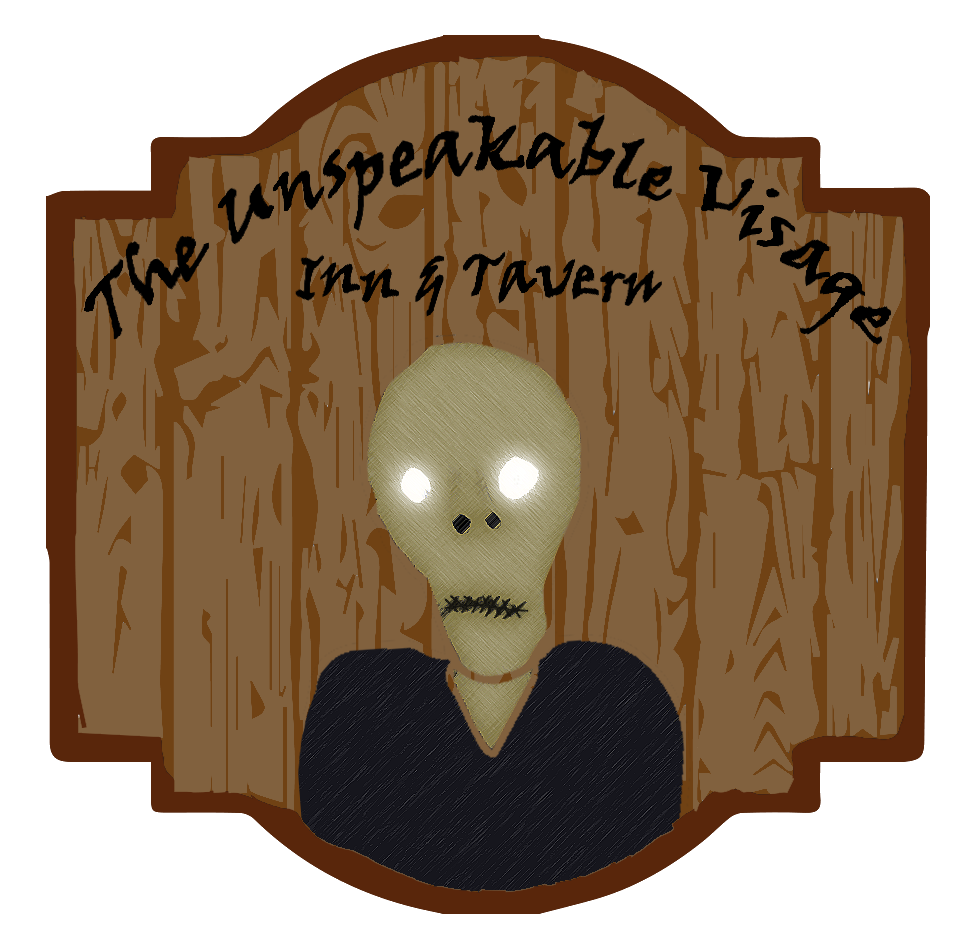
His mouth is meant to be stitched shut. “Unspeakable", see? Ahahahahaha.
Aster rolls a natural 20 on an unprompted Bardic Knowledge check, and remembers an entire story cycle she's heard that was set in this region. As she recalls, some decades ago there was a minor Far Realms incursion nearby, and she heard the dramatized version of the local heroes fighting off the nameless creatures that slipped through. To her knowledge, there are still strange things up in the hills, but not anything that's sufficiently dangerous or organized to pose a real threat to the town. This more or less explains the unusual statuary, paranoid guards, and probably the name of the tavern; the whole event took a bit of a toll on the local psychology.4

The party enters the inn, and finds that the first floor is a tavern filled with raucous drinkers. The inhabitants all seem pretty... redneck-y, for lack of a better term. The sort of person whom one would associate with a rural, huntin' and fishin' and drinkin' lifestyle. They're also a little... greenish-gray, slightly tusky, kind of bulky and hairy... like there's just a touch of orcish blood floating around the local gene pool. They're a long way from half-orc, but might be the sort of person to boast that their great-great-grandfather was a full-blooded Medfudr.5,6 They seem pretty friendly, though, and jovially toast the new folk as they come in.

Bork scans the room for the wealthiest-looking group, and sees some men wearing nicer furs with what appear to be masterwork weapons at their belts; she decides she's going to try and get them drunk so she can scam some money off of them. Bork heads up to the bar and asks for a pitcher of their finest beer, which turns out to be a fairly strange concoction. The substance the barman pours for her is black as pitch and thick as mud; it smells like something profane, moldering, and rotten has been burnt to make it. If the dark beers you can buy in a more conventional bar are “stouts", this might be called a “corpulent", or possibly a “bloated"7. She carries the pitcher over to the table with the wealthy hunters, and announces, “this round's on me!" After a decent Diplomacy roll, the drinkers are very pleased to see her.
Drinkers: Woo! Yeah, drinks on... um..
Bork: Bork.
Drinkers: Drinks on Bork!
Bork sits down to drink with them. The beer is incredibly strong8, but Bork rolls a 24 on her Fortitude save, and is completely unaffected by it.
Bork: What race are these guys? I'm probably, like, twice their size.9
GM: Mostly human. By which I mean each individual is “mostly" human.
Bork eyes the hunters' weapons [Appraise: 16] and notes that everyone at her chosen table has at least one axe, bow, or other weapon of masterwork quality, though she can't tell whether any are enchanted. Aster wanders around the room and makes a very low Gather Information check10, while Bariarti scans the room with detect good. Aster doesn't pick up anything other than the exaggerated hunting stories being told around the bar, and Bariarti doesn't see anyone light up other than Aster. Notably, the hunting stories are a little odd -- there are very few about stags and similar, but "strange tentacular beasties" are apparently valid quarry in these parts.
Bork: So, guys, what's there to do in this town?
Dolyn11: We drink, we hunt... and that's more or less it.
Bork: What's the biggest thing you've ever killed?
Dolyn: I once shot a moon-beast up on the peak of that mountain over there.
Bork: What is that?
Dolyn: It's this great bat-wingèd thing with dangling tentacles and eyes that drive men maaad.
According to the 3e Monster Manual II, this thing is actually a mooncalf -- the moonbeast is the entry on the page right before it, and has no bat wings. To further confuse matters, the term mooncalf originally referred to a deformed cow fetus -- which sounds like it could have been made into a much weirder monster than this thing -- and in Pathfinder, a moon-beast is one of those things from The Dream-Quest of Unknown Kadath. I'm explaining this whole mixup in-universe by pointing out that Dolyn is a hunter, not a scholar; he doesn't place the beasties in a taxonomy, he just places an arrow in their brain-pan.
While Dolyn is telling his story, Bork uses her mage hand to lift his purse from his belt and into one of her belt pouches [Sleight of Hand: 28]. Bork asks Dolyn about how he shot the “moon-beast" in its madness-inducing eyes “without getting induced into madness" -- he tells her the trick is to already be a little mad.
 Bork: I really love stories about men killing big things.
GM: I don't know if you're trying to flirt with him there, but I'm going to go ahead and tell you that's a low-percentage strategy considering you're a giant hyena.
Bork: They're just jealous because I have a bigger dick than they do.12
She then repeats this process with another drinker  -- Otes -- and he tells a wild story about hunting a creature that looked like a basilisk but was made of translucent jelly “as if it had been touched by otherworldly energies."
Bork: How did you kill it?
Otes: From behind.
Bork rolls fairly low on her Sleight of Hand check this time, but Otes rolls even lower on Perception, so she gets away with it. Aster asks about the giant statue in the middle of town, and another drinker -- Teig -- explains that “when the Dread Gate opened fifty years ago, the great hunter Gastornax the Fabulous13 fought one-on-one with a hornèd beast from beyond reality and defeated it so that our town could continue to exist." Bork lifts Teig's purse while he is talking, then ducks into the privy so she can count her ill-gotten gains and consolidate them into her own purse. All together, the purses of the three wealthy hunters come to about 85gp, in varying denominations.

Bork decides that taking more purses would be pushing her luck, but the hunters continue to regale the party with stories. It becomes apparent that the reason they have more money than the others in the bar is because they are employed by an aristocrat who maintains a hunting lodge in town; he pays them handsomely to act as guides to the region and to lend aid if he runs into anything really dangerous. Bork is intrigued by the presence of an aristocrat nearby whom she might be able to rob, and prompts the hunters for more information. They tell her he is called the Marquis de Jezhibal14, that his hunting lodge is only a few minutes away, and that he summers here specifically to hunt the Far Realms aberrations that one still finds in the hills.
Bork: Does he kill them just for sport, or is he a mage harvesting bits of them, or...
Otes: I believe partially for sport and partially for culinary adventure.
Bork: I'm also a fan of culinary adventure.
Aster: I didn't realize you could eat those things.
Otes: Normally, you probably shouldn't. But... well, the Jezhibal Marches is one of those little states down to the south... you know, in the Necrotic Bloc? The Marquis himself is a ghoul15, so I'm assuming that a lot of what he eats is not healthy for actual living people.
Aster: What's it like working for a ghoul?
Otes: Well, it gives you the creeps at first, but eventually you get used to it. And it's not like they're animals -- he knows it's bad form to eat his employees.
Bork: Is he around?16
Otes: Yeah, he's in town. We just went hunting with him yesterday.
Bork: Oh, what'd you get?
Otes: Well, I haven't had time to make up an exaggerated story yet, but we did bag a few rock lizards.
Bork: Oh, rock lizards, fascinating.
Otes: Well, no, they're fairly easy quarry, nothing to write home about -- but the great thing about rock lizards is that if you get their hides tanned, they make good, tough clothing. There's a tannery outside town, and the guy there is real good at making armor and clothing out of animal bits.17
At this point, Aster, who noticed one of the purses Bork took, pulls her off to the side and lets her know that she's going to be very upset if Bork gets them kicked out of the inn before they even get their rooms. Bork heads back to the table, and tries to find out if there are any other nobles in town she could target -- there's an ambassador from the gnoll settlement of Grasp, which Bork has no interest in -- if there's somewhere she can buy magic weapons -- there's a talented smith in town who can forge enchantable-quality stuff, and knows where to contact people to do the actual enchanting -- and if any of them have magic weapons (presumably so she can steal them) -- Teig has an axe that can neutralize acid, which Bork thinks is boring.

Aster goes off to listen at other tables, and makes another Gather Information check -- she gets a 17 this time, and hears someone mention that there's a powerful magic-user who lives in a cabin way up in the hills -- a crone by the name of Old Mother Rictus. Soon after this, the party retires for the night -- they're the only outsiders in town, and the rooms are cheap, so they can each get their own. For a little while, sleep is difficult, because some of the drinkers downstairs are playing the pipes very badly, and the atonal, discordant music keeps them up.

Bork does not go directly to sleep, but instead sneaks out the window to go a-burgling. She decides that the smithy sounds like a safer target than the Marquis's lodge, and is able to find it with little difficulty. After checking that there is nobody watching, she takes 20 to pick the lock, and slips in. According to her Appraise check, there are a couple swords hanging on the wall that have elaborate designs -- at least masterwork, possibly enchanted -- and among the metal ingots sitting by the forge are a few small bars of mithral. She decides taking the swords would be too conspicuous, so she grabs two bars of mithral and leaves. Considering what to do with them, she eventually makes the very canine18 decision to bury them in the dirt floor of the inn's privy and come back for them later. Bork then heads back to her bed.

NPC Interlude -- Old Mother Rictus

Old Mother Rictus sat hunched in her cabin, breathing in the scent of the herbs she had burned in this room every day for -- oh, so many years. Across the table was a visitor. She got a lot of visitors like this one; nervous men and women, criminals with mundane concerns like the value of a stolen wand or how to evade the guards who even now chased them down. They were boring people, but very... profitable. She grinned at the visitor, her thin, dry, cracked lips stretching over unnervingly strong and sharp teeth; this grin, the one that came at opportune times and was just a little too wide, was her trademark now -- it put the visitors in the right frame of mind.

“What can old Mother Rictus do for you, dearie?" She asked, solicitous kindness not fully covering the eager, hungry greed.

The visitor placed two items on the table. “What are these?"

Under Mother Rictus's arcane sight, the items flouresced with strange colors, shades one only sees if one has the Sight. The patterns in which the colors moved were... interesting. Something she hadn't seen in a long time. “I can tell you," Mother Rictus said, “for a price."

Mother Rictus never charged in anything so mundane as gold. It had long since ceased to amaze her at what people would give for such simple spells. Mother Rictus named her price, and the visitor blanched, but agreed. 

“Hold on just a moment, dearie." Mother Rictus hobbled back further into the cabin, and rummaged through her pantry before producing a small jug of wine. She made the wine herself, from tannersblossom and weepingberry, plants that grew in some of the deeper valleys. The taste was passable, but it was mostly for this sort of thing. From a hook hanging on the wall, she retrieved a large brown feather, its quill having been carefully silvered and attached to a ring from which it could hang. Some years ago -- many years ago -- she'd demanded a dozen of these from a local hunter in payment for a spell; it was from an owlbear. Finally, she opened a cabinet and retrieved a shallow clay bowl.

Mother Rictus returned to the table, and poured the wine into the bowl, then carefully stirred it with the feather, whispering incantations under her breath. She poured the wine over the items in front of her; if one was looking closely, as she was, one might see that the wine never quite touched the items, but turned into vapor a fraction of an inch from their surface. To Mother Rictus's eyes, the vapor spiraled into larger, clearer, more detailed imitations of the invisible magical patterns that covered the statues, showing clearer gradations of the shades of arcane coloring. She nodded, satisfied.

“Now give me your arm, dearie. This'll only hurt a moment." The visitor flinched, but followed instructions. Mother Rictus gripped the arm before her with unexpected strength, and, with the index fingernail of her other hand, quickly and expertly carved a complex symbol into the flesh. It healed, leaving no trace, as soon as it was done. “Good. Now --" She told her visitor what the items she had brought were, and grinned as the visitor's eyes grew wide and avaricious. Yes, this one was worth watching, at least for a little while. 

“Better hurry, dearie," she said. “Your friends will be waking up in just a few hours; if you leave now, you'll be able to get back to town and take care of business before they do." The visitor looked at her with naked surprise. “Oh, yes. Mother Rictus knows, dearie. Don't worry, though; it's none of my business."

Some time after the visitor hurried out of her cabin and back down the winding road -- a path that had been formed, not by design, but by decades of people walking from the town to see Old Mother Rictus -- she whistled softly into the night air, and one of her little helpers soon loped into view, its four delicate hooves leaving almost no impression in the dirt, with something clutched in the jaws of its great wedge-shaped head. “What have you brought for me, Tsega?"

Tsega spit a dead snake onto the ground, and Mother Rictus picked it up. “Perfect. Would you like to watch?"

“Yesss."

Mother Rictus fetched the rest of the jug of wine, and poured it into a large brass bowl she kept on a pedestal out back; the ignorant might have mistaken it for a birdbath, though birds only landed there when she needed one. She slit the snake open with her fingernail, and threw its entrails into the wine. Lighting the candles that circled the rim of the bowl, she whispered some incantations and watched. The entrails formed shapes, which soon acquired detail and color -- and she was watching her visitor, back in the town, creeping into a room. 

“That's the one who came here tonight," she explained to Tsega. “To identify some unusual magic items. But, of course, the items belong to that one in the bed, so there's a problem." 

Tsega laughed in his high-pitched way.

The visitor looked at the items, then at the sleeping figure -- then grabbed a candlestick from beside the bed, and with a practiced, precise, violent effort, struck the figure at the base of its skull. It went from sleeping to unconscious with barely a transition between. With care, the visitor lifted the sleeper over its shoulder, and headed towards the window.

“Wherrre do theyyy go?" Tsega asked.

“I expect," said Mother Rictus with a secret smile, “that they made sure to find out the best way in this town to get rid of someone inconvenient."

Tsega grinned, and the pair watched the scene in the bowl carry on.


1. I regret not having made a different horrific beast" follow the party, invisible to them but not to others, and just letting the party assume the guard means Bariarti.
2. The “zh" is meant to be pronounced /ʒ/ -- many European languages would skip the “h" and write “ž", but computers are often touchy about diacritics, so I stopped trying to use them. So it's /ir.ʒi.hal/.
3. Which I then, like some sort of sucker, pronounced as /dʒɛz.hi.bal/ instead of /dʒɛ.ʒi.bal/.
4. The town is actually so weird because the general feel was inspired by Laird Barron's short story “Hand of Glory", but even a natural 20 doesn't let Aster's bardic knowledge extend to out-of-game material.
5. One of the better-known orcish tribes of the Afnung Mountains. It roughly translates as “Bear Kicker".
6. As I write this, I'm filing away the idea of playing a character who has just a tiny bit of non-human heritage -- not enough for it to affect his stats in any way -- but brings it up every chance he gets. “Actually, I'm 132 elven, so I know what I'm talking about." Then again, that might be the sort of character who ends up "heroically" dying by GM fiat; that's what happened to my Neanderthal character Og after one session of “this remind Og of time Og hunt great mammoth."
7. Bork's player is more knowledgeable about beer than I am, and after she asked what type of beer the Leering Lamprey's “good" brew was -- and all I could come up with was “brown ale" -- I decided there should be a more interesting answer to that question in the Unspeakable Visage. Her reaction to my description of the odor was, “oh, a smoky beer then; hmm."
8. In modern terms, it's somewhere around 15-20% ABV -- so much less than, say, gin, but much more than normal beer.
9. Gnolls are at least seven feet tall. Since, in my setting, gnolls have a society based directly on their spotted-hyena counterparts, the women are noticeably larger than the men, meaning Bork would be significantly above seven feet. So not twice their size, but bigger.
10. I house-ruled the skill back in. Having it as a subset of Diplomacy just doesn't make sense to me, and Aster's player uses it a lot but never seems comfortable with rolling Diplomacy when she's trying to overhear something or trying to look stuff up in books. While I could rule that those actions are a Perception check and a Knowledge check respectively, it just makes things smoother to have a single skill for general information-gathering.
11. Bork didn't ask for the names of any of her drinking companions, so I didn't give them any. It is only now, in this write-up, that I am assigning them these so that I don't have to call them “Drinker #1" and so forth.
12. Bork's player has familiarized herself with the anatomical peculiarities of female spotted hyenas (hyenae?). If you are feeling inspired to look up the details, I advise not thinking about them too much, especially if you are the type of person to wince when you see an unpleasant injury on television.
13. I paused trying to come up with a name, and Aster's player immediately dropped in “Gaston". I tweaked it just a little in case I wanted to re-use the story in a future game, but after being reminded of Gaston -- nobody cleanses the land of beasts from beyond the walls of sanity like Gaston! -- the only thing I could think of as an epithet was “The Fabulous". I now have a growing table of NPC names from various species and cultures so I don't end up naming anyone after Disney characters out of desperation.
14. Sigh...
15. For years now, I've been kind of irked by the standard game depiction of ghouls as feral creatures living in crypts. I mean, that niche is pretty well filled. Ghouls are not only intelligent undead, they're smarter than the average human. Pathfinder gives ghouls these mental stats -- Int 13, Wis 14, Cha 14 -- and then tells us “Ghouls are undead that haunt graveyards and eat corpses," and “Ghouls lurk on the edges of civilization (in or near cemeteries or in city sewers) where they can find ample supplies of their favorite food." Why do they do that? They aren't just smart, they have charisma -- and since it can't possibly refer to physical attractiveness in this case, that must mean they're really fast talkers and have a strong force of personality. They should be cunning, clever, leader-type monsters -- more like a vampire than a zombie. Plus that allows for the scene of a group of ghoul aristocrats inviting the PCs to join them for a banquet -- oh, no, as guests, not as the food, don't be silly, you're such a card, Sir Jeff -- here, have some leg of rotted elf. And then the GM describes in detail the unnaturally mobile jaws, long tongues, pointed teeth, and the substance on which they are -- in a genteel way of course -- consuming... and the players decide to go play something else, probably. Besides, having the PCs encounter a bunch of ghouls in a cemetery is creepy and evocative, of course, but that always brings up questions like, “so how many people are buried here? And how many ghouls is this supporting? For how long?" Basically, an undead creature whose defining characteristic is that they eat suddenly has an ecology to worry about. So, in my setting, ghouls are usually the smooth-talking servants of someone powerful -- or, in the Necrotic Bloc, they often are the power.
16. Out of character, Bork checks to make sure it's actually summer. Oculi 16th is equivalent, on our calendar, to June 17th, so it is.
17. This is my “hint, hint, remember you're carrying around all that ankheg chitin, maybe you should do something with it."
18. Yes, I know hyenas aren't actually canine, but just look at them -- don't you just want to give them ear scritches and belly rubs and cuddle them?
Lookit the little baby
(Picture from the Cincinnati Zoo -- it's an aardwolf, the smallest member of the 
Hyaenidae)

Monday, July 24, 2017

The Hungry Sky, Chapter Five

In Which

A Journey Begins ⁂ The Snail Flails ⁂ Firing into Melee is a Bad Idea ⁂ Bariarti Meets the Critical Hit Table ⁂ Nocturnal Attackers Figure ⁂ Death by Shoulder-Tap ⁂ Evil is Smitten ⁂ Aster Makes Numismatic Deductions

Oculi 13th, 211 Ravensblood (Feast of Saurivuntyr)

The party, having been notified that Fritha wants to get on the road in the near future and this may be their last full day in Stagnant Lake for a while, consider whether they have anything they still need to take care of. They generally conclude that they do not, and, in the words of the GM (i.e., my own recorded voice), “the day is generally uneventful and not worth recording."

That evening over dinner, Fritha informs the party (and Fluryka) that they should leave at dawn the next day in order to follow her preferred traveling plan. Sticking to the main roads would take weeks, but if they're willing to make a slightly riskier overland journey, they can reach the port town of Hoturla in just a few days and buy passage on a ship to Verunn. If they leave town early enough tomorrow, they can reach the Tomb of St. Tris1 before dark, and thus sleep safely with the knowledge that they are surrounded by paladins. From there, they'll have to find their way through the foothills to Ang vy Moir, which will involve at least one night of camping, but Ang vy Moir has walls and an inn, and then it's only a day on the road to Hoturla. 

The party also has to decide whether they want Brother Saros travelling with them, given that he's somewhat irritating and gives them a weird vibe. They do, however, eventually agree that the greater access to healing is worth it.
Aster: If he's with us, we can keep an eye on him.
Bork: If he's with us, we can kill him in his sleep.
It is a minor side note that this day was also the Feast of Saurivuntyr, and a small banquet was held at the Tower of Eyes, local headquarters of the Royal Intelligence Corps, a few miles further along the lake's coast. The PCs were not invited.

Oculi 14th, 211 Ravensblood

The next morning, the party sets out, their numbers effectively doubled by the trio of NPCs with them. The road to St. Tris is not traveled very frequently; pilgrims visit there, and they buy food or other supplies from Stagnant Lake, and the occasional person in search of a high-level healer might find their way to the monastery, but generally the traffic is barely enough to warrant the existence of the road. Aster tries to make the day's walk2 more cheerful:
Aster: Fritha, do you know any good stories?
Fritha: That's an... interesting question. [pause] The answer to which is “no".
Aster: Well, I do. Would you like to hear one?
Fritha: If that helps pass the time.
Aster OOC: Whan that Aprille with his shoures soote / The droghte of Marche hath perced to the roote...
The summer sun is hot, and the dust rises around their feet as they walk. On either side of the narrow, sporadically-maintained road, the tall yellowish grass that characterizes the area refuses to wave in the lack-of-breeze. The buzzing of insects and occasional rustling of snakes goes gradually silent, and the PCs make Perception checks. Bork gets a 25 3, and is able to alert her companions to a strange scraping from underground, and the vibrations of movement in the soil. Thus there is no surprise round when the ankhegs burst from the soil...
From the 2e Monstrous Manual
Three ankhegs menace the PCs. Ankhegs, for the uninitiated, are ten-foot-long, carnivorous, burrowing insects with acidic saliva, so this is tremendously inconvenient4. Fluryka and Saros take the first opportunity to flee combat and leave the fight to others, being as they are unarmed. Bork manages to stab one, and it retaliates by gripping her firmly in its mandibles for significant damage. Another spits acid on Aster, Bariarti, and Saros -- who apparently didn't move far enough away. Bariarti slithers into battle with a flail; one assumes that Bariarti's player, as a long-time gamer, did this intentionally in order to invoke a “flail snail".

A flail snail, again for the uninitiated; a monster from the 1st-edition days generally considered to be absurd.5
I believe it was actually revived for 5e in the recent Volo's Guide to Monsters.
Some relatively unremarkable combat proceeds, in which Bork is crushed some more in the ankheg's mandibles, and Saros delivers some healing. One of the ankhegs then manages a critical, followed by a roll of 93 on the d100 critical table, and bites off one of Bariarti's hands. Aster manages to respond with her own critical, and does a whopping 6 damage with her halfling-sized crossbow; Bork finally kills the one grappling her. Fritha decides to fire into melee a few times, and manages to put more than one crossbow bolt into Bork over the course of the fight. Eventually the party kills two of them and drives off the last.

Once combat has ended, Fluryka returns from her hiding place in the grass and drops some wisdom: apparently you can use every part of the ankheg, or at least goblins do. She mentions to the party that not only are they edible, but you can make passable armor out of ankheg exoskeleton. Bork collects the biggest bits laying around for future armorsmithing, and Fluryka decides to cook some of the flesh up for lunch. It tastes not entirely unlike lobster.

That evening, they arrive at St. Tris and head straight to the monastery to see if someone can put Bariarti's hand back on. The monk they meet in the entrance hall is pretty skeptical, and even asks if Bariarti is some sort of demon they've brought into their monastery, on the grounds that he's never seen anything that looks like him and belongs on this plane of existence. He also asks whether they're sure his species normally has two hands; Bork produces the severed one from her pack. It turns out that the abbess is actually sufficiently powerful to do such a thing -- it's a real stroke of luck that this happened when the party was already on their way to a significant religious outpost.
The Tomb of St. Tris, in the foothills of the Afnung Mountains.
The monk is insistent on a sizable donation to the church for such a service, and is openly doubtful that this strange group of people has that kind of money on them6. Bork tries and fails to convince them to bill the monks who brought them back; the monk tries to convince Bariarti to agree to undertake a quest-to-be-decided-upon-later; eventually it turns out that Bariarti's player spent very little of his starting budget, and produces the requisite 1000 gold pieces. For this donation, the abbess takes time out of her busy schedule and ushers Bariarti to a consecrated altar, where she chants over him for nearly an hour until his hand reattaches itself.

The party then heads to the Civilian Quarter, on the monks' advice, where pilgrims can generally pay a local to let them sleep on someone's floor. (Fluryka, who is used to sleeping in real beds, insists on this.) Aster makes a low Gather Information roll, and finds an elderly man who used to be a cook at the military academy; he has enough room on his floor for two people, and that ends up being Fluryka and Saros. Bork, who doesn't mind sleeping outside but didn't buy camping gear, curls up on the ground outside like a dog.

Oculi 15th, 211 Ravensblood

Aster and Bariarti go to morning service at the temple, to hear about valiant adventure and the cleansing powers of fire. Bork idly considers “derail[ing] the entire campaign to plan an elaborate heist on the monastery and get our thousand gold back," but decides against it. Before the party leaves, they stop by the barracks to see if they're willing to part with some of the equipment they keep around for the paladins. They procure some traveling supplies so Bork has something to sleep under; Aster also takes a look around their armory and manages to buy a masterwork longsword with really nice scrollwork on the hilt. They then leave St. Tris on the grounds that there is no tavern and it is therefore a boring town.

As they leave town, Fritha warns them that this next leg of the journey is likely to be dangerous, as there is no established road. They should also plan to camp tonight, as they're definitely not going to reach Ang vy Moir before dark. The party moves through hills and valleys along a path that's not so much a road as a game trail; the day goes by fairly uneventfully, despite the ominous milieu. Before they make camp, Aster organizes a watch schedule. Fritha volunteers for first watch, and Aster for third. After some back-and-forth between Bariarti and Bork, Bork reluctantly agrees to take second watch on the grounds that she has a much better track record at spotting things than Bariarti.

This turns out to be beneficial, as not long into Bork's turn on watch, she spots a pair of shadowy figures moving silently towards the camp. Their use of stealth is actually very impressive, but gnolls have sensitive noses and the intruders smell terrible. Bork decides to use her rogue talent of “minor magic" and taps one of the approaching figures on the shoulder with mage hand.7 A successful Bluff check causes it to actually look around, and she shoots it while it's flat-footed, causing it to barely bite back a scream of pain. If they weren't hostile before, they are now. The two figures head out of the shadows -- allowing Bork to identify them as bugbears -- bothering much less with stealth. Some failed Perception checks on the part of the five sleeping members mean that literally nobody wakes up until Bork shouts.
Bugbear, from the 2e Monstrous Manual.8
The two that Bork spotted earlier proceed to clobber her with their morningstars, and two that had been successfully making their Stealth checks until now hurl javelins from the other side of the camp. Aster starts singing for her inspire courage effect, and the noise finally wakes Fritha, though the other two NPCs appear to be unusually heavy sleepers. Bork tries the “tap on the shoulder" trick again -- on the same bugbear -- and he fails his Sense Motive despite the penalty given for this trick already being done; she then gets a critical hit on her attack of opportunity, and kills him outright with a stab through the kidney. Bork's player makes it clear to all that her “laughing uproariously" should be considered as in-character.

Fritha's signature firing-into-melee move actually works out in this fight, and she does a small amount of damage to the bugbears. Aster shoots off one of the bugbears' thumbs on a critical that does all of two damage. Bork reduces the other one in melee with her to exactly zero hit points, so that it's unconscious but alive. Bariarti successfully smites evil for the first time, but rolls terribly low on damage. Aster takes down the one missing a thumb, and Fritha goes to poke the unconscious one to see if it's dead or not; the final bugbear flees, and manages to evade Bork's attack of opportunity by a hair.

There is some discussion about whether to interrogate the unconscious bugbear or kill it outright. Bork wonders out loud if they're actually sapient, and Aster points out that they're smart enough to use javelins; Bork is of the opinion that a sufficiently motivated dog could throw a javelin, so that doesn't prove anything.9 It is, however, fairly common knowledge that bugbears are just a variety of goblinoid, and are known to be sapient even if the fact that they're carrying weapons and wearing armor isn't enough to convince Bork. Bariarti wants to just kill it -- his smite evil worked on one, so as far as he's concerned, his god wants them dead. Aster convinces the party to bind it instead, then wake it up and ask it questions. The interrogation proceeds as follows:
Bork: Why did you attack us? (Intimidate: 23)
Bugbear: What? It's just -- I mean -- you know -- a good night's fun.
Bork: [glares]
Bugbear: Right, right, so it was a hit. But we were hired through an intermediary; we don't know who wanted it done.
Bork: Intermediary?
Bugbear: Just some guy, you know? He -- they -- just showed up with a message.
Bork: He or they?
Bugbear: Look, I don't know how to recognize human genders.
Bork: But just one person?
Bugbear: Yes. One guy. Could have been a chick. Dunno.
Aster: But human.
Bugbear: Yeah.
Bork: What did they say?
Bugbear: That if we saw a hyena and a snail traveling together, we should ambush them and try to kill the whole group.
Bork: I'm a gnoll, you racist fuck.
Bugbear: I don't have time for political correctness.
Bork: Yeah, you don't have time because I'm going to cut off your head if you don't give us the answers we want.
Bugbear: Hey, I'm cooperating. Cooperating. I'm answering, aren't I?
Bork: Are you sure it was a human who hired you and not, like, a frog?
Bugbear: I think I would have noticed.
Bork: I dunno, you're kind of dumb.
Bugbear: You're kind of dumb.
Bork: I killed your partner by tapping him on the shoulder in the middle of combat.
Bugbear: He was kind of dumb. Look, I gave you your answers. Are you going to let me go?
Bork: I'll let the paladin decide. Was the person who hired you wearing any religious symbols or weird jewelry?
Bugbear: Not that I saw. They were dressed like a human. Doing human things.
Bork: What did they pay you?
Bugbear: They gave us a bag of gold.
Bork: Where's the gold?
Bugbear: With the rest of the tribe.
Aster: [Sense Motive] Liar.
Bugbear: All right, it's on the dead guy over there.
Bork: Paladin, he's all yours.
Bugbear: Remember I cooperated! And I'm unarmed!
Bariarti clobbers him to death with his flail without apparent moral compunction as Bork loots the bodies. She does indeed find a bag with 21 gold pieces in it, as well as a necklace of scrimshawed human teeth and a small wooden tribal totem. Aster's bardic knowledge identifies the carvings on the totem as being characteristic of Tribe Drool-Dark, a nomadic tribe in the foothills that is known for ambushing travelers for fun and profit.
Bork: Want to go slaughter their families too?
GM: Whoa.
Bork: He's the one that killed an unarmed man!
Aster: Yeah, I kind of feel like that's un-paladin-like.
Bariarti: [shrug]
Aster: I guess it depends on the god.
GM: Grandfather Kraken is pretty hands-off.10 His paladin status is not in danger.
Aster also wants to examine the coins in the bag and see if they come from anywhere in particular. This actually reveals something interesting -- all of them are coins minted in the now-defunct Necrocracy. They are still the currency of choice in the dozens of tiny fiefdoms south of the Afnung Mountains where the Necrocracy used to be, now referred to as the Necrotic Bloc. Though they are not uncommon sights in general circulation, it is unusual that the entire bag is Necrotic currency.
Necrotic currency is easily identified because of the onyx incorporated into the design. Though the metal is copper, silver, and gold-colored in order to match the schema used by neighboring countries, it's actually just cheap alloys; the value of the currency is based on onyx. Copper “scythes" have almost-negligible amounts of onyx dust mixed into them; silver “chiefs" have a small shard through the center; and golden “dances" have a thin slice inlaid on the reverse. Another unique aspect of Necrotic currency is that the “platinum piece" has been eliminated in favor of the “eye", which is a thin ring of tarnished bronze around a flat disc of onyx, valued at 25 gold pieces; the onyx discs used are of sufficient size and quality to use in the creation of undead, thus giving them inherent value.
The party discusses how much they can deduce from that, and then splits the coins three ways. Bork informs Fritha that she earned a gold piece for actually shooting an enemy this time, but she owes Bork a gold piece for shooting her yesterday, so it's a wash. They then (mostly) return to sleep.


1. St. Tris, in life, was actually a PC in a previous campaign some years ago -- the first campaign in this particular world, in fact. She erred on the “good" side of “Lawful Good" and tended to solve her problems with fire and sword. After spending some of her afterlife as a saint of Pelor, she became a demigod in her own right after Pelor abandoned the world in the Great Holy War. Her worshipers are few, and her only temple is the one by her tomb. Her doctrine is mostly about being an active force for good in the world, with a strong undercurrent of “smite evil first, and ask questions later". Most of the permanent residents of the “town" of St. Tris are either monks or paladins-in-training -- her church maintains a highly-specialized military academy.
2. Not only were they unable to find any mounts for sale in Stagnant Lake, Bariarti is physically incapable of riding anything, so going on foot is really their only option.
3. Bork OOC: Not only do I hear what you're having me roll for, but I can hear the dreams of my compatriots.
4. It should be noted, however, that they do wonderful things for the quality of the soil. I'm not making this up.
5.  Though Zak S. said the following nice things about it here:
Ok so a flail snail is silly but, really have you ever looked at a snail? A snail is fucked. In a line drawing on a Hallmark card a snail is just a wiggle and a spiral, but in reality a snail is a gross fucking monster from hell. Imagine that slick, slightly pocked, stretching moist slugskin forming the spheres and spikes of a morning-star-shaped faceless-vegetable-like unface and then wanting to touch you with it. If you still don't get it, watch that scene in Microcosmos where the two banana slugs mate on a rope of their own slime while an aria plays in the backround--a thing like that pounding on you with its own eyeless faces would drive you insane. See? Ok.
 (In context, that counts as saying nice things.)
6. This is actually on me -- I thought spells of that level were more expensive than it turns out they are. We spent a solid fifteen minutes at the table conversing with the monk before I checked the cost and found out it was more affordable than I thought.
7. Or, you know, telekinetically prods their shoulder in such a way that it feels like a finger tap.
8. From the setting document: “Bugbears are yet another variety of goblinoid, and the same sort of questions about whether they’re a subspecies or… what, exactly, tend to float around. In general, however, they are a combination of the worst traits of their goblinoid cousins: the strength and organization of hobgoblins, but the bad attitude and destructive tendencies of goblins. Not only are they big enough to take pretty much anyone in a straight-up fight, but their personalities tend to range over the spectrum between ‘asshole' and ‘serial killer' — with the occasional spike into ‘war criminal'. They tend to stick to small, mobile groups — not so much because that’s their preference, but because larger groups tend to collapse into infighting and any more permanent settlements end up in conflict with their neighbors. Of course, since nobody is ‘always Chaotic Evil', there is in fact a decent-sized bugbear settlement to the far north — Putiurl — where those who don’t fit into traditional bugbear culture often settle."
9. Bork OOC: Some people do agility courses with their dogs; we do random sadistic javelin throwing.
Bariarti OOC: That's basically reverse fetch.
10. Tentacles-off.

Wednesday, July 19, 2017

The Hungry Sky, Chapter Four

In Which

Monks are Spoken Sharply To ⁂ Research is Performed ⁂ Some Acquaintances are Made ⁂ Prophecy is Trusted Blindly ⁂ Bork Acquires Eel Jerky ⁂ “Weird Fish"


(For the reference of people reading this, I'm putting a link here to some relevant maps.)

The party decides that they need to get some more information about that prophecy. Most of the stuff that needs looking up is the list of things that they should “beware".
For reference.
Aster is pretty certain that the “Turning Wheel" refers to the Church of the Eternal Cycle, as mentioned in the previous post, and she thinks she remembers a legendary place called the Land of Sharpened Beaks. Also, according to a successful Knowledge (nature) check, she is aware than an epilimnion is the uppermost layer on a lake. Additional research, they've decided, is in order.

The party proceed to the Order of the Stagnant Lake, where the door is answered by a skittish-looking young woman in a monk's habit. They ask to speak to Father Repose, but the woman at the door -- Acolyte Restful -- is unwilling to bring them to him. The party asks to be given all of the information that the monastery has on the prophecy; Restful insists that there is no information the monastery has that the party does not, as they believe, with complete faith, that fate will ensure everything works out the way their god said it would, and the don't want to interfere. Further badgering by the party gets Restful to admit that there was one additional note with the prophecy, but it only gave a date and time.

Bork asks who decided which people would be brought back to fulfill the prophecy; Restful explains that the monks just followed their intuition and trusted Qualmë to take care of it. They will not be deterred.
Bork: We still want to talk to Father Repose.
Restful: He's quite busy.
Bork: You told me he was deep in prayer. That doesn't sound busy.
Aster: Technically, that is an occupation.
Restful: It's kind of what we do here. That's what being busy in a monastery is.
Bork is exceptionally pushy and intentionally dense until Restful agrees to go fetch Father Repose.
Aster, to Bork: I do believe the word is “obstreperous." Is that a good word for you?
Eventually, Father Repose comes to the door, and is irritated because the party is “supposed to be out saving the world." Upon some questioning, he says he knows very little about the Church of the Eternal Cycle. They are surprised by this, since the prophecy he gave them warns them about the Turning Wheel, and they think the connection is pretty clear.
Father Repose: You know, I never thought of it that way, but I can see the argument. I knew y'all were the right people for the job -- you're really on top of things.
Bork is increasingly incredulous that the monks have not done any research about this prophecy at all; Bariarti thinks that trusting in fate and the gods makes perfect sense for a religious order, and he is the paladin here. Finally, Aster asks if the monastery has archives, so they can see if previous monks have put any thought into the meaning of the prophecy. Father Repose shows them into the archives; Bork, as someone uninterested in archive-diving, wanders out into town with the idea of finding other members of the Church of the Eternal Cycle to question.

Bariarti decides to also trust in fate, and read scrolls at random. He finds a scroll that lists the “temple names" of every monk who has been here1. Aster, following actual research strategies and rolling for her attempts, also finds little of use -- however, she does find a scroll mentioning the arrival of a people called the Kech, who claim to be from the “Land of Sharpened Beaks" and are described as having long, tangled, sloth-like hair. The monks don't seem to approve of them, because they appear to be exclusively loyal to the god Jivmarana, who is a much less pleasant god of death and a rival of Qualmë. Aster, of course, recognizes the description of the Kech as matching the people who they fought in Fritha's room last night.

Bork heads to Market Field to see if she can convince anyone there to give her stuff and send the bill to the monks. She looks for the most expensive items she can find, but it's a really small town, so the best she can find in that respect is a stall selling miscellaneous leather goods. After some more poking around, she ends up deciding on buying some eel jerky to supplement her trail rations. However, she can't seem to convince the vendor (whose name, not that she asked, is Voktu Tribe Scum-Stone) to just bill the monks for the purchase.
Bork: Are you aware that I was dead? They brought us back from the dead in order to save your sorry ass.
Voktu: What, me specifically?
Bork: So if you don't help us out, I will ensure that the forces of darkness descend directly on you, and your tiny pathetic little skull.
It turns out Voktu is easier to persuade through threats, and he lets her take a big sack of jerky on the promise that the monks will reimburse him later.

Aster and Bariarti, meanwhile, head over to the town library, which is much more extensive than the monks' archives. Aster has a really cheerful conversation with the librarian, a fellow halfling named Wisteria Leagallow. Wisteria helps Aster find a dictionary, in which she discovers that the word “benthic" means “of, relating to, or occurring at the bottom of a body of water".
Bork OOC: So the bottom of the top of the lake? Fuck you.
Aster's next priority is to learn more about the homeland of the Kech. Wisteria informs her that they most recently came from the far south of this continent, an area that explorers have only rarely visited, but folkloric accounts indicate their original homeland was elsewhere. She helpfully directs Aster to the folklore section, where Aster finds the following in a thick encyclopedia of folklore from the Doldrum Marshes:

While this is going on, Bariarti decides to scan the shelves with detect good. He considers his ability to detect good as the Kraken calling his attention to things that are important and worthy of protection, so if any books light up, he'll assume they are worth reading. Sadly, a roll of the dice indicates that there are no inherently-good books in this library -- which, one assumes, would be something like the polar opposite of the Necronomicon.

Aster reads the list of things they are meant to beware to Wisteria, hoping that she can help.2 She thinks she remembers “feathered scale" being used to describe a particular creature in poetic terms, but can't remember what that creature is. Wisteria, however, does know a local bard who is very interested in folklore, and suggests Aster stop by the Leering Lamprey to speak to a black-scaled kobold named Blik the Sirenical. At this point, Aster and Bariarti can't think of anything else they need to look up, but before they leave, they mention to Wisteria that they've heard there's a circus in town -- and promptly discover that they are the circus, at least according to rumor.
Aster: I was looking forward to the circus, too. Oh well -- I suppose you can't get everything you want.
Wisteria: But if you try sometimes, you just might find you get what you need!
Aster: You know, my da used to say that.
Wisteria: It's an old halfling saying, from, I believe, a man called Mossy Rollingstone.
At this point, Aster and Bariarti decide to head to the market themselves, having accomplished their research here. Aster augments her rations with some hard, long-lasting bread and some pickled vegetables. They then decide to just kill some time until they can catch Blik at the tavern; Aster practices her fletching back in her room at the inn. While she's there, she runs into Fritha, and discovers that her intention is to walk to a coastal city a few days away, then buy passage on a ship to Verunn.

They then head to the Leering Lamprey. Bork gets some more beer on credit -- the bartender having already been convinced that he can send her bill to the monks -- and also requests some food. The bartender -- whose name, incidentally, is Kobrun Tribe Scum-Stone -- offers some fish, as this is more or less the only food they have at their rundown dockside tavern.
Aster: What's the house specialty?
Kobrun: Whatever we have on hand -- we are right next to a lake. We serve whatever we caught recently.
Aster: What's freshest?
Kobrun: We found this weird fish crawling out of the lake a few hours ago. That happens sometimes; we get weird fish around here.
Aster gets some eel, and Bork gets a plate of sashimi. They request to see the “weird fish", which looks something like this:
Bork asks Kobrun to cook it for her, and he obliges. They then sit back to listen to Blik's singing, which is all traditional kobold ballads, mostly about dragons. When she next takes a break, Aster intercepts her and says that Wisteria has suggested she would be a good source for folkloric information. Bork diplomatically pours her some beer, and offers her “some weird fish and sashimi".
Blik: I love fish. Especially the weird ones.
Aster gets Blik talking about her studies. Blik, it seems, studies dragons, which have been apparently absent from this region for centuries -- and the reason she's performing in this random tavern is because she once asked a seer where a dragon might be seen in her lifetime, and he told her to go to the Stagnant Lake. He didn't say when, though, so she's “just kind of hanging out". Aster floats the phrase “feathered scale", and Blik suggests that it might be referring to a xocothian, a creature that lives on the border of the elemental planes of Air and Water3.

Blik eventually goes to start her next set, which is more traditional kobold ballads. She admits that they don't go over terribly well around here, but she's the only professional bard in town, so the audience kind of has to put up with it. The party spends the rest of the evening relaxing at the tavern, and then heads back to the inn for the night. Fritha, they know, wants to get moving within the next few days.


1. Bariarti's player asks if any of the names seem particularly ominous or have double meanings -- I inform him that, since part of this god's portfolio is death, a lot of them seem kind of ominous. Current monks of the order include “Brother Cenotaph", “Sister Scythe", “Acolyte Sepulchre", and “Acolyte Charnel". 
2. Bariarti does suggest, out of character I think, that “The Devil's Arms" would be a great name for a bar. (We have dibs on that name now, BTW.)
3. One might argue that the fact that information about such an obscure creature being so easily found by the PCs might indicate that fate is, actually, working on their side.

Wednesday, July 5, 2017

The Hungry Sky, Chapter Three

In Which

The Guard is Called ⁂ Dead Bodies are not Thrown out the Window ⁂ Statues are Examined and Remembered ⁂ “I identify as a zombie" ⁂ The Party Acquires Traveling Companions

Back in the Exarch's Arms, the party is continuing to offer their assistance to Threefingers, who eventually concedes that it would be convenient to have competent people travelling with her, so that she doesn't have to wait for a caravan. First, however, she wants to stick around for a few days and see if anything else unusual comes up. It also comes up that her actual name is Fritha Doonasdochtir -- “Threefingers" being, of course, a nickname. 

The conversation then turns to the dead bodies that Fritha would prefer not to have cluttering up her room. She suggests that Bork help her heave them out the window; Bork seems to think it would be a better idea to throw them into the town's well. At this point, Bariarti intervenes to remind them that the town guard are coming, and they'll probably want the bodies. The toad-creature, still frightened of Bork, nonetheless finds the courage to voice a suggestion that they be respectfully burned on a pyre.

NPC Interlude: Ralph Rudhall

Constable Rudhall of the Stagnant Lake Town Guard was not a particularly formidable-looking individual. He was a heavy man with hair that was distinctly thinning on top, and a set of florid jowls. His face was constantly red and sweaty, as if he had just run a mile, even if he hadn't exerted himself at all. However, beneath the jowls and the layer of fat, Constable Rudhall had an impressive amount of muscle hidden. He could knock a man out with one punch, and he was known in town for his strategy of ending brawls by simply lifting each combatant in one hand and carrying them to the holding cells -- easier to do when the offenders were usually goblins, but still nothing to sneeze at. Behind his piggy little eyes, however, lurked an intelligence best described as “exactly what you'd expect"; Rudhall was just as slow, dull, and unimaginative as he looked. 

This here picture of Sgt. Fred Colon just appeared in this space all unaccountable-like.
(Character from Terry Pratchett -- art by Paul Kidby)
This last is why, when Kozzory came rushing down the road looking for a guard, he wasn't alone; Rudhall was rarely trusted to patrol on his own in case something unexpected came up. This evening, his partner on the otherwise-quiet streets was Constable Betty Cosyngton; Cosyngton may have been reckless, and with a certain vicious streak, but unlike Rudhall, her mind rose all the way to the lofty heights of “roughly average". From the confused explanation proffered by Kozzory, who was apparently not even a proper witness to events, Cosyngton and Rudhall were at least able to gather that whatever was going on would be a break from their normal routine of smacking sense into a handful of rowdy drunks. Besides, they liked Kozzory; she didn't cause trouble, and treated the guard with the respect Rudhall was certain they were due.

Ten minutes later, Rudhall cheerfully kicked open the (unlocked) door on the second floor of the Exarch's Arms, taking a second to note the carefully-painted amphisbaena1 below a number “2", indicating he had the right room. “What's going on here, eh?" He bellowed, to the apparent lack-of-fright of the motley collection of creatures in the room. The gnoll just calmly asks him to dispose of the dead bodies, and whether he can arrange a new room for the human. This is... not within his prior experience as an officer of the law.

As Rudhall tries to sort out what exactly he is supposed to do with all this, the gnoll speaks again, asking if she can go back to bed. Happy to get her out of here, Rudhall encourages this -- though the gnoll then does not actually leave -- and turns to the smallest person in the room to ask what had happened. The account he gets from Aster is pretty confused, but he gathers that the human -- “Fritha" -- is the victim, and that she was attacked by “frog people". There do seem to be frog people present, one of which is still alive, so he's willing to take that as truth for now. 
Rudhall: Right. What's with the snail?
Aster: What, Bariarti?
Rudhall: Yeah. Is he with the frogs? I mean, that kind of makes a certain sense.
Bork: That's racist.
Aster: No, he and Bork and I are all travelling together.
Rudhall: Some sort of circus?
At this point, the halfling (gnome?) and the gnoll start telling some complicated story about presumptuous priests bringing them back from the dead. Rudhall opts not to pay attention to any of that, and distractedly watches Cosyngton “examine the room". At this point, she seems to be focused on repeatedly poking the dead frog-person with her (sheathed) sword, with a moderately inappropriate grin on her face. The gnoll continues to be unpleasant.
Bork: Can you let the priests know we have a tab open at the bar?
Rudhall: Really not my job.
Bork: Well, if you're going to talk to them anyway --
Rudhall: I'm not.
Bork: They don't like talking to me.
Rudhall: Can't imagine why.
Rudhall decides that he's done with these people -- what did they say they were doing here? He remembered something about a circus? He rolls it around in his brain and can't think of anything else, so he opts to chase the circus out of the room. Politely, though, since they're large and armed.
Rudhall: Why don't the three of you go back to whatever you were doing, and I'll speak to Fritha and the frog and see if we can piece things together?
Bork: Why should we trust you?
Rudhall: I have a badge.
Bork:That is so idiotic that I do actually trust you. I'm going to bed.
The circus leaves, and a quick conversation with Fritha confirms the story that the little gnome gave him. This is Fritha's room, and she was attacked in her sleep. She insists she knows nothing else, and really just wants to go back to bed. After some time conversing, Rudhall lets her go hunt down Kozzory to ask about a less-bloodsoaked room. He's not at home with complicated issues; his bosses point him in the direction of the criminal element, and he beats on them until he can drag them back to the dungeons. Witnesses say the frog-man and the hairy guy are the criminals, so they go to the dungeon. No problem. He sends Fritha off to do whatever she's going to do, and turns to the task of properly arresting the offenders.

Cosyngton has the two criminals restrained, but once it's just the two guards and the two... whatevers, there is a long moment of tension wherein the hairy one bares its teeth and flexes its claws. Rudhall is abruptly aware that the ropes are really not holding it still very well, and that it could probably take him and Cosyngton apart in a handful of heartbeats -- a phrase which might not stay as figurative as he'd like. Just as he becomes certain that all Abyss is about to break loose, and that maybe sending all of the armed civilians away might have been a tremendously bad idea, the frog-thing gives the hairy one a look and speaks. “Good sir," it says, “I would like to make a suggestion. If you were to ensure that the bodies of my comrades were respectfully disposed of, Ur-Nungal here and I would be willing to ‘go quietly,' as you say."

“Sounds complicated," Cosyngton interjected. Rudhall could see the light in her eyes as she anticipated violence -- he could also see that violence would not go well for them no matter what Cosyngton thought.

“There happens to be, according to our intelligence, a priest staying in this inn who holds no allegiance to any particular god," said the frog. “I would consider the matter settled if you simply hand custody of the bodies over to him -- as a theologically neutral party, he can probably be trusted to do the right thing."

Twenty minutes later, Rudhall and Cosyngton were leading the two restrained criminals to the cells in Count Malacaster's dungeons.

An hour later, on a borrowed boat, Brother Saros said a quick prayer and tipped two weighted corpses into the lake, where the Eternal Cycle would ensure that the substance of their bodies went to feed the fish that they had -- presumably -- fed upon in turn when they were living.


Oculi 12th, 211 Ravensblood

In the morning, the party tries to decide what their next step should be. Aster does some asking around about the town of Verunn, which is Threefingers' destination. It seems that she's going up there to look into a ring of slavers who have been augmenting their inventory by grabbing the less-fortunate off the streets and docks; unusually, the highly-competent local authorities have been able to do nothing to stop them. Aster -- hamstrung by the fact that few people in the general vicinity have been to Verunn anyway -- gathers, essentially, the information in the setting document, which is as follows.

First, she is reminded that Verunn is one of the three towns that constitute the political entity known as the Iron Law, which is centered in the far northwest. The description of the Iron Law from the setting document was reproduced in a footnote in a previous entry, but here it is again, in case you skipped or don't remember it.
A figure known as the Iron Magos dwells in a tower by the coast, in the town of Aglaitiraup. He/she/it/they have no public life, interact with nobody, and in general live like a recluse. What is known, however, is that the Iron Magos offers protection to any tribe that performs a certain rite of allegiance and whose leader signs their name, in blood, on the surface of a great iron monolith that stands outside the Magos’s tower, and on which is engraved the legal code of the land. Those tribes and towns who have sworn themselves to the Iron Law find themselves defended from outside attack by arcane intervention, generally presumed to be the magic of the Iron Magos. The price, of course, is that the same power is turned against any who violate the law within those tribes. Within the Iron Law, the penalty for any crime is immediate capital punishment, and it is whispered that the Magos uses the life force of these criminals to power the magic of the land.
Verunn itself is originally an ogre town, and ogres still maintain a plurality there, with humans as a close second. It is mostly known for a strict town guard2 and humorless citizenry, but it is also home to the Mantle of God, the largest temple to Grandfather Kraken on the western coast. It's actually fairly unusual to have a significant town guard within the Iron Law, since most law enforcement is carried out by the Iron Magos -- one of the other towns in the Iron Law doesn't have one at all. In Verunn, the official explanation is that the town guard enforces the local regulations that the Magos doesn't bother with.

Having gathered this information, Aster goes to take a look at the magic items Bork got Fluryka to show her last night, with the intent of casting identify. She finds the ambassador, and asks to see them in a friendly, nonthreatening sort of way [Diplomacy: 15].
Aster: So, I'm -- I've been travelling -- I'm with Bork.
Fluryka: Ah, yes, the hyena with the free beer.
Aster: The gnoll, yes.
Fluryka: Right. So hard to keep up with the politically-correct terms these days.3
Aster: Anyway, I hope it's not too indiscreet, but she did mention that you had some objects you might want identified, and I might be able to help you with that.
Fluryka turns out to have the cyclops statues on her person, as she's not comfortable leaving them lying around in her room. Aster convinces her to step into a private corner of the inn so that they don't air her business for everyone to see.
Bork OOC: Are you trying to lure her into an alley and murder her?
The cyclopes are produced, and Aster leans in to look at them. As a bard, her magic works in a somewhat undignified fashion -- she quietly sings to the statues as Fluryka holds them.
Aster OOC: ♫Who do you think you are♫ / ♫Runnin' 'round leaving scars♫
The ambassador looks slightly baffled. Aster's visual examination confirms the lack of a shadow, and something else. As she looks at the statues, she notes certain scuffs and spots that tug at her memory; she suddenly realizes that she's seen them before. She'd forgotten all about it, but when she was a child, her mother had these exact statues in her laboratory, doing duty as bookends. Not just statues like them, but these specific items: she recognizes a scratch on one's head, and a slight discoloration on the other's side that she knows for a fact was the result of an errant arcane experiment. How, she thought, did her mother's bookends end up buried outside of a goblin town, only to be coincidentally dug up by archaeologists a few years later?

As she thinks, she continues singing, and a soft glow appears deep within the statues -- at least, to Aster's sight, augmented by the spell. She stares at the light and tries to analyze it [Spellcraft: 22 (after the +10 bonus from identify)]. Watching the patterns in the statues' inner light, she sees that they are not only so much more complex than she was expecting, but that the patterns themselves are completely unfamiliar to her. These are items of significant power, the function of which is beyond her; all she can say is that the arcane techniques that power them are apparently unlike any practiced today.

Aster asks Fluryka where her village is, thinking that maybe it's near her mother's home. Apparently she's from Norfrici, which is technically closer to the gnomish settlements than Stagnant Lake is, but not significantly so.
This is from a map of the Waste Lands I included in the setting document. I forgot to include a scale, but suffice to say that it's several hundred miles from Norfrici to the gnomish settlements on the southern shore of Brightmoor Lake -- which is slightly off the bottom of the map there. (The dotted lines are rough approximations of common overland trade routes.)
Fluryka takes this opportunity to ask about some gossip she's heard -- that the party and Fritha are travelling up the coast in the near future. She's interested in going with them, as they're going more or less directly where she needs to go; not only is Verunn in the right direction, but travel from there to Fluryka's destination in Aglaitiraup is trivial to arrange. First, though, she confirms that the party is at least moderately skilled at self-defense; the reason most people wait for a caravan is for the protection of the guards, so she wants to be sure that the party can provide a reasonable substitute for that protection if she travels with them. Aster assures her that they're “all right" at that, and that she'll check with her traveling companions to make sure there are no objections to Fluryka going with them.

Bork, who has wandered into the dining room for breakfast and has excellent hearing, comes over to suggest to Fluryka that maybe showing those things to everyone that asks isn't the best idea, security-wise. (Bork has decided against just stealing them by this point.) Aster, upon receiving little guidance from Fluryka as to what people do for fun around here, starts considering the option of livening the place up with her own bardic performances, which sparks the following conversation:
Aster: I think I ought to volunteer myself to perform.
Bork: Something about that sounds lewd.
Aster: I just dress up and put on a show for strangers, for money.
Fluryka: Do all your performances involve singing to rocks?
Aster: No, sometimes I sing to other things. Or people. I can also do a bit of tumbling, but it's not my specialty.
Fluryka: Tumbling? You... fall off of things?
Aster: No, no, no -- have you ever heard of a circus?
Fluryka: I think I heard one was in town, actually.
Aster: ... we should check that out.
This segues, somehow, into an argument over whether the monks who brought them back are assholes for doing so. The argument arrives here:
Bork: Well, maybe you should have preconceived notions.
Aster: My preconceived notions are that caravans should treat their donkeys well  --
Bork: Hey, maybe this “Beware the Turning Wheel" thing means we should avoid caravans.
Aster: I'm pretty sure it means we should avoid more people like Saros.
Aster decides to make a Bardic Knowledge roll to see what she knows about Brother Saros's religion, the Church of the Eternal Cycle [Knowledge: 19]. She knows the basics well enough, then -- it's a fairly recent (i.e., only a few decades old) religion that worships the abstract concept of cycles and renewal rather than an actual god. She also knows that it is centered in the nearby gnoll-majority town of Airuuur (Gnoll for “blood" -- since Gnoll is hard to pronounce without a lot of practice, people just call the town “Blood"). In Blood4, ever since a long and dramatic period of strife and feuding between religious factions, the Church of the Eternal Cycle has taken and held onto control; it more or less runs the town. Aster knows the basic details about the town as well, since the town of Blood and the Church of the Eternal Cycle are overlapping entities in many ways. There are no other significant centers of this religion, but proselytizing is a big part of their belief system, so wandering evangelists like Brother Saros are scattered all over the continent. Aster hasn't met them before, but that's not a huge surprise -- the Waste Lands are a big place, and the Church of the Eternal Cycle has a very small congregation.

Bork wants to go talk to the monks, and see if they know any more about the prophecy than they've been told. Aster is pretty sure that the monks are just going to tell them to “please, please, please, please go away," since the whole business makes them uncomfortable. Bork declares that if the monks are that uncomfortable around them, the party can “hold them hostage by our very presence". There follows some discussion about the proper term for the party's resurrected status:
Aster: ... but we're not undead.
Bork: I identify as a zombie.
They go to give Fritha a heads-up about Fluryka wanting to travel with them -- or, as Bork says, “the ambassador from I-forget-where is going to I-forget-where, and she wants to come with us." Fritha is perfectly fine with this, on the grounds that if something attacks that they can't defend against, maybe it will eat the ambassador instead of Fritha.

Fritha, in turn, gives them a similar heads-up: Brother Saros wants to join them, on the grounds that he needs to move on to proselytize in other places. This is, Fritha makes clear, something of a mixed blessing: an extra cleric around means more healing available if they need it, but it also means that they have to put up with Saros's irritating personality. Aster and Bork decide to consider the matter -- Bariarti registers no opinion one way or the other.

Bork then declares, to Fritha's confusion, that they're off to visit the “zombie monks". An incoherent multi-person explanation follows, in which the general concept that the party was brought back from the dead to save the world from “the Hungry Sky" can be extracted. Aster asks if Fritha has ever heard of the Hungry Sky; when Fritha says she does not, Aster immediately rolls Sense Motive. (The GM does not have any ranks in Bluff.) Unfortunately for the party, Fritha crits her Bluff check, and Aster is perfectly satisfied that their new companion is hiding nothing.


1. Kozzory is fascinated by human culture in general, and heraldry in particular -- which is why, upon taking over her family's inn, she added some additional decoration. In the dining area, there's a Ravensblood coat of arms and the arms of the chief of Tribe Scum-Stone (who holds a hereditary knighthood), in addition to the pre-existing Malacaster arms. She has also assigned each room in the inn a heraldic beast “theme", but thus far the budget hasn't let her get past painting the doors.
2. This is pretty standard for ogres, at least in my campaign world. You'll notice from their creature type that they're not big humanoids, but small giants; the way I've described the relationship in past setting documents is that if a true giant is like a wolf -- with all of the danger, beauty, and wildness that that implies -- then an ogre is like a bad-tempered Boston terrier. Ogres thus tend toward a certain petty evil and bloody-mindedness, and a love of pushing around smaller species. This makes them very bad law enforcement in terms of morality -- but very good law enforcement in terms of effectiveness. In a previous campaign, a cop bar in an ogre-majority town was called B'zintwarri -- a Giantish term that roughly translates to “Suicide By Cop". It says something about a culture that has a single word for that.
3. She's not a very good ambassador.
4. From the setting document: “The ruins of some forgotten city surround this town, and there is consistently some form of archaeological research going on here. However, other than that, it’s a deeply unpleasant place to live. The founding tribe is xenophobic in the extreme, and there’s just something… wrong with the area. Until a few years ago, there was also constant infighting over religious differences, but such things were put to an end when the Church of the Eternal Cycle gained the upper hand and took complete control of the town."